Immigrants and Proletarians
Labour history read through migration
Description
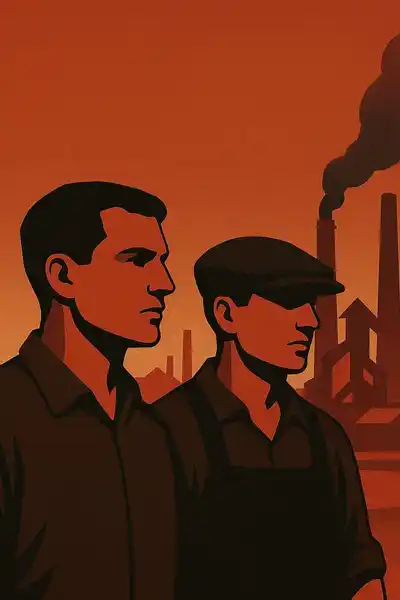
In the coal basins of the Nord, in the steelworks of Lorraine, in the salt marshes and the sugar refineries of the early twentieth century, a large share of the men doing the hardest, dirtiest, most dangerous jobs were not French. They were Belgian, Italian, Polish, later Spanish, Portuguese, Algerian. They arrived by the trainload, were housed in barracks near the pit, worked shifts that broke bodies, and then — in the standard telling of French history — vanished from the record. For a long time, the story of the French working class was written as if it had been made entirely of French people. Gérard Noiriel, a historian who came out of that industrial world himself, set out to correct the omission.
His book "Immigrants and Proletarians," first published in 1988 under the French title "Le creuset français," made an argument that sounds obvious once stated and was almost invisible before he stated it. France, he showed, has been a country of mass immigration since the nineteenth century — proportionally as much as the United States over the long run — and that immigration was not a side story to industrialization. It was industrialization. The proletariat that built modern France was, to a striking degree, an imported proletariat, replaced generation after generation as each wave assimilated and moved up.
What Noiriel does with that fact is where the book earns its place. He is not writing a sympathetic chronicle of newcomers, nor a celebration of the melting pot. He is asking how a country can experience continuous mass immigration for more than a century and yet keep telling itself that immigration is a recent problem, an anomaly, a threat from outside. The answer takes him into factories, but also into archives, census categories, and the machinery of the state.
The question we’re asking : How did foreign workers become both the engine of French industry and the people its national story chose to forget?What we’ll see : How labour history looks once we read it through the movement of people rather than the borders of a nation.
Table of contents
01 Chapter 1 — The workers France forgot to count
Start with the amnesia, because it is the thing Noiriel finds most revealing. France received millions of immigrants across the nineteenth and twentieth centuries. By the 1930s, foreigners made up a larger share of the population than in the United States at the same moment, and the flow had been steady for decades. Yet French national memory carried almost no trace of this. The country that imagined itself as a settled, rooted, essentially agrarian nation was in fact one of the great immigration societies of the modern era, and it had somehow managed not to notice.
The reason, Noiriel argues, is partly structural. Unlike the United States, France did not build a founding myth around immigration; it built one around the Republic, the Revolution, the soil. The immigrant did not fit that story, so the immigrant was absorbed into it and then erased. A Polish miner's grandson became simply French, his origins folded away within two or three generations. The melting worked so well that it dissolved its own history — the "creuset," the crucible, left no residue anyone cared to examine.

02 Chapter 2 — The factory door as a border
To understand why foreign labour mattered so much, Noiriel takes us onto the shop floor and into the economics of the industrial firm. Nineteenth-century French employers faced a peculiar problem: the country's demographic growth had stalled, its peasantry was reluctant to leave the land, and the mines and mills needed bodies. The rural French worker, still tied to a plot and a village, made a poor industrial proletarian — he came and went with the harvest, refused the worst shifts, drifted home. Foreign workers, uprooted and dependent, were more available and more disciplined precisely because they had less to fall back on.
So the factory became a kind of border in its own right, sorting labour before the state fully learned to. Employers actively recruited abroad, sending agents into Italian villages and Polish provinces, organizing transport, building the barracks that housed whole colonies of foreign miners near the pithead. These men could be paid less, moved around, and — crucially — dismissed and deported when they became troublesome. The precariousness that made them attractive to employers was manufactured, not natural.
03 Chapter 3 — Why the foreigner became a category
The most original move in the book is Noiriel's attention to something abstract: the very category of "the foreigner." We tend to assume the distinction between national and foreigner is timeless, a natural line between us and them. Noiriel shows it is a historical construction, built relatively recently, and built largely by the modern state as it learned to identify, register, and control the people on its territory.
Before the late nineteenth century, the paperwork barely existed. A worker crossed from Belgium into the Nord and there was no systematic apparatus to fix his status. That changed as the state developed the tools of identification — the identity card, the residence permit, the census category, the naturalization procedure. Each of these instruments drew a sharper line around who counted as French and who did not. The foreigner did not simply arrive; he was produced, administratively, by a state that needed to know whom it governed.
04 Chapter 4 — The nation, assembled on the shop floor
Step back from the mines and the identity cards and a larger claim comes into focus, which is really the point Noiriel has been building toward. National identity is usually imagined as the ground on which the drama of immigration plays out — a stable French nation that newcomers either join or threaten. His history inverts this. The nation was not the stable backdrop. It was itself being manufactured, at the very same moment and through the very same machinery that was sorting foreign labour.
Consider what was happening in parallel. The state was building the tools to say who was French — papers, census, naturalization, schooling, military service. Those tools did not merely detect a pre-existing Frenchness; they created it, by drawing the line that made the foreigner foreign and, by contrast, made the national national. You cannot have one category without the other. Every residence permit issued to a Pole was also, silently, a document defining what a French citizen was. Identity was produced at the border, and the factory door was one of those borders.
05 Conclusion
Noiriel began by noticing an absence — the missing immigrants in the history of the French working class — and ended by rewriting how that class, and the nation around it, came to exist. The Polish miner in his barracks near the pit was not a footnote to French industrialization. He was one of the people it was built on and out of, absorbed so completely that his grandchildren could believe France had always been theirs and always been closed. The crucible left no residue precisely because it worked.
Related books