I Think, Therefore I Laugh
Math's funny side explained
Description
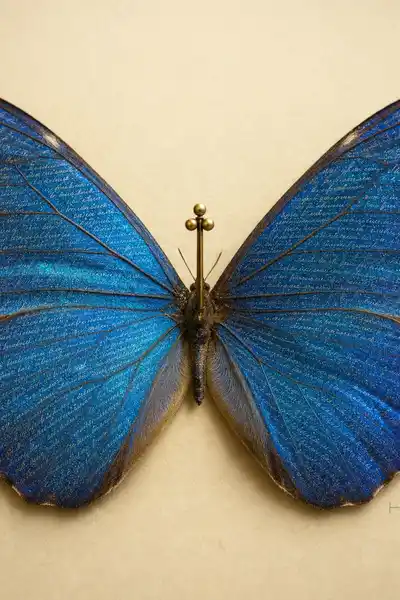
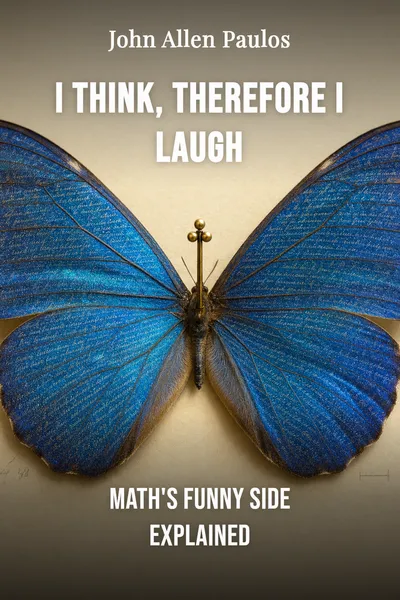
There is an old worry that explaining a joke kills it, the way pinning a butterfly to a board leaves you with a dead butterfly. John Allen Paulos, a mathematician who spent his career translating logic for people who fled the subject at the first sight of a proof, never accepted the premise. His slim 1985 book *I Think, Therefore I Laugh* sets out to show that taking a joke apart and taking an argument apart are, at bottom, the same operation — and that the operation is a pleasure, not an autopsy. The title alone tells you the game: Descartes's most famous line, bent just enough to make you smile before you have finished reading it.
Paulos was not a comedian moonlighting as a professor. He was the professor, best known for *Innumeracy*, his later broadside against a public that could not handle probabilities, and a familiar voice on radio and in print — *Newsweek*, the *New York Times Book Review*, later a run on television. But *I Think, Therefore I Laugh* came first, and it is the odder, more playful cousin. Its claim is that the great problems of analytic philosophy — meaning, reference, self-reference, the limits of what can be said — sit surprisingly close to the mechanics of a good gag.
The people he leans on are not the ones you would expect at a comedy night. Wittgenstein, Bertrand Russell, W. V. O. Quine, Lewis Carroll — logicians and philosophers who spent their lives worrying about how words hook onto the world. Paulos's wager is that their worries are funny, and that our laughter is a kind of thinking we do without noticing.
The question we’re asking : If explaining a joke supposedly ruins it, why does a mathematician insist that dissecting humor and dissecting logic are the same delight?What we’ll see : A book that treats the punchline and the proof as two settings on one machine, run by the minds who built modern logic.
Table of contents
01Chapter 1 — A comedian and a logician walk into a book
The structure of *I Think, Therefore I Laugh* is deliberately unruly. Rather than a linear argument, Paulos builds the book as a set of interlocking dialogues, aphorisms, jokes, logical puzzles, and short essays that talk to one another across the pages. A one-liner sits next to a discussion of formal logic; a riddle about a barber leads into Russell's paradox. The format is the argument: if humor and reasoning really do share a spine, then a book that keeps switching between them without warning should feel coherent rather than chaotic. And it mostly does.
Paulos's central intuition is that a joke works by setting up an expectation and then violating it in a way that turns out, on reflection, to make its own kind of sense. We are led down one interpretive path, and the punchline yanks us onto another that was available the whole time. That double structure — a frame, and a sudden reframe — is precisely what happens in a good logical puzzle or a well-turned paradox. The pleasure is the same click. You did not see it coming, and yet it was always there.

02Chapter 2 — The joke and the proof share a spine
To make the case concrete, Paulos keeps returning to self-reference — the trick of a statement talking about itself. It is the engine of the oldest paradox in the book: the Cretan who says all Cretans are liars. If he is telling the truth, he is lying; if he is lying, he may be telling the truth. Russell hit a grander version of the same wall with his paradox about the set of all sets that do not contain themselves, a discovery that shook the foundations of mathematics in the early twentieth century and forced logicians to rebuild their house from the basement up.
The joke version is friendlier but built identically. A sign reads "Ignore this sign." A note says "The sentence below is false," and the sentence below says "The sentence above is true." We laugh because the mind tries to obey and finds itself spinning in place. Paulos's point is that the vertigo of the paradox and the delight of the joke are the same sensation, felt at different intensities. Kurt Gödel turned that same loop into the most important logical result of the century, proving that any sufficiently rich formal system contains truths it cannot prove about itself.
03Chapter 3 — Wittgenstein, meaning, and the punchline
The philosopher who dominates the book is Ludwig Wittgenstein, and for Paulos he is the presiding spirit of the whole enterprise. Wittgenstein's later work, gathered in the *Philosophical Investigations*, abandoned the dream of a perfectly precise language mirroring the world and replaced it with the idea of language as a bundle of games, each with its own rules, learned by use rather than definition. Meaning, on this view, is not a fixed thing a word points at but a role a word plays in a form of life. And that, Paulos argues, is exactly the soil jokes grow in.
A great deal of humor lives in the seam between language games. A pun forces two of them into the same word at once. A literal answer to a figurative question — the classic "Do you know what time it is?" answered with a simple "Yes" — gets a laugh because it obeys one game's rules inside another game's context. Wittgenstein himself reportedly said a serious and good philosophical work could be written that consisted entirely of jokes, and Paulos treats the remark as a mission statement rather than a throwaway.
04Chapter 4 — Why the funniest minds are the most rigorous
Step back from the particular jokes and paradoxes, and Paulos's book makes a broader claim about the shape of the mind. Getting a joke and grasping an argument, he suggests, are not two separate faculties that happen to coexist in clever people. They are one faculty doing one thing: holding two frames at once and feeling the moment they collide. The setup and the punchline, the premise and the surprising conclusion, the rule and its literal-minded abuse — all of it is the mental act of running two interpretations in parallel until one of them buckles. That is why the driest logicians are so often the best company, and why the funniest people tend to be quietly precise.
This reframes the old anxiety that analysis murders delight. If the delight was always the analysis — the pleasure of seeing the hidden structure snap into place — then explaining it does not kill anything. It just does more slowly, and in the open, what the mind did in a flash. Paulos treats the dissection of a joke the way a musician treats hearing the chord change inside a song they love: knowing why it works does not dull the shiver, it deepens it. The killjoy premise assumes understanding and enjoyment are rivals. His whole book is a wager that they are the same event.
05Conclusion
The title turns out to be the argument in miniature. Descartes offered *I think, therefore I am* as bedrock, the one thing doubt could not dislodge. Paulos swaps the last word and lands somewhere just as serious: the same act of thinking that convinces us we exist is the act that makes us laugh. To get the pun on Descartes, you have to know Descartes — which is exactly the point about competence and the punchline, folded into four words.
Related books