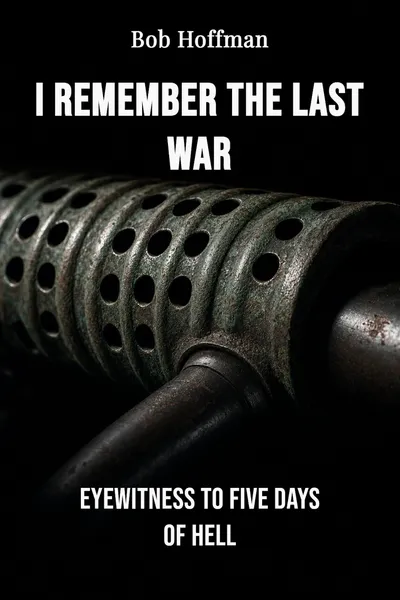
I Remember The Last War
Eyewitness to five days of hell
Description
Bob Hoffman was not a professional writer, and he never pretended to be one. Before the First World War he was an ordinary young man from Pennsylvania; after it he became famous for something else entirely — barbells, weightlifting, the York Barbell Company, decades of coaching American strongmen. But somewhere in between he wrote a war book, and he opened it with an unusual confession. Better writers than him had already told the story of America in France, he admitted. Men more fitted to put what they saw onto the page. He was not going to compete with them on style. He had only one thing they mostly lacked, and he knew it was the thing that counted: he had actually been there, at the front, in front of the front, for days and weeks and months of hard fighting.
What he wanted to describe, above all, were five days in the summer of 1918 at a small French village called Fismette. He called them the five worst days any unit of the American army experienced in France. There was nothing beautiful in the telling and nothing glorious, and he said so plainly. He was a machine-gunner. He watched friends die within arm's reach. He crossed a bridge into a town that the army would spend the following days being unable to hold, unable to reinforce, and unwilling to abandon. He came out alive by luck, and he knew that too.
So the book became a debt. He had survived when the men beside him had not, and the survivor's task, as he understood it, was to tell their story since they no longer could. Not to make it heroic. Not to make it readable in the way a novelist would. Just to get down, as honestly as one man's memory allowed, what it was actually like to be there.
The question we’re asking : What does an ordinary soldier remember about a battle that the official histories tend to leave out?What we’ll see : A machine-gunner's account of Fismette, and why he believed his plain memory told the war more truly than better prose could.
Table of contents
01 Chapter 1 — A machine-gunner going over
Hoffman served in a machine-gun outfit, and that fact shapes everything about how he remembers the war. A machine-gunner does not go over the top and disappear into the general chaos of an infantry charge. He hauls a heavy weapon and its ammunition, sets it up, and stays put — which means he watches. He sees the ground in front of him fill and empty. He sees who reaches cover and who does not. The memory of a man tied to one position for hours is a different kind of memory from the memory of a man running, and Hoffman's book keeps returning to what he could see from where he was pinned.
What he describes first is the ordinariness giving way. The training in the United States, the crossing, the slow approach toward the sound of the guns — all of it had the quality of something happening to other people, until suddenly it was not. He is careful, throughout, not to inflate himself. He does not present himself as fearless. He records being afraid, being exhausted, being hungry, being filthy, and he treats these as the normal condition of the men around him rather than as personal failings to be confessed.

02 Chapter 2 — The bridge into Fismette
Fismette sat on the far bank of the Vesle, across from the larger town of Fismes. Between them ran a river and a single crossing, and that crossing is the hinge of Hoffman's whole story. The American command wanted a foothold on the German side of the water. Getting men into Fismette meant sending them over an exposed bridge under fire, into a village the enemy overlooked from higher ground on three sides. Once across, a man was in a pocket that could be watched, shelled, and swept by machine guns almost at will.
Hoffman describes the crossing as the kind of thing that sounds simple on a map and is murderous in practice. The bridge was a known target. The Germans had it registered, meaning their artillery could drop shells on it without needing to aim afresh. To reinforce Fismette, to resupply it, to get the wounded out, everything had to pass over that one span. He watched men go over it. He went over it. The narrowness of the whole situation — one small town, one bridge, one river — becomes almost unbearable in his telling precisely because he refuses to widen the lens and make it sound like part of a grand design.
03 Chapter 3 — Five days no relief came
The heart of the book is the stretch Hoffman calls the five worst days any American unit went through in France. His unit was in Fismette, or fighting to hold the ground around it, while the German shelling and machine-gun fire never really let up. What he conveys is less a sequence of tidy engagements than a state of continuous pressure: attacks, counterattacks, snipers, artillery, and the grinding erosion of a group of men who were not being pulled out and rested the way they expected to be.
He is precise about the small mechanics of survival because that is what filled the hours. Where to put the gun. How to keep it firing. How to move without being seen. How to get water. How to deal with the wounded when there was nowhere to send them and no safe way to carry them back. These are not thrilling details, and Hoffman knows it, but they are the true texture of the days, and he insists on them over the cleaner storytelling a novelist might prefer.
04 Chapter 4 — What a private saw that the histories missed
Hoffman's opening claim was not modesty; it was an argument about whose memory gets to count. Better writers had told the story of America in France, he granted, but he did not believe any of them had spent the days, weeks and months at or in front of the front that he and his comrades had. That distinction is the whole wager of the book. He is saying that closeness to the thing — literal, physical closeness, being in the mud where the shells landed — produces a truth that fine prose written from a safer distance cannot reach.
There is something quietly radical in that. Official histories are written from headquarters, from maps, from after-action reports and the recollections of commanders. They tend to describe Fismette as a position, a decision, a line on the Vesle. Hoffman describes it as a bridge you might die crossing and a town you could not leave. Both are true, but they are not the same truth, and he is arguing that the soldier's version — smaller, dirtier, more frightened — is the one that tells you what the war actually was for the men who fought it.
05 Conclusion
Fismette ended for Hoffman the way it ended for the men who came out: with far fewer of them than had gone in, and no sense of victory to soften the count. He had crossed the bridge, held the gun, watched his friends die around him, and walked away by luck he never claimed to deserve. The book he later wrote was the debt he paid for that luck — a plain, unglamorous record set down by a man who knew he was not the finest writer, only one of the few who had truly been there.
Related books