
I Am That
The sage who transcended self
Description
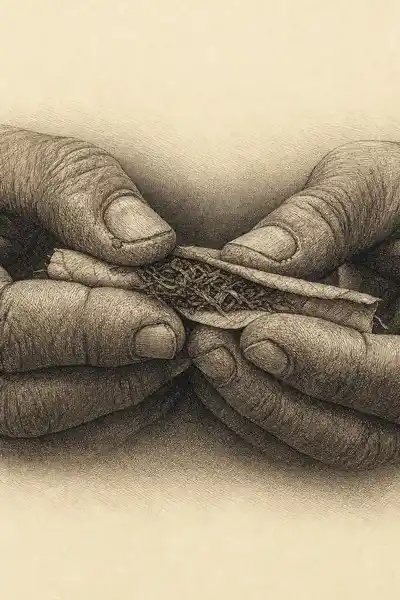
In a cramped upstairs room above a cigarette-and-bidi shop in a working-class district of Bombay, a man sat cross-legged and answered questions. He had no ashram, no organization, no polished English. He rolled and sold cheap tobacco to feed his family, and in his spare hours he received visitors — Indians, Europeans, Americans — who climbed the narrow stairs to ask him about death, God, suffering, the meaning of a life. His name was Sri Nisargadatta Maharaj, and the conversations recorded in that room between roughly 1970 and 1973 became a book called I Am That, published in 1973 in a translation by Maurice Frydman.
What makes the book strange is how little it offers. There is no program, no ladder of stages, no set of practices to master over years. Nisargadatta rarely lets a visitor settle into comfort. Someone asks how to become enlightened, and he refuses the premise of the question. Someone describes their spiritual progress, and he tells them progress is happening to a person who does not exist. The tone is patient and blunt at once — a shopkeeper who has stopped being impressed by the things everyone else spends their lives chasing, and who keeps pointing at something so close we walk past it a thousand times a day.
The teaching belongs to Advaita, the strand of Indian thought that denies any real separation between the self and the whole. But Nisargadatta does not argue it as philosophy. He treats it as something to be noticed, right now, in the room. The book has since traveled far beyond India, read by people who never set foot in an ashram, precisely because it keeps returning to one ordinary experience nobody escapes.
The question we’re asking : What was Nisargadatta pointing at when he told visitors that the person they took themselves to be was not real?What we’ll see : How a Bombay shopkeeper turned a single, undeniable sense of being into a lever that dismantles the whole idea of a separate self.
Table of contents
01Chapter 1 — A cigarette shop in Bombay
Nisargadatta Maharaj was born in 1897 in Bombay, into a poor family, and worked most of his life as a small trader. He was not a scholar and had no reputation to speak of when, in his mid-thirties, he met a teacher named Siddharameshwar Maharaj. The instruction he received was disarmingly simple. His teacher told him to hold on to the sense of being, the bare feeling "I am," and to trust nothing else. Nisargadatta did exactly that, with the stubbornness of a man who takes an instruction literally, and within a few years reported that the seeking had ended. His teacher died in 1936; Nisargadatta went on selling bidis and living an unremarkable domestic life.
What changed was that people began to find him. By the early 1970s the little room above the shop had become a destination for seekers, and a Polish-born engineer and former disciple named Maurice Frydman began recording and translating the dialogues. Those recordings, edited into I Am That, are the reason the world knows him at all. The setting matters. There is a smell of tobacco, the noise of the street, a fan turning. Nisargadatta is not performing sanctity. He coughs, he loses patience, he laughs.

02Chapter 2 — The one thing you already know
The whole book turns on a single certainty. We can doubt almost everything — our memories, our beliefs, the reliability of our senses, whether the world is as it seems. But there is one thing that cannot be doubted while there is anyone to do the doubting: the fact of being present, the sheer sense that "I am." Not "I am this" or "I am that," not the name, the body, the history, the role — just the bare, wordless knowledge of existing. Nisargadatta treats this as the one solid fact in a life otherwise built on assumptions, and he keeps directing every visitor back to it.
His instruction, repeated in a hundred forms across the dialogues, is to dwell on that sense of being and nothing else. Not to think about it, not to conceptualize it, but to stay with the raw feeling of presence the way one might stay with a warmth. Most of us, he points out, immediately dress the "I am" in attributes — I am tired, I am a father, I am afraid, I am fifty-two years old. Each of these fastens the pure sense of existing to a particular limited thing. Peel the attributes away, and what remains is not nothing. It is the ground on which every experience appears.
03Chapter 3 — Before the sense "I am"
This is where Nisargadatta parts company with almost every comforting spirituality. Having led the seeker to treasure the sense of being, he then asks them to look beyond it. The "I am," he explains, is not eternal. It appeared. There was a time — before birth, in deep dreamless sleep — when even that bare sense of presence was absent, and one did not suffer from its absence. If it comes and goes, it cannot be the deepest truth. Something must be prior to it: that which was there before the sense of being arose and remains when it dissolves.
He calls this the Absolute, or often simply refuses to name it at all, because any name turns it into an object, another thing the mind can grasp. It is not a bigger self. It is what is left when even the self drops away. The dialogues circle this with a kind of ruthless honesty. A visitor wants to be told they are a divine, immortal individual; Nisargadatta will not offer it. The individual, the person, even the witnessing awareness — all of it is content that appears and passes. What we are, at bottom, is not a thing that can be lost, because it was never something that was gained.
04Chapter 4 — What a self is worth
Step back from the method and the book makes a claim that reaches far past its incense-and-tobacco setting. We spend most of a life defending, improving, and worrying about a self — building its résumé, guarding its reputation, mourning its losses — and Nisargadatta's quiet provocation is that the one thing we never do is examine whether it is there at all. We take the self as the given, the fixed point around which everything else is arranged. He suggests it is instead the least examined assumption we carry, a bundle of memories and reactions we mistook for an owner.
What is bracing about I Am That is that it does not treat this as bad news. Nisargadatta is not a nihilist telling us we are nothing. He is pointing at the opposite: that the sense of being a small, threatened, separate person is a kind of contraction, and that loosening it does not leave a void but an openness that was there the whole time. The suffering we take as the human condition, he keeps implying, is largely the suffering of a self trying to hold together something that was never solid.
05Conclusion
The room above the shop is long gone; Nisargadatta died in 1981, still a trader, still without an institution to carry his name. What remains is a book of conversations that keep doing the same thing to whoever reads them — returning, patiently, to the bare fact of being present, and then asking who is present. The title says it plainly. Not I am this, not I am that, but I am That: the whole, not the fragment that spends its days believing itself separate.