How to Win Every Argument
A field guide to fallacies
Description
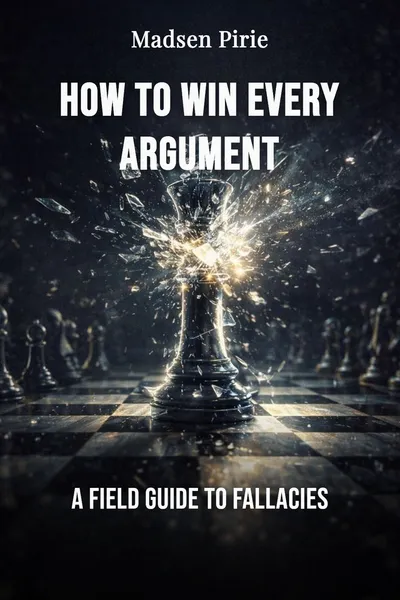
There is a small, slightly disreputable book by the Scottish philosopher Madsen Pirie that opens with a promise most philosophy books would never dare make. Its title is How to Win Every Argument, and its first move is to admit that the honest way to win an argument is to be right — and then to set that aside entirely. What follows is a catalogue of roughly eighty ways to be wrong while sounding convincing. Pirie arranges them alphabetically, from abusive analogy to the wrong number of questions, and treats each one with the deadpan care of a man handing you a loaded weapon and explaining, very precisely, where to point it.
Pirie was not writing a morality tale. He ran the Adam Smith Institute, spent years in public debate, and had clearly watched a great many clever people lose exchanges they should have won and win exchanges they should have lost. His book grew out of that: a taxonomy of the tricks, first published in the 1980s and expanded since, written for people who suspect that the person shouting them down is not actually reasoning at all. The device is that each fallacy comes with a worked example, and then — this is the part that stings — a short note on how to deploy it yourself.
So the book is two books at once. It is a defensive manual, teaching us to name the move being pulled on us, and it is an offensive one, teaching us to pull it first. Pirie is entirely open about the mischief. The interesting thing is what happens to a reader who takes both halves seriously — who learns the moves well enough to spot them, and then finds them turning up in the last place anyone looks.
The question we’re asking : What exactly is a fallacy, and does learning to name the tricks make us better arguers or just more dangerous ones?What we’ll see : A tour through Pirie's catalogue of bad reasoning, from the crude to the nearly invisible, and where the trail eventually leads.
Table of contents
01 Chapter 1 — The oldest tools in the box
Pirie starts where the ancient logicians started, because the crudest fallacies are also the sturdiest. Take the argumentum ad baculum — the appeal to force. Strictly, it is no argument at all: "agree with me or something bad happens to you" says nothing about whether the claim is true. Yet it wins constantly, because most disputes are settled not by logic but by consequence. Pirie's example is dry: a manager explaining to staff that those who question the new policy tend not to be promoted. Nobody has been refuted. Everybody has been persuaded.
Then there is the straw man, which Pirie treats as the workhorse of everyday quarrels. The trick is to replace your opponent's actual position with a weaker, cartoonish version, demolish that, and walk away looking victorious. Someone argues for reducing military spending; you reply as though they wanted the country left defenceless. The move works because refuting the caricature feels, in the moment, exactly like refuting the person. What Pirie notices is how rarely anyone in the audience checks whether the position knocked down was the one being defended.

02 Chapter 2 — When the words do the cheating
A whole family of Pirie's fallacies never touches the logic at all; they operate entirely in the vocabulary. The classic is equivocation — using a word in two different senses inside the same argument and letting the shift pass unnoticed. "The end of a thing is its perfection; death is the end of life; therefore death is the perfection of life." It sounds like a proof. It is a pun wearing a suit, resting on "end" meaning both purpose and termination. Pirie's point is that the machinery of logic runs perfectly well on words whose meanings quietly change underneath it.
Then comes the loaded question and its relatives, where the deception is smuggled into a premise nobody agreed to. "Have you stopped mistreating your staff?" cannot be answered yes or no without conceding the mistreatment. The claim is never argued — it is presupposed, tucked into the grammar so that the listener grants it just by responding. Pirie ranks this among the most quietly effective moves available, because attacking the smuggled assumption makes the questioner look like the reasonable one and you the evasive.
03 Chapter 3 — The crowd, the expert, and the man
The largest group in Pirie's catalogue diverts attention from the claim onto its source, its popularity, or its backers. The best known is the ad hominem — attacking the person instead of the position. Their argument about tax is answered by noting they are wealthy, or hypocritical, or unpleasant. None of which bears on whether the argument holds. Pirie observes that it feels like a rebuttal because we instinctively read a bad messenger as a sign of a bad message, and the two have nothing necessarily to do with each other.
Next to it sits the appeal to authority, which Pirie handles with care because authority is not always a fallacy. A doctor's view on a symptom carries weight; the trouble begins when the authority is borrowed from the wrong field, or invented, or the mere fact of eminence is treated as proof. A famous physicist's opinion on economics is worth what any layman's is. The fallacy is not respecting expertise — it is mistaking reputation for evidence, and letting a name close a question that only argument can close.
04 Chapter 4 — Fallacies that hide inside the logic itself
The subtlest entries in Pirie's book are the ones where the argument looks airtight and the flaw is structural. Begging the question is the purest: assuming, in your premises, the very thing you set out to prove. "We know the text is reliable because it says so, and what it says is reliable." The conclusion was already sitting inside the starting point; the argument merely walked in a circle and arrived where it began. Pirie's warning is that a tight circle is hard to see from inside, because every step genuinely follows from the last.
Then the slippery slope — the claim that one small step must lead, inevitably, to some distant catastrophe, with each link assumed rather than shown. And the false dilemma, which offers two options as though they exhausted the field: either we do this, or disaster follows. Pirie's repeated move is to ask where the missing possibilities went. Most real choices have more than two doors, and most chains of consequence have joints that can be broken. The fallacy works by hiding the alternatives.
05 Conclusion
Pirie's book keeps its promise in a lawyer's way. It really does teach us to win every argument, because there is always a trick available, and a listener who cannot name the trick cannot answer it. Eighty-odd fallacies, each with its worked example and its quiet note on how to deploy it, add up to a genuinely effective manual for prevailing over people who are unarmed. That is the joke, and Pirie never pretends otherwise.
Related books