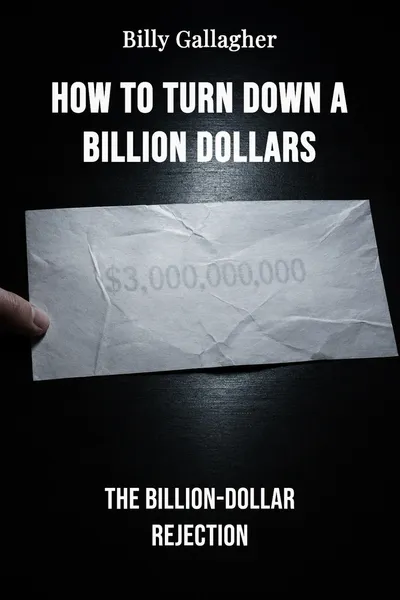
How to Turn Down a Billion Dollars
The billion-dollar rejection
Description
In the fall of 2013, Facebook offered to buy a two-year-old company for $3 billion in cash. The company had almost no revenue. Its product let people send photos that erased themselves after a few seconds, which most adults over thirty found either pointless or vaguely alarming. Its chief executive, Evan Spiegel, was twenty-three years old and had dropped out of Stanford before finishing his degree. He said no. Not counter-offered, not negotiated a higher price — just no, without much visible agonizing, to more money than most people can conceive of.
Billy Gallagher, who covered the company as a student journalist at Stanford and later for TechCrunch, spent years reconstructing how a fraternity project called Picaboo became Snapchat, and how two young co-founders ended up in a position to turn down a fortune. His book, How to Turn Down a Billion Dollars, is less a business manual than a close reading of a specific gamble: the belief that the thing you built is worth more than anyone is currently willing to pay for it.
The refusal became legend, then punchline, then case study. What it rarely became was understood. Behind the headline number sat a founder who had watched Instagram sell to Facebook for $1 billion and concluded the sellers had left something enormous on the table — and a product whose whole premise cut against how social media was supposed to work.
The question we’re asking : Why would two founders in their early twenties walk away from a life-changing amount of money for a company that barely made any?What we’ll see : How a disappearing-photo app grew out of a Stanford dorm, why its founders bet against the industry's instinct to sell, and what that bet says about who really controls a company.
Table of contents
01 Chapter 1 — A dorm room, a disappearing photo
The origin story Gallagher tells is unglamorous in the way most real ones are. In early 2011, Evan Spiegel and Reggie Brown were Stanford students, members of the Kappa Sigma fraternity, batting around an idea Brown had voiced almost as a joke: what if photos you sent could disappear? The pitch landed because it named something everyone already felt. Every picture posted online was permanent, searchable, and potentially embarrassing forever. A photo that vanished was a different kind of message — closer to talking than to publishing.
Spiegel brought in Bobby Murphy, a friend with the engineering skills to actually build it, and the three shipped an app called Picaboo in July 2011. It went nowhere at first. A few hundred users, mostly friends. Then something odd happened: usage spiked at a high school in Southern California, where Spiegel's mother had mentioned the app to a nephew. Teenagers got it instantly. They were not trying to curate a permanent identity; they wanted to goof off without a record. The disappearing photo was not a gimmick to them. It was the point.

02 Chapter 2 — The offer nobody expected them to refuse
What made Snapchat threatening to Facebook was not its revenue, which was essentially zero, but its growth curve and its demographic. Teenagers were spending real time inside it, sending hundreds of millions of photos a day by 2013, and they were doing it somewhere Facebook could not see or copy easily. Facebook had already tried to compete directly with a clone called Poke, launched at the end of 2012, which Mark Zuckerberg reportedly built quickly and which flopped just as quickly. When you cannot copy something, the next move is to buy it.
So Zuckerberg approached Spiegel. Gallagher reconstructs the courtship in detail — the meetings, the flattery, the eventual offer of roughly $3 billion, in cash, in late 2013. For a company with no meaningful earnings, run by founders barely out of college, this was an almost absurd sum. Most advisers, most reasonable observers, most people who had ever wanted for money would have taken it and never worked again.
03 Chapter 3 — Building a company on things that vanish
Turning down $3 billion only makes sense if you can build something worth more, and the years after the refusal were Snapchat trying to prove the wager was not vanity. The company kept adding features that pushed against the disappearing core without abandoning it. Stories, launched in 2013, let users string moments into a feed that lasted twenty-four hours — ephemeral, but shareable and lingering long enough to build an audience. It became the most consequential product decision the company made, and, tellingly, the one Facebook would later copy most shamelessly.
Gallagher tracks how Snapchat tried to become a business rather than just a phenomenon. It built Discover for publishers, experimented with advertising that many users found intrusive, and pushed into hardware with Spectacles, camera-equipped sunglasses that launched with hype in 2016 and quietly turned into a costly misfire, with unsold inventory reportedly written down by tens of millions of dollars. The pattern was consistent: bold bets, uneven execution, a founder who trusted his own instincts over data and was sometimes brilliantly right and sometimes expensively wrong.
04 Chapter 4 — What a rejection reveals about who owns the future
Step back from the number and the Snapchat story becomes a story about control. When Spiegel and Murphy took the company public, they did something unusual even by the loose standards of tech founders: they issued shares to the public that carried no voting rights at all. The founders kept command of the company regardless of what outside shareholders thought. The refusal of Facebook's billions and the structure of the IPO were the same instinct expressed twice — a refusal to let anyone else decide what the company was for.
Gallagher's book, read this way, is less about a specific app than about a recurring choice in Silicon Valley: sell and become rich and safe, or hold and stay in command of an unfinished bet. Selling is almost always the rational move. The founder who sells locks in a fortune; the founder who holds risks watching a larger rival copy the product and erode the lead, which is roughly what happened to Snapchat. Spiegel chose command over safety, and the choice looked visionary and reckless in turns, sometimes within the same quarter.
05 Conclusion
The scene that opens Gallagher's book — a twenty-three-year-old saying no to $3 billion — never resolves into a clean verdict, and that is the point. Snapchat did not collapse, did not conquer, did not become the next Facebook or the next Friendster. It became a mid-sized company that changed how a generation communicates and then spent years fighting to hold ground its ideas had opened up. The founders who declared themselves worth more than the offer were, in the messiest possible way, both vindicated and undercut.
Related books