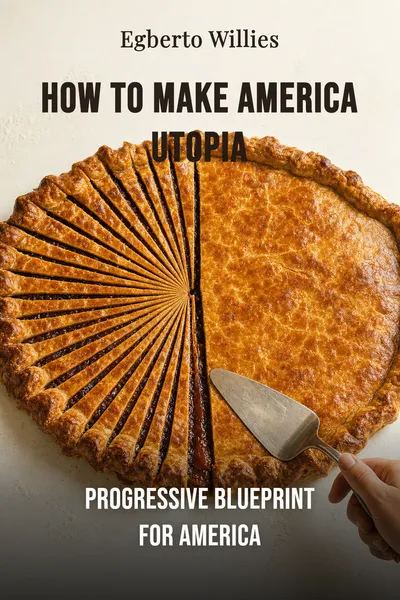
How to Make America Utopia
Progressive blueprint for America
Description
There is a particular kind of American political book that arrives every few years promising to fix everything, and most of them hedge. They talk about incremental reform, bipartisan windows, the art of the possible. Egberto Willies, a Houston-based writer, activist and longtime progressive commentator, does something different in How to Make America Utopia. He puts the biggest word he can find right there in the title. Not a better America, not a fairer one — a utopia. It is a deliberate provocation, and the book knows it. Willies is betting that the problem with progressive politics is not that it asks for too much, but that it has learned to ask for too little.
The bet is unusual because "utopia" is normally a word the left avoids. It carries the smell of failed experiments, of central planning, of promises that curdled. Conservatives have spent decades weaponizing it — utopia is what you accuse the other side of chasing right before it all goes wrong. Willies reclaims it on purpose, arguing that the United States already produces more than enough wealth for everyone to live well, and that the only thing standing between the country and that abundance is a set of political choices dressed up as natural laws. The book is part argument, part diagnosis, part call to get off the couch.
What makes it more than a wish list is the second half of its title's implicit promise: not just what a fairer country would look like, but how ordinary people might actually build it. Willies has spent years as an organizer and podcaster, and it shows. The manifesto keeps circling back from policy to the person reading it, insisting that the blueprint is worthless without the hands to raise it.
The question we’re asking : Can a country as divided and as wealthy as the United States be argued toward a genuinely fairer arrangement — and who does the arguing?What we’ll see : A progressive writer stakes everything on a word most of his allies avoid, and tries to turn a vision into a set of instructions.
Table of contents
01Chapter 1 — The word that scares people off
Willies opens by confronting the obvious objection head-on. Utopia is a loaded word, and he knows readers will flinch. The Greek root means "no place" — Thomas More coined it in 1516 for an island that did not exist — and ever since, it has doubled as an insult. To call a plan utopian is to call it naive. Willies argues that this reflex is itself a political achievement, one manufactured over decades to make Americans stop imagining that things could be dramatically better rather than marginally less bad.
His move is to redefine the term. He is not describing a perfect society with no conflict and no scarcity. He is describing a country that uses the resources it already has to guarantee its people a decent floor: healthcare, education, housing, a living wage, dignity in old age. Framed that way, the word stops sounding like fantasy and starts sounding like arithmetic. The United States is the richest nation in human history. The question Willies keeps returning to is not whether abundance exists, but who has been allowed to capture it.

02Chapter 2 — Abundance is a choice, not a law of nature
Once the word is defended, Willies gets to the substance, and the substance is a fairly familiar progressive program stated without apology. Universal healthcare. Tuition-free public college. A federal jobs guarantee. A serious minimum wage. Robust public investment in infrastructure and housing. Higher taxes on wealth and corporations to pay for it. None of these ideas are new, and Willies does not pretend they are. What he offers is a way of holding them together as a single moral proposition rather than a menu of disconnected demands.
The connective tissue is his insistence that scarcity is largely engineered. When people say the country cannot afford to house everyone or treat everyone, Willies reads that not as an economic fact but as a decision about priorities — a decision that has consistently found money for tax cuts, bailouts and military budgets while pleading poverty on human needs. He points to the sheer scale of American output and asks why a nation this productive tolerates hunger and medical bankruptcy at all. The framing turns questions of cost into questions of will.
03Chapter 3 — The citizen is the missing machinery
If the book stopped at policy, it would be one more progressive wish list. What distinguishes it is that Willies spends real energy on the part most manifestos skip: how any of this actually happens. His answer is unglamorous and insistent. Nobody hands you a fairer country. You organize for it, precinct by precinct, election by election, conversation by conversation, and you do it whether or not you feel like it on a given Tuesday.
This is where his decades as an activist show through. Willies is skeptical of the notion that a single charismatic figure or a single landmark election will deliver the transformation. Power, in his telling, responds to sustained pressure, not to eloquence or to hope. He pushes readers toward the tedious infrastructure of democracy — local elections, school boards, primaries, town halls, the county party meeting nobody attends — precisely because those are the venues where organized minorities routinely beat disorganized majorities. The utopia is built at the level most people ignore.
04Chapter 4 — When a manifesto meets the country it describes
Step back from the specific proposals and the book becomes a case study in something larger: the state of progressive imagination in America, and what it has cost the left to lose the language of aspiration. For most of the twentieth century, the American right did not have a monopoly on big dreams. The New Deal was audacious. The Great Society was audacious. Somewhere along the way, the party of ambition became the party of caution, forever explaining why the good thing is not quite feasible this cycle. Willies's title is a protest against that shrinking, and reading it that way explains why he reached for such an outsized word.
The wager he is making is essentially about morale. He believes that movements do not mobilize around incrementalism, because incrementalism does not inspire anyone to knock on a stranger's door in the rain. People sacrifice for visions, not for adjustments at the margin. By putting utopia on the cover, Willies is trying to hand the progressive movement back a horizon large enough to organize around. Whether that works or backfires — whether the word inspires or simply confirms the caricature opponents have drawn — is the open question the book cannot answer for itself.
05Conclusion
How to Make America Utopia ends more or less where it began: with a word and a dare. Willies has spent the book insisting that the country's problem is not a shortage of resources but a shortage of nerve, and that the fix is neither mysterious nor primarily technical. It is a matter of deciding that a nation this rich should stop tolerating the suffering it can afford to end, and then doing the unglamorous work of forcing that decision through the machinery of elections and organizing. The vision is unapologetically partisan, and the book never pretends otherwise.
Related books