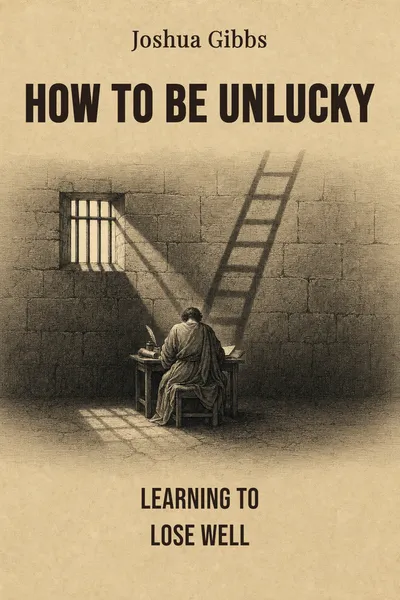
How to Be Unlucky
Learning to lose well
Description
Joshua Gibbs teaches humanities to teenagers at a small classical Christian school in Virginia, and one year he noticed something odd about the way his students talked about their lives. When good things happened, they said they were lucky. When bad things happened, they said they were unlucky. The vocabulary was cheerful and it was also, Gibbs came to think, a quiet disaster. It handed every important thing about a life over to chance, and left the person inside that life with nothing to do but wait and hope the dice came up right. Out of that observation grew a slim, strange book with a title that reads like a dare.
How to Be Unlucky is not a self-help manual, though its title borrows the shape of one. It is a set of reflections built around a single classical text — the sixth-century Consolation of Philosophy, written by Boethius while he awaited execution — and around the question of what that text might do to a room full of adolescents who assume comfort is the point of being alive. Gibbs is not trying to make his students successful. He is trying, by his own account, to make them the kind of people who can lose things well: money, health, reputation, the people they love, and eventually life itself.
The premise sounds bleak stated flatly, and Gibbs knows it. But the book is warm, often funny, and stubbornly practical about a subject most contemporary writing avoids. It treats misfortune not as a problem to be solved but as material — the raw stuff character is actually made from. That is a deeply old idea wearing modern clothes, and Gibbs spends the book earning it back.
The question we’re asking : What does a teacher mean when he says he wants his students to be unlucky, and why would anyone want to learn it?What we’ll see : How a classroom, a condemned Roman philosopher, and a quarrel with the modern good life converge on a single unfashionable claim.
Table of contents
01Chapter 1 — A book against the goddess
The old world had a name for the thing Gibbs's students called luck. She was Fortune, and she was often drawn as a woman turning a wheel — lifting some people up as she brought others down, indifferent to who deserved what. To be at the top of the wheel felt like proof of worth; to be at the bottom felt like injustice. Boethius, writing from prison, imagines her speaking in her own defense: everything she gave you was hers, a loan, never yours to keep, and the turning of the wheel is simply what she is. To be angry at Fortune is to be angry at the sea for being wet.
Gibbs takes this figure seriously because he thinks we still worship her, only without admitting it. The modern person does not build shrines to Fortune, but they organize their emotional life around her — elated when things break their way, wronged when they don't, forever negotiating with a force they cannot see and cannot control. The problem, as Gibbs frames it, is not that this makes people unhappy. It is that it makes them passive. If a good life is something that happens to you, there is nothing to practice, nothing to become. You just get lucky, or you don't.

02Chapter 2 — The classroom as a workshop for the soul
Much of the book takes place at eye level with actual teaching, and this is where Gibbs is most original. He does not treat education as the transfer of information. He treats it as the slow formation of taste — of what a person is capable of loving. A student who has only ever been fed easy pleasures, he argues, will find hard and good things boring, not because those things are boring but because the student has never been trained to want them. Virtue, in this telling, is largely a matter of acquired appetite.
The mechanism he trusts is repetition, and he is unfashionably comfortable with it. Reading the same great text many times, memorizing passages, returning to the same questions year after year — practices that a lot of modern pedagogy finds tedious — are for Gibbs the whole point. You do not become patient by hearing a lecture on patience. You become patient by doing patient things until they stop feeling like an imposition. The classroom is less a place of discovery than a gym, and the reps are the curriculum.
03Chapter 3 — Boethius in the waiting room
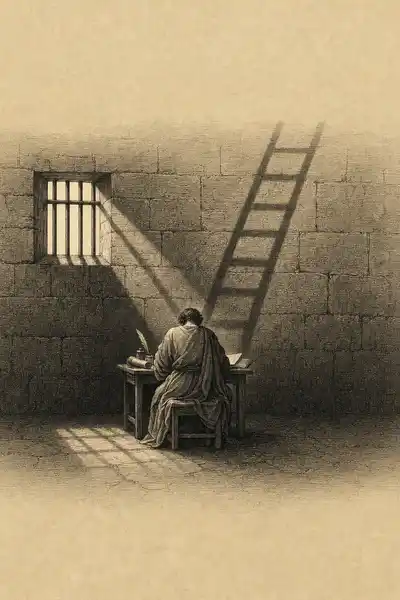
The Consolation of Philosophy is the book's spine, and it helps to know the situation that produced it. Boethius was a Roman statesman and scholar, wealthy and accomplished, who fell suddenly out of favor and was imprisoned on charges he denied. Awaiting death around the year 524, he wrote a dialogue in which Lady Philosophy visits him in his cell and, rather than comforting him with hope of release, argues him out of the belief that his life had been ruined. Everything Fortune took, she reminds him, had never truly been his. What she could not touch — his mind, his capacity for reason and love of the good — remained intact.
Gibbs is honest that this is a hard sell to a teenager, or to anyone whose losses are still fresh. The argument can sound cold on the page. What redeems it, in his reading, is the setting. This is not a comfortable man theorizing about hardship from a distance; it is a condemned man reasoning his way toward peace with hours left to live. The consolation is being tested in real time by the worst that Fortune can do. That gives the words a weight that no seminar-room version of the same ideas could carry.
04Chapter 4 — The long argument against the modern good life
Stepping back, what Gibbs has really written is a small dissent from an assumption so widespread we rarely notice holding it: that a good life and a comfortable life are the same thing. Nearly every message the culture sends — through advertising, through the shape of ambition, through the way we describe success — assumes that the aim of living is to arrange circumstances so that misfortune stays away. Health, wealth, safety, ease. Learn the right skills, make the right choices, and you can wall the wheel out. Gibbs thinks this is both false and quietly corrosive.
It is false because the wall never holds; Fortune reaches everyone eventually, and a life organized entirely around keeping her out is a life spent in a losing defensive crouch. It is corrosive because the effort to avoid all hardship also forecloses the very experiences that make people deep. The tradition Gibbs draws on insists that courage, patience, generosity, and gratitude cannot be learned in comfort. They are muscles that only grow under load. A life engineered to remove all load produces a person with no strength, pleasant and brittle.
05Conclusion
The teenagers who first prompted the book will graduate and scatter, and Gibbs will not know for decades, if ever, which of them absorbed anything. That uncertainty is written into the whole enterprise. He is teaching for a future he won't witness, planting habits whose test will come long after the class photograph fades. What he offers them is not a plan for winning at Fortune's game but a way of stepping off her wheel — the same offer Lady Philosophy carried into a Roman prison cell fifteen centuries ago, and the same one that has quietly survived every century since.
Related books