How Proust Can Change Your Life
Literature as practical wisdom
Description
In 1922, a French novelist who had spent the last years of his life in a cork-lined bedroom, writing at night and sleeping through the day, died at fifty-one, leaving behind a novel of roughly 1.25 million words that most people have never finished. Marcel Proust's In Search of Lost Time is the book people mean when they want to signal the very idea of a difficult book—long, slow, the punchline of jokes about reading nothing all summer. Seven decades later, a young writer named Alain de Botton looked at this monument and asked a question nobody was supposed to ask about it: could it be useful?
The result, published in 1997, was How Proust Can Change Your Life. The title sounds like a joke, and de Botton knows it. He takes the two least compatible genres on the shelf—the reverent literary biography and the breezy self-help manual, the kind with chapter headings like "How to Be Happy in Love"—and welds them together. The book is organized as a set of lessons: how to suffer successfully, how to take your time, how to be a good friend, how to open your eyes. Each lesson is drawn from Proust's life and sentences, treated not as sacred text but as advice from someone who thought unusually hard about how to live.
What saves it from gimmick is that de Botton is serious underneath the wit. Proust genuinely believed a novel could teach us to see, and de Botton takes him at his word, testing whether the slowest writer in the canon can actually help us move through an ordinary day differently. The tone stays light; the intent does not.
The question we’re asking : Can a 1.25-million-word novel nobody finishes actually function as a practical guide to living?What we’ll see : How de Botton turns Proust's life and sentences into working advice—and what that does to our idea of what reading is for.
Table of contents
01 Chapter 1 — A self-help manual disguised as a biography
The premise is a provocation, and de Botton leans into it. Self-help is the genre serious readers are trained to sneer at—the airport shelf, the promises, the exclamation marks. Literary biography is the opposite: careful, footnoted, allergic to the word "you." De Botton's move is to smuggle the second into the first. He keeps the self-help scaffolding, the chapters that promise to fix something in your life, but he fills them with Proust's actual sentences and the small, strange facts of his existence. The joke and the argument are the same joke.
And the joke has a target. De Botton is quietly needling the way we read the classics—with a kind of dutiful reverence that keeps them at arm's length, admired and unopened. Proust, of all writers, gets the worst of this treatment, filed under "long books I should read someday" and left there. By dragging him onto the self-help shelf, de Botton insists that the point of the novel was never to be admired from a distance. Proust wrote, in de Botton's reading, to change how his readers lived, and treating the book as untouchable art betrays that ambition more than any airport paperback would.

02 Chapter 2 — The man who took his time
The first lesson de Botton draws is the one Proust's reputation makes obvious and everyone still ignores: slow down. Proust wrote a novel about the recovery of time, in sentences so long that a single one can run past a page, and he did it because he believed that most of what matters in life goes unnoticed at ordinary speed. We rush past the taste of a meal, the shape of a face, the actual texture of an afternoon, and then wonder why our days feel empty. His prose is slow on purpose. It is trying to make us look at what we habitually skip.
De Botton's favorite illustration is the newspaper. Proust wanted us to read the daily paper the way we might read a great tragedy—with astonishment that any of it is happening at all. A short notice about a fire, a death, a scandal contains events that, seen properly, are as full of feeling as anything in Sophocles; we skim them because we have decided in advance that nothing in our own moment is important. The trick Proust offers is not to seek out extraordinary experiences but to grant ordinary ones the attention we reserve for art.
03 Chapter 3 — Suffering, put to work
The strangest lesson, and the one de Botton develops most, concerns suffering. Proust's life was a catalogue of it: chronic asthma from the age of nine, a body that failed him constantly, a mother whose love was so intense it became its own affliction, unrequited attachments, jealousy so corrosive it drove whole sections of the novel. By any self-help logic he should have been a cautionary tale. Instead de Botton argues that Proust turned suffering into the central instrument of his intelligence.
The claim rests on something Proust believed about pain: that it is the only reliable teacher. Happiness, in his view, leaves us stupid and complacent—content people have no reason to examine anything. It is when we are miserable, jilted, jealous, ill, that we are finally forced to think, to notice, to ask why. The lover who has been left learns more about love in a week than the contented partner learns in years. Grief and disappointment, far from being obstacles to a good life, are the raw material of understanding, provided we are willing to convert them rather than merely endure them.
04 Chapter 4 — How to read without becoming Proust
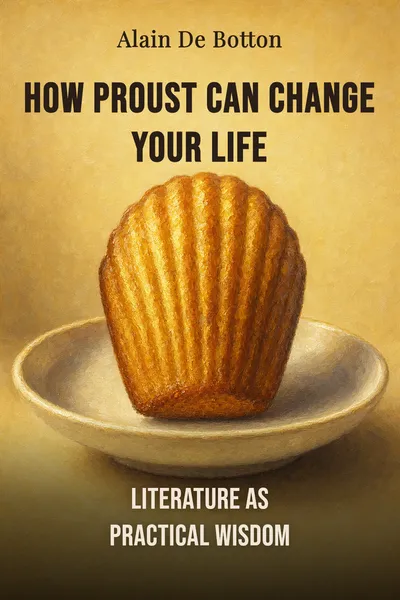
Having spent the book urging us to read Proust, de Botton ends by warning against reading him too well. There is a danger in the whole enterprise—the danger of turning a writer into an idol, of substituting his sentences for our own perception, of walking through life quoting the master instead of seeing what he taught us to see. Proust himself dreaded producing that kind of reader. The last thing he wanted was disciples who could recite the madeleine passage and had stopped tasting their own tea.
This is de Botton's sharpest point, and it turns the self-help premise inside out. A book cannot change your life if you treat it as a destination. Proust's value lies not in his conclusions, which are his, but in his method, which can be ours: the habit of attention, the willingness to sit with feeling, the refusal to skim. Read correctly, the novel makes itself unnecessary. It hands us a way of looking and then wants us to put it down and look. The worshipful reader who never leaves the book has missed the entire point of it.
05 Conclusion
The man in the cork-lined room, writing through the night about time he was afraid of losing, turns out to be an odd sort of life coach—one whose advice is to slow down, to stay inside your pain, and to eventually stop reading him. De Botton's trick was never really to make Proust easy. It was to make him useful, to prove that the gap we imagine between serious literature and practical living is largely a snobbery we could put down. The novel nobody finishes is, in this reading, a manual for the one thing everybody is trying to do: get through a day without missing it.
Related books