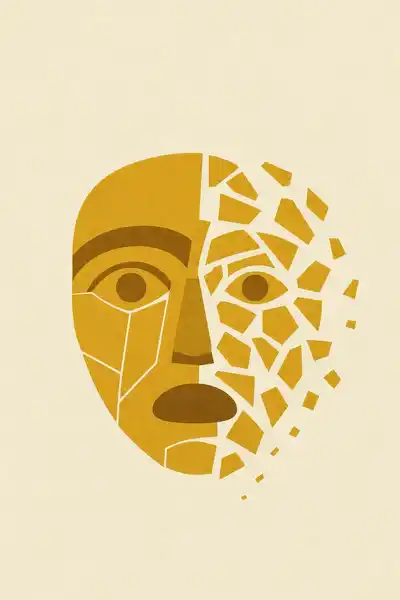
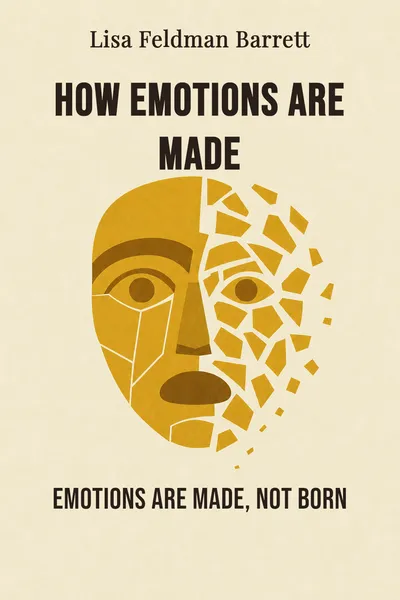
How Emotions Are Made
Emotions are made, not born
Description
For most of the twentieth century, the story of emotion was tidy. Somewhere inside us sat a set of built-in reactions — fear, anger, sadness, disgust, surprise, joy — waiting to be tripped. A threat appeared, a circuit fired, a face contorted in a way any human anywhere would recognize. Emotions were things that happened to us, ancient and involuntary, the same in a Tokyo boardroom and a Papua New Guinea highland village. This idea, often called the classical view, felt obvious because it matched how emotion feels from the inside: it arrives, it grips us, we react. Charles Darwin lent it authority; decades of research seemed to confirm it; Pixar built a whole film on it.
Then the evidence started to wobble. Lisa Feldman Barrett, a psychologist and neuroscientist, spent years running the experiments meant to nail down where fear lives in the brain, or whether a scowl reliably means anger. The results kept refusing to cooperate. No single brain region turned out to own a single emotion. Faces did not match feelings as cleanly as the textbooks promised. Two people could sit in the same racing-heart, sweating-palm state and call it two completely different things. The neat machinery began to look less like a discovery and more like an assumption nobody had properly checked.
In How Emotions Are Made, Barrett gathers this into a claim that sounds almost like a provocation: emotions are not triggered, they are constructed. Not born in us, but built by us — assembled in the moment from bodily signals, past experience, and the concepts a culture hands down. It is a quiet sentence with loud consequences, because so much of how we judge, treat, punish, and raise each other rests on the older story being true.
The question we’re asking : If emotions aren't hardwired reactions waiting to fire, where do they actually come from — and who does the making?What we’ll see : How a stubborn body of evidence toppled the classical view, and what a brain that predicts rather than reacts means once it leaves the lab.
Table of contents
01Chapter 1 — The face that wouldn't confess its feelings
The classical view had a poster child: the human face. If emotions were universal biological events, then a frightened person should make a recognizable fear face, and anyone, anywhere, should read it correctly. In the 1960s and 70s, the psychologist Paul Ekman ran experiments that seemed to prove exactly this. He showed posed photographs of wide-eyed fear, wrinkled-nose disgust, and toothy joy to people around the world, including remote communities with little Western contact, and reported high agreement. The finding hardened into common knowledge. Emotions, it was said, have fingerprints — fixed facial signatures shared by all of humanity.
Barrett's problem was that the fingerprints kept smudging. When researchers stopped handing people a short list of emotion words to pick from and instead let them describe faces freely, the tidy matches collapsed. A scowl, supposedly the face of anger, turned up when people concentrated, when they were confused, even when they were amused. People in cultures studied without pre-supplied labels did not sort the photos the way the theory required. The famous agreement, it seemed, had been partly manufactured by the format of the questions.

02Chapter 2 — Your brain is a prediction machine, not a reactor
If emotions are not stored reactions, something has to explain how they arrive so fast and feel so real. Barrett's answer draws on a broader shift in neuroscience: the brain is not mainly a reaction machine that waits for the world to poke it. It is a prediction machine. Locked inside a dark, silent skull, it never encounters the world directly — it gets a stream of ambiguous signals from the eyes, ears, and, crucially, the organs inside the body. To act in time, it cannot afford to wait and interpret. It guesses, constantly, running a model of what is about to happen and correcting only when reality pushes back.
The raw material of these guesses, when it comes to emotion, is something Barrett calls affect: the simple, ever-present sense of feeling pleasant or unpleasant, worked up or calm. Affect is not emotion. It is the background hum produced by the brain managing the body's budget — its energy, its heart rate, its glucose, its stress load, a process she names interoception. We are always feeling something along these lines, even when nothing in particular is happening. The heart pounds, the stomach tightens, the mood dips, and the brain, ever the predictor, must make sense of it.
03Chapter 3 — Concepts, words, and the emotions we build with them
A prediction needs a vocabulary. To turn a jolt of unpleasant arousal into fear rather than anger, the brain needs the concept of fear — a category built from countless past instances, tying together situations, sensations, and actions that a culture treats as belonging together. Barrett argues that emotions are, at bottom, concepts. We are not born knowing them; we learn them, the way we learn what counts as money or as a weed. And the concepts vary from place to place, which is why the emotional world is not as universal as the classical view insisted.
Language does a lot of the assembling. Other cultures name emotional states English has no single word for. There is a Dutch word for the specific coziness of being warm and safe indoors with loved ones, a German word for pleasure taken in another's misfortune, and words in various languages for feelings of shame, longing, or dread that carve up experience along different lines than English does. These are not just labels stuck onto pre-existing feelings. Learning the word helps build the concept, and the concept helps the brain construct the experience in the first place.
04Chapter 4 — When a construction gets treated as a fact
Barrett does not leave the argument in the lab, because the classical view is quietly wired into institutions that make decisions about people's lives. Consider the courtroom. Juries and judges are routinely asked to read a defendant's face and infer remorse, or its absence. A man who looks unmoved is assumed to feel nothing, and sentences have turned on that assumption. But if scowls and blank stares carry no fixed emotional meaning — if a face is read through the observer's own concepts and biases — then a criminal justice system that treats faces as windows into guilt is grounding life-and-death judgments in folklore. The stakes rise further given how differently faces are read across race.
The same premise underwrites the airport security programs that trained officers to spot 'micro-expressions' of hidden intent, and the lie-detection industry more broadly. Barrett is blunt that the science does not support reliably reading concealed emotion from the outside; the body has no leak that betrays a specific inner state. Where security theater assumes a universal emotional grammar, it is scanning for signals that were never there in the first place.
05Conclusion
The experiments that were supposed to locate fear in the brain, or catch anger on the face, kept coming back empty — not because the researchers were careless, but because they were looking for fingerprints that emotions do not leave. What Barrett assembled from those dead ends is a different account entirely: a predicting brain, a body sending up its ceaseless signals of pleasant and unpleasant, and a set of learned concepts that fuse the two into the feelings we take to be timeless and involuntary. Emotions turn out to be less like sneezes and more like colors we have learned to name.
Related books