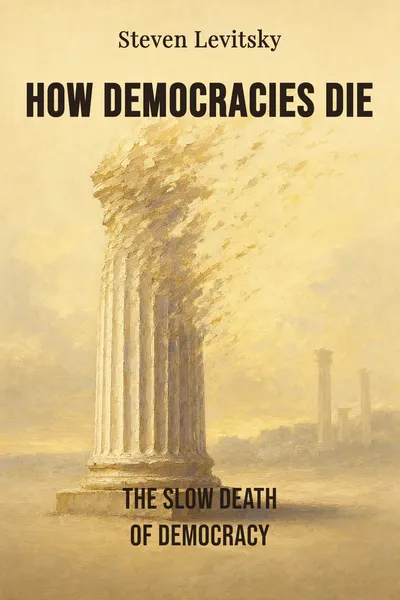
How Democracies Die
The slow death of democracy
Description
We tend to picture the death of a democracy as a single loud morning: tanks in the streets, a general on the radio, a constitution suspended before lunch. That is the version most of us learned — Chile in 1973, the newsreel image of the palace in flames. But when two Harvard political scientists, Steven Levitsky and Daniel Ziblatt, sat down to write about how democracies actually collapse in our era, they found the newsreel was misleading. Most modern democracies do not die at the hands of men with guns. They die at the hands of elected leaders — presidents and prime ministers who came to power through the ballot box and then hollowed the system out from the inside.
Levitsky and Ziblatt had spent more than two decades studying breakdowns in Europe and Latin America — Perón's Argentina, Chávez's Venezuela, Fujimori's Peru, Orbán's Hungary. What struck them was the pattern. There is rarely a clean line between democracy and dictatorship. Instead there is a slow slide: a court packed here, a broadcaster leaned on there, an opponent investigated, a norm quietly broken because breaking it worked. Each step is defensible on its own. Only in sum do they add up to something that is no longer a democracy, by which point it is often too late to name it.
The book that came out of this — published in 2018, written in the shadow of Donald Trump's election — was never meant to be only about the United States. It was meant to hold American anxieties up against a century of foreign cases and ask a colder question than the headlines allowed. Not "is Trump a dictator?" but "what are the warning signs that any democracy is in trouble, and how many of them are now flashing here?"
The question we’re asking : How do democracies actually die in the twenty-first century, and can the warning signs be read in time?What we’ll see : How elected strongmen replace coups, why the people meant to stop them so often don't, and what really keeps a democracy standing when the law alone can't.
Table of contents
01 Chapter 1 — The coup that never comes
Levitsky and Ziblatt open with a correction to our imagination. For most of the twentieth century, democracies did die by coup — armed men seizing the palace at dawn. But since the end of the Cold War, that route has become rare. The more common path is subtler and, for that reason, more dangerous: democracies are now killed by insiders, by leaders who win legitimate elections and then use the powers of their office to dismantle the very system that elected them.
The examples do the arguing. Hugo Chávez was elected in Venezuela in 1998 on a wave of frustration with corrupt establishment parties. Alberto Fujimori won in Peru. Viktor Orbán returned to power in Hungary in 2010 with a democratic mandate. None of them stormed anything. They governed. And while governing, they slowly rewrote the rules — expanding courts, changing electoral laws, pressuring media owners — until the playing field tilted so far that losing an election became almost impossible.

02 Chapter 2 — The gatekeepers who fell asleep
If elected demagogues are the threat, the obvious question is why voters put them there in the first place. Levitsky and Ziblatt's answer is uncomfortable: the problem is rarely the voters. Would-be authoritarians circulate in most democracies most of the time. What normally stops them isn't the public rejecting them — it's political parties refusing to let them near power. Parties, in a healthy democracy, are the gatekeepers.
They build the argument around a test they call the four warning signs of an authoritarian. Does a figure reject the democratic rules of the game, or hint at it? Do they deny the legitimacy of their opponents, treating rivals as criminals or traitors? Do they tolerate or encourage violence? Are they willing to curtail the civil liberties of opponents and the press? A leader who ticks even one of these boxes, the authors argue, deserves to be kept away from real power.
03 Chapter 3 — The unwritten rules that hold everything up
Here the book makes its most original move. We like to believe that democracy is protected by its constitution — that the words on the page will hold when everything else fails. Levitsky and Ziblatt are gently ruthless about this. Constitutions, they observe, are just parchment. Plenty of authoritarian regimes have beautiful ones. What actually keeps a democracy alive are two informal norms so ingrained we barely notice them, until they're gone.
The first they call mutual toleration: the shared acceptance that your rivals are legitimate. You may think they are wrong, even dangerous, but you accept their right to exist, to compete, and to govern if they win. The opposite is treating the other side as an enemy of the nation — traitors, criminals, an existential threat. Once opponents are seen that way, almost anything becomes justified to keep them out of power, because the alternative is framed as catastrophe.
04 Chapter 4 — When the referees, the players, and the rules bend at once
Step back from the cases, and Levitsky and Ziblatt's deeper argument comes into focus: authoritarians don't need to abolish democracy, they only need to bend three things at once. They capture the referees — the courts, the prosecutors, the electoral and regulatory agencies meant to be neutral. They sideline the players who can check them — opposition figures, independent media, business leaders, cultural voices — through lawsuits, audits, and pressure. And they rewrite the rules just enough to lock in advantage: redrawn districts, tightened voting laws, new restrictions dressed as reform.
The unnerving part is that each of these can be done legally, one measure at a time, by a government that keeps holding elections and calling itself democratic. This is why the authors insist the danger to the United States was never a Trump who cancels the vote and declares himself president for life. That is the coup we know how to fear. The realistic danger is slower and quieter — a system that stays formally democratic while the referees, the players, and the rules all tilt in one direction, until competition becomes theater.
05 Conclusion
The book ends without the reassurance we might want. Levitsky and Ziblatt refuse to promise that American democracy will survive, and they refuse to declare it doomed. Their point was always comparative: what happened in Venezuela, Hungary, and interwar Europe was not the product of exotic peoples or broken cultures, but of ordinary political choices — establishment figures cutting deals, opponents demonized, restraint abandoned because abandoning it paid. Those choices are available everywhere, including in the country that thought itself the model.
Related books