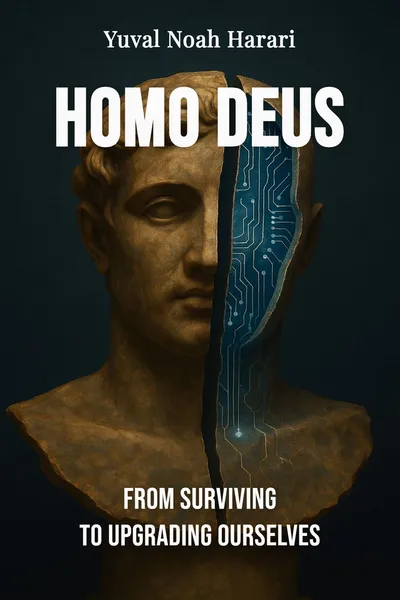
Homo Deus
From surviving to upgrading ourselves
Description
For most of recorded history, the human agenda was written by three authors we couldn't argue with: famine, plague, and war. They set the ceiling on what a life could be. A bad harvest emptied villages, a virus emptied cities, and a neighbouring army could undo a generation of work in an afternoon. In Homo Deus, published in 2015, historian Yuval Noah Harari opens with the claim that this ceiling has quietly lifted. For the first time, he argues, more people die from eating too much than too little, more from old age than infectious disease, more by their own hand than at the hands of soldiers. The old enemies haven't vanished, but they've been demoted from cosmic forces to manageable problems.
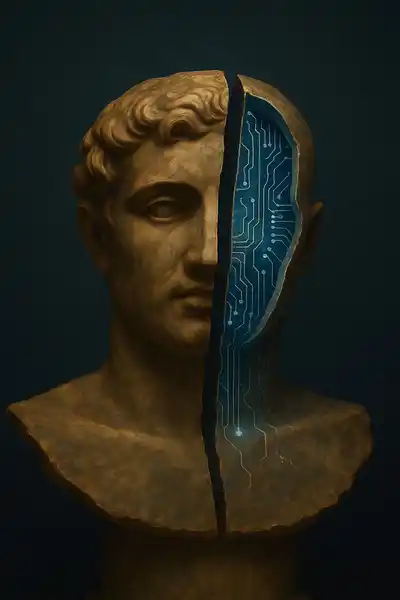
That shift leaves us with an odd vacancy. A species organised for millennia around survival suddenly has room on its agenda, and it tends to fill empty agendas with fresh ambitions. Harari's forecast is that the next projects will be the ones we once left to the gods: engineering longer lives, re-tuning our minds, and eventually redesigning the human being itself. Having spent our history trying not to die, we may spend our future trying to upgrade. The title names the destination — not Homo sapiens, the wise human, but Homo Deus, the human turned would-be god.
What makes the book more than a technology wish-list is where Harari points the argument next. The same sciences that let us re-engineer bodies are also dismantling the story modern civilisation tells about itself: that each of us contains a free, unified, authoritative inner self whose choices are the ultimate source of meaning and value. If that story cracks, the scaffolding built on it — democracy, free markets, individual rights, romantic love as a compass — starts to wobble too.
The question we’re asking : When medicine, computing and biotech let us redesign ourselves, what happens to the belief that the individual human is the source of all authority and meaning?What we’ll see : How Harari traces our jump from survival to self-upgrade, why the humanist faith he thinks we live by is quietly being replaced, and the questions his forecast deliberately leaves open.
Table of contents
01Chapter 1 — The old enemies are beaten
Homo Deus begins not with the future but with a ledger of the past, because Harari's whole case rests on how thoroughly the human condition has already changed. Famine, plague, and war were for thousands of years treated as fixed features of existence — expressions of divine will, karma, or simple fate. You prayed, you endured, you buried people. What you did not do was assume they could be solved. That assumption — that these horrors are technical problems with technical answers — is itself a recent invention, and Harari dates its confident arrival to roughly the last century.
The numbers he marshals are meant to unsettle. In 2010, obesity-related conditions killed far more people than famine, and sugar had become more dangerous than gunpowder. Great pandemics still erupt, but the medical response is now investigation and containment rather than resignation. Even war, historically the most reliable killer, has become statistically rarer between major states, however brutal it remains in specific places. Harari is careful not to promise these victories are permanent — a new plague or a nuclear exchange could rewrite the ledger overnight — but the trend line, he insists, is real.

02Chapter 2 — The humanist bargain
Before Harari can explain what might replace us, he has to name what we currently believe, and his answer is that modern people are almost all humanists, whether or not they'd use the word. Humanism, in his usage, isn't a philosophy club. It's the working religion of the modern world: the conviction that meaning and authority flow from within the individual human being. Where a medieval Christian looked to scripture and priest for answers, the modern person looks inward — to feelings, preferences, choices, the voice of the heart. The customer is always right, the voter knows best, beauty is in the eye of the beholder, follow your dream. All of these, Harari argues, are humanist commandments.
This inward turn quietly underwrites nearly everything we treat as obvious. Free-market economics assumes each individual is the best judge of their own interest. Democracy assumes the aggregate of individual feelings, expressed as votes, is the legitimate source of political authority. Modern education asks students to think for themselves. Even romantic love became a matter of consulting one's feelings rather than one's parents. The self, in this scheme, is the ultimate court of appeal — unified, free, and authoritative. There is nowhere higher to take the question.
03Chapter 3 — Data flows and the new religion
Into the vacancy a fading humanism might leave, Harari sees a successor already assembling itself, and he gives it a provocative name: Dataism. Dataism is the emerging worldview that treats the universe as flows of information, judging any phenomenon — a person, a company, a poem — by its contribution to data processing. In this view, humanity is not the pinnacle of creation but a step in a longer process: the creation of an all-encompassing data system into which our own value ultimately drains. It is, he argues, a religion in the making, complete with commandments like maximise data flow and connect everything to everything.
What makes the idea more than science fiction is how naturally we already obey it. We record our runs, log our heartbeats, share our meals, and consult our feeds before we trust our own judgement. Every time we let an app choose a route, a song, or a partner, we quietly concede that an external algorithm may know us better than we do. Harari notes that the humanist injunction to listen to yourself is being replaced, almost imperceptibly, by a new one: listen to the algorithm, feed it your data, and let it decide.
04Chapter 4 — When the individual stops being the author
Read straight, Homo Deus can sound like a prophecy, but that's a misreading Harari works to prevent. The book's deeper subject isn't gadgets or lifespans; it's authority — who, or what, gets to decide what matters. Humanism answered: the individual. Harari's argument is that this answer is being quietly withdrawn, not by tyrants but by the ordinary logic of biotech and data, and that we haven't noticed we're changing our minds. What he offers is less a forecast than a warning issued as a set of open questions.
The first question is about consciousness itself. If machines can outperform us without any inner experience, does experience still count, or was it always beside the point? Harari refuses to resolve this. He simply notes that a civilisation which decides consciousness is dispensable would be a profoundly different place, and that we are drifting toward that decision without a vote. The mind that humanism worshipped may survive as a curiosity rather than a throne.
05Conclusion
The book ends where it began, with a species that has run out of its oldest enemies and gone looking for new frontiers. Having beaten famine, plague and war down to manageable size, Harari argues, we are turning our powers inward — extending life, tuning happiness, redesigning the raw material we're made of. The move from surviving to upgrading is not a wild leap but the next reasonable step for a species that never rests inside a solved problem. The upgrade is not coming from outside us; it is us, following our own success to its edge.
Related books