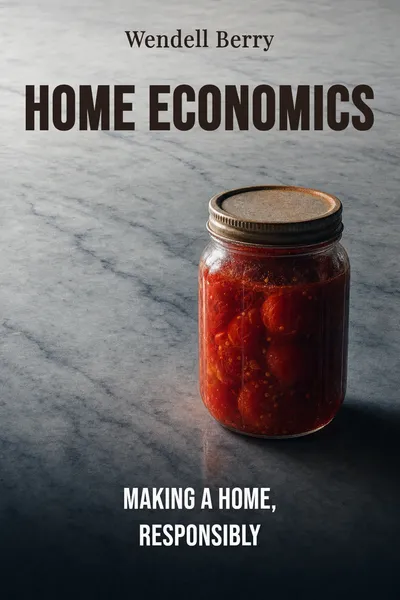
Home Economics
Making a home, responsibly
Description
In 1987, a Kentucky farmer who happened also to be one of America's better essayists published a slim book of fourteen essays called Home Economics. Wendell Berry had by then been working the same hillside land along the Kentucky River for two decades, and had already made a name arguing, against most of the momentum of his century, that leaving the farm was not obviously progress. The book collects arguments he had been turning over for years — some delivered as lectures, some written for magazines — and gathers them around a phrase he keeps returning to: the desire, as he put it, to make himself responsibly at home in this world and in his native and chosen place.
That word, responsibly, is doing more work than it first appears. Berry is not writing a how-to for canning tomatoes or balancing a household budget, though he would not sneer at either. He is asking what it would mean to actually belong somewhere — to a piece of ground, a marriage, a community, a species — in a way that accepts the costs and does not pass them quietly to someone else. The essays circle land use, marriage, the word "nature," the practice of farming, the difference between a healthy community and a productive one. Underneath them runs a single quarrel with the way we've learned to keep the books.
The title is not decoration. Berry means economics in something close to its old sense — the management of a household — and he wants to know why the version taught in universities and practiced by corporations seems to produce wealth on paper while the actual households, farms, and small towns it draws from grow poorer, emptier, and more damaged. He suspects the accounting is wrong, and that the error is not technical but moral.
The question we’re asking : What does it actually cost to make oneself at home in a place, and why does modern economics refuse to count it?What we’ll see : A farmer's quarrel with how we keep the books, and his case for an older, harder kind of belonging.
Table of contents
01Chapter 1 — The two economies
Berry begins with a distinction he returns to throughout the book. There are, he argues, two economies at work in any human life, and we have learned to see only one of them. The first is what he calls the little economy — the market, the sphere of money, prices, and human calculation. It is the economy we mean when we say the word. It measures what people are willing to pay, tallies what changes hands, and treats everything it cannot price as though it were free.
The second, the one we ignore, he calls at various points the Great Economy, borrowing loosely from the older idea of the Kingdom of God. This is the economy that includes the little one and vastly exceeds it: the topsoil, the rainfall, the health of a watershed, the fertility that took ten thousand years to accumulate and can be spent in a generation. It includes things no market invented and no market can replace. The little economy is a subsidiary of the Great Economy, whether it admits this or not, in the way a business is a subsidiary of the planet it operates on.

02Chapter 2 — What a farm knows that a corporation cannot
From this distinction Berry moves to the ground he knows best. A good farm, he argues, is a kind of practical philosophy — a place where the two economies are forced to meet, and where the honest accounting he wants becomes not a theory but a daily obligation. The farmer who mines his soil for a few big harvests will pay for it, and will pay in a currency the market does not recognize until it is too late: hardpan, erosion, a field that no longer holds water. The land keeps its own books, and they always balance eventually.
What a farm knows, in Berry's telling, is scale. A farm can be understood by one person or one family. Its problems are legible; its damage is visible; its health can be felt underfoot. The farmer who lives on the place he works sees the gully forming, smells when the soil is wrong, knows which slope should never have been plowed. This knowledge is not transferable to a spreadsheet, and it does not survive the separation of the decision-maker from the consequences. It is the knowledge of a resident, not an owner at a distance.
03Chapter 3 — The false savings of leaving home
Much of the century Berry was writing in had been organized around a single promise: that leaving home was liberation. Leave the farm for the city, the small town for the metropolis, the parents' trade for a profession, and you would rise. Efficiency and progress both pointed away from the local and toward the large. Berry does not deny that some people were freed by this. He denies that the freedom was free, and he thinks we cashed the promise without ever reading the fine print.
The essays keep tallying what the migration cost. When the young leave, the town loses not only workers but the accumulated knowledge of how to live in that particular place — which land floods, which crop suits the soil, how the community mends itself. That knowledge is not written down; it lives in people, and it dies when they scatter. What replaces it is dependence: on distant suppliers, on packaged food, on expertise that arrives from outside and does not stay. A community that cannot feed, mend, or teach itself has not become modern so much as newly helpless.
04Chapter 4 — Membership, and the limits it teaches
Step back from the farm and the quarrel over accounting, and Berry's book reveals what it has been about all along: membership. The word runs through his work like a keel. To be responsibly at home is not chiefly to own or to manage; it is to belong — to a place, a community, a marriage, the living world — in a way that binds you to its fate. And belonging, in his sense, is inseparable from limits. You are a member of something precisely because you are not the whole of it, cannot stand outside it, cannot escape the consequences of harming it.
This is why scale matters so much to him. Responsibility requires that a person be small enough, and rooted enough, to see what their actions do. Enlarge the scale far enough and responsibility evaporates — not because people become wicked, but because they can no longer perceive the harm they cause. The industrial economy's genius, in Berry's reading, is its manufacture of this blindness at scale: it arranges the world so that almost no one can see the whole of what they participate in. Membership is the cure because it refuses the distance. It puts you back within the thing you are affecting.
05Conclusion
The book ends where it began, on the ground of that phrase: to make oneself responsibly at home in the world and in one's native and chosen place. Every essay turns out to be an attempt to say what the word responsibly demands. It demands honest accounting, which means seeing the Great Economy behind the little one. It demands scale small enough to perceive consequences. It demands the acceptance of limits that membership imposes. None of these are techniques Berry can hand over; they are dispositions, learned slowly, in a particular place, by staying.
Related books