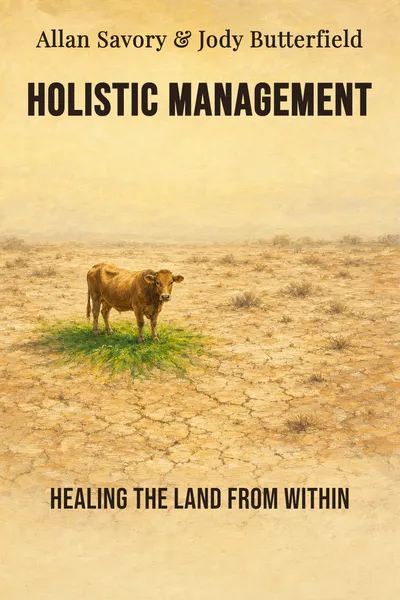
Holistic Management
Healing the land from within
Description
Allan Savory spent the early part of his career as a wildlife biologist in what was then Rhodesia, watching grasslands turn to bare dirt. He was so convinced that too many animals were the cause that, in the 1960s, he recommended culling tens of thousands of elephants in national parks to save the land. The elephants were shot. The land got worse. It is a confession he has repeated for decades, and it sits at the root of everything in this book: the moment he realized the story he had been telling about degradation was, in some fundamental way, backwards.
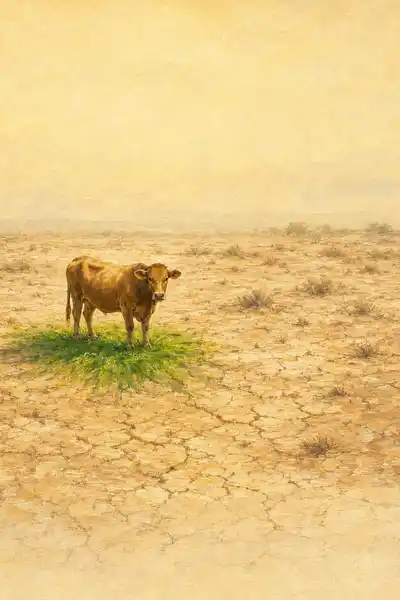
What Savory eventually argued, alongside co-author Jody Butterfield, is that vast areas of the world's grasslands did not evolve in the absence of large herds but because of them. Bunched, moving, grazing, trampling, fertilizing, then leaving — that pattern kept the soil covered and alive. Remove the animals, or let them spread out and nibble everywhere at once, and the land bakes, seals, and dies. From this reversal grows a whole management framework, one that treats the cow not as the villain of desertification but as a possible tool for reversing it.
But the grazing is only the visible half. The larger claim of "Holistic Management" is that our environmental troubles are really trouble with how we make decisions — piecemeal, aimed at single problems, blind to the web of consequences. The book offers a way of deciding that holds ecology, economy, and human values in one frame. It is a bold, contested, and genuinely different proposition, and it asks us to rethink what management even means.
The question we’re asking : Can putting more animals on fragile land actually heal it, and if so, what kind of thinking makes that possible?What we’ll see : How a discredited biologist rebuilt his ideas into a framework that treats decision-making, not livestock, as the real lever on the living world.
Table of contents
01 Chapter 1 — The counterintuitive case for more cattle
The intuition most of us carry is simple: overgrazing wrecks land, so fewer animals means healthier ground. Savory's decades in the field led him somewhere stranger. He noticed that the grasslands falling apart were often the ones where animals had been removed or thinned, and that some of the most trampled, densely stocked patches were the greenest. The variable that mattered, he decided, was not how many animals but how they moved.
His reasoning runs through the biology of seasonally dry grasslands — roughly two-thirds of the planet's land. In these places, rain comes in bursts and the rest of the year is arid. Grass that isn't grazed or knocked down doesn't neatly decompose; it oxidizes standing up, greying and choking the plant beneath it. Bare soil between plants seals over, sheds rainwater, and stops breathing. What such land is starving for, Savory argues, is disturbance — the churn a wild herd once provided.

02 Chapter 2 — From single problems to whole systems
If the grazing insight is the book's hook, its heart is a quieter argument about how people think. Savory came to believe that the elephant cull, and countless failures like it, shared one flaw: they attacked a problem in isolation. Too many elephants, so cull them. Too much brush, so spray it. Eroding riverbank, so build a wall. Each fix ignored that land, water, plants, animals, and the humans depending on them form a single web, where pulling one strand tugs all the others.
So the framework begins not with a technique but with a question: what are we actually managing? The answer, Savory insists, is a whole — a piece of land together with the people, money, and life bound up in it. You cannot manage the grass without managing the household economy that depends on it, or the family whose values shape what "success" even means. Treating any of these separately guarantees that solving one thing quietly breaks another.
03 Chapter 3 — The plan is never finished
A striking feature of the book is how little it trusts the plan itself. Savory and Butterfield are emphatic that nature is too complex for anyone to predict, so any decision, however carefully tested, is really a hypothesis. The honest posture is not confidence but vigilance: assume you might be wrong, and set up to catch the error early.
This is why monitoring runs through everything. A holistic grazing plan lays out where animals go and for how long, mapping recovery periods across a season, but it is drawn in pencil. Rain fails, or arrives early; a paddock recovers faster than expected; a market shifts. The manager watches the land — is bare ground shrinking, are new plants seeding, is water soaking in rather than running off — and adjusts. The plan bends to the feedback rather than the other way around.
04 Chapter 4 — When land management becomes a way of deciding
Step back from the cattle and the grass, and "Holistic Management" starts to look less like a ranching manual than a claim about the shape of our problems. Savory's wager is that the great environmental failures aren't caused by ignorance of ecology or shortage of tools. They're caused by how decisions get made — narrowly, toward a single goal, cut off from the tangle of consequences that any real place holds. Desertification, in this view, is downstream of a way of thinking.
That reframing gives the book its ambition and its limits at once. If the diagnosis is decision-making, then the same framework should apply well beyond a fenceline — to a farm's finances, a village's water, a family weighing what land means to them. The authors lean into this, presenting the holistic context and the testing questions as portable, usable by anyone managing something too complex to reduce to one number. The method is really an argument that ecology, economy, and human meaning cannot be optimized separately without one wrecking the others.
05 Conclusion
The book ends where Savory's own story began, with the elephants he helped kill and the land that refused to recover. That failure is not buried in a footnote; it's the credential. A man who staked his early authority on a simple answer spent the rest of his life building a framework designed to catch exactly that kind of mistake sooner. The cattle, the grazing charts, the testing questions all trace back to one hard lesson about acting confidently on an incomplete picture.
Related books