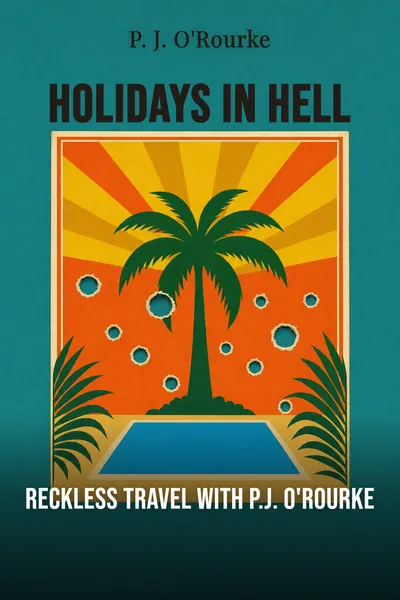
Holidays in Hell
Reckless travel with P.J. O'Rourke
Description
In 1988, an American journalist with a taste for cheap hotels and expensive trouble collected a decade of his dispatches into a book called Holidays in Hell. P. J. O'Rourke had spent the mid-eighties filing for Rolling Stone and other magazines from the places most vacationers organize their lives to avoid: Beirut during the civil war, the West Bank, Warsaw under martial law, apartheid South Africa, El Salvador mid-election, the Korean streets during the 1988 protests. He went, roughly, wherever the shooting was. And he wrote it up the way a friend home from a very bad trip tells the story — fast, funny, appalled, and unwilling to let anyone off the hook, himself included.
The premise sounds like a stunt, and O'Rourke half-plays it that way. The subtitle promised a travel writer investigating why the world's worst places were worse than the brochures let on. But the joke had a serious spine. O'Rourke had come out of the National Lampoon and the counterculture, drifted rightward, and arrived at a suspicion of every official explanation on offer — the guerrilla's, the government's, the aid worker's, the tour guide's. What he trusted instead was the plainly visible: the traffic, the food, the graffiti, the way people actually behaved when the cameras left.
Reading it now, decades after most of its datelines have changed regimes, the book keeps its charge because it refuses the two easy exits — the solemn foreign-correspondent voice and the tourist's shrug. O'Rourke stays in the uncomfortable middle, laughing at things that are not funny, and somehow making them clearer for it.
The question we’re asking : What was a comedian doing in a war zone, and what did the joke let him see that the straight report missed?What we’ll see : How reckless humor became a method for reading the world's worst places — and what that method was quietly loyal to.
Table of contents
01Chapter 1 — The reporter who went where the fun stopped
O'Rourke's route was not the war correspondent's. He wasn't embedded, wasn't chasing the front, wasn't building a career on gravitas. He booked flights, checked into whatever hotel still had running water, hired a driver, and wandered. The method was closer to a very ill-advised holiday than to journalism, which is exactly the frame he chose. Holidays in Hell reads its subjects as destinations — with restaurants, nightlife, and local customs — and then lets the absurdity of applying that vocabulary to a shelled city do the work.
Beirut is the set piece. He arrives in a place where the Green Line divides the city, where checkpoints are run by teenagers with automatic weapons, and where the hotel bar still, somehow, functions. He notes the food, rates the accommodations, describes the shopping. The gag is relentless, but it isn't only a gag: by treating catastrophe as a place people still live in — buy groceries in, fall in love in, get bored in — he restores something the news footage strips away. War as a condition of daily life, not a montage.

02Chapter 2 — Laughter as a weapon, and its recoil
The comedy in Holidays in Hell is not decoration. It's the instrument. O'Rourke had learned at the National Lampoon that a joke is a compression device: it can carry an argument, a judgment, and a fact in fewer words than an essay, and it lands before the reader's defenses go up. Applied to famine, ideology, and gunfire, this produces a voice that is constantly doing two things at once — entertaining you and indicting something.
The technique has range. Sometimes the target is a government, sometimes a guerrilla movement, sometimes the international press corps he traveled among, sometimes the reader's own comfortable assumptions. He is especially hard on the sanctimony of political tourists who visit oppression to have their views confirmed. And he turns the weapon inward: the recurring figure of the book is O'Rourke himself, overfed, hungover, out of his depth, wondering what a man like him is doing in a place like this. Self-mockery is what keeps the swagger from curdling into cruelty.
03Chapter 3 — The traveler's eye against the official story
O'Rourke's governing suspicion was that every place he visited came pre-equipped with an authorized narrative, and that the narrative was almost always wrong in the same direction — too tidy, too heroic, too convenient for whoever was selling it. Against this he set the traveler's eye: the small, checkable, physical detail that no press officer bothered to spin because it seemed too trivial to matter. The queue at the shop. The state of the roads. What the money would actually buy. Who ate well and who didn't.
In the Communist bloc, the argument writes itself through the plumbing. He doesn't need to lecture on the failures of central planning; he describes the hotels, the transport, the food, the gray exhaustion of daily transactions, and the case is made by inventory. This is where his politics and his reporting fuse: he had concluded that ideology should be judged by its groceries, by whether the system it produced could keep the lights on and the shelves stocked, and he tested that conviction on the ground rather than in the abstract.
04Chapter 4 — What the wisecrack was actually defending
It's tempting to file O'Rourke under provocation — a funny man saying rude things about serious places. But the recklessness had a loyalty underneath it, and naming that loyalty is what makes Holidays in Hell more than a collection of good lines. What he defended, consistently, was the ordinary. Not the ideology, not the flag, not the cause, but the unremarkable business of people trying to live decent, well-supplied, un-terrorized lives — and his contempt was reserved for anything that got in the way of that, whichever direction it came from.
This is why the book reads as conservative in temperament even where it's rude about the powerful. O'Rourke had a settled distrust of grand designs, the plans that promise to remake human life and require, first, that a lot of it be broken. He'd seen the results in enough places to treat every utopian pitch as an invoice waiting to arrive. Against the grand design he set the small verifiable good: functioning shops, safe streets, food you'd willingly eat, freedom boring enough that nobody had to write dispatches about it.
05Conclusion
Holidays in Hell ends where it began: with a man who chose to spend his holidays somewhere no reasonable person would, and came back with the news that the world's worst places are worst not because of some exotic evil but because ordinary life has been made impossible there. The datelines have aged — Beirut's war ended, the Berlin Wall fell the year after the book came out, apartheid unwound — but the method survives the events it recorded. Look at the groceries, not the manifesto. Distrust the story that wants your assent too easily.
Related books