History of the Conquest of Mexico
When empires collide in Mexico
Description
In 1843, a nearly blind Boston historian named William Hickling Prescott published a two-thousand-page account of events that had happened three centuries earlier and an ocean away. He had never seen Mexico. He could barely read the documents he depended on — an accident in his student years had cost him the use of one eye and badly weakened the other, so assistants read Spanish archives aloud while he composed long passages in his head before dictating them. Out of that strange working method came "History of the Conquest of Mexico," a book that read less like a scholarly monograph than a tragedy in five acts, with a doomed empire, a ruthless captain, and a sovereign who could not decide whether his visitor was a man or a god.
The story it told was, on its surface, almost too dramatic to be true. In 1519 a Spanish adventurer named Hernán Cortés landed on the Gulf coast with roughly six hundred men, a handful of horses, and a few cannon, and within two years he had brought down the Aztec empire — a civilization of millions, with a capital, Tenochtitlan, larger and cleaner than most cities in Europe. Prescott arranged these facts into a narrative so propulsive that it was translated into ten languages, reprinted hundreds of times, and read as avidly as a novel by people who had no particular interest in Mexico at all.
What made the book endure was not only the events but the way Prescott staged them: as a genuine collision, two civilizations meeting for the first time, each unable to comprehend the other, and one of them about to vanish. That framing has proved almost impossible to shake — which is worth understanding, because a version of history repeated two hundred times starts to feel like the thing itself.
The question we’re asking : How did a blind Boston historian turn the fall of the Aztec empire into a story the world could not put down — and what did that story leave out?What we’ll see : How Prescott built his epic, what his sources let him see and hide, and why his version still shapes how a hemisphere tells its own beginning.
Table of contents
01Chapter 1 — Two worlds that did not know each other existed
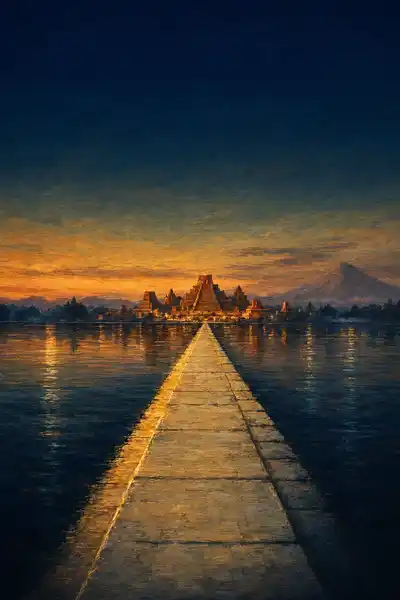
Prescott opens not with the Spanish but with the Aztecs, and he takes his time. Before a single conquistador appears, he spends whole chapters on the civilization that would be destroyed — its calendar, its picture-writing, its markets, its human sacrifice, its capital built on an island in a lake and reached by causeways. The decision was deliberate. A tragedy needs a protagonist worth losing, and Prescott wanted the reader to feel the weight of what was about to fall. He describes Tenochtitlan as a marvel that astonished the Spanish who first saw it, a city of canals and gardens and temples that some of Cortés's own men compared to the enchantments of a romance.
This is the book's founding move: it presents the encounter as a meeting of two fully formed worlds, each with centuries of history behind it, neither aware the other existed until the ships appeared on the horizon. Prescott leans into the strangeness of that mutual ignorance. The Aztecs had no word for the horse, no experience of firearms, no concept of the ocean-crossing empire that had produced these visitors. The Spanish, for their part, walked into a religious and political order they never fully grasped, mistaking a vast tributary state for a single kingdom ruled by one man.

02Chapter 2 — The march inland, and the art of the alliance
The popular memory of the conquest imagines a few hundred Spaniards toppling an empire through sheer boldness and superior weapons. Prescott tells a more interesting story, and it turns on politics rather than firepower. Cortés, he shows, understood almost from the moment he landed that the Aztec empire was not a nation but a machine of domination, resented by the peoples it taxed and raided for sacrificial victims. His genius — and Prescott uses the word without much comfort about it — was to turn that resentment into an army.
The pivotal episode is Tlaxcala. The Tlaxcalans, a fierce people the Aztecs had never subdued, first fought the Spanish hard and then, after brutal battles, allied with them against Tenochtitlan. Prescott narrates this shift as the true hinge of the conquest. From that point on, Cortés marched inland at the head of a force that was overwhelmingly Indigenous, with the Spanish serving as its armored spearhead. The conquest of Mexico, in Prescott's account, was in large part a war of Mexicans against Mexicans, with Cortés as its improbable coordinator.
03Chapter 3 — The city on the lake, and the man who let him in
The Spanish reached Tenochtitlan in November 1519, and Prescott gives the arrival the full force he has been saving. Cortés and his men crossed the causeway into the island city and were received by Moctezuma with ceremony rather than resistance — housed in a palace, given gifts, treated as guests of extraordinary rank. Then, within days, Cortés seized the emperor and began ruling the empire through him, a hostage on his own throne. Prescott presents this as one of the most audacious strokes in the history of conquest: a few hundred foreigners governing a city of hundreds of thousands by holding its sovereign captive.
The arrangement could not last. While Cortés was away on the coast dealing with a rival Spanish expedition, his deputy ordered a massacre of Aztec nobles during a religious festival, and the city rose. Prescott's account of the return, the siege inside the palace, and the desperate night the Spanish called the Noche Triste — when they fought their way out along the causeway under attack, losing men and treasure into the lake — is the dramatic peak of the book. Moctezuma died during the uprising, and Prescott, working from conflicting sources, leaves the exact circumstances shadowed.
04Chapter 4 — A landmark that shaped how a hemisphere remembers itself
Step back from the events and the more remarkable object is the book itself. Prescott was writing at the moment when history was becoming a literary form in English, and he treated the conquest as a subject worthy of Homer or Shakespeare — a fall of empires with heroes, villains, and fate. His biographer Harry Thurston Peck called it one of the most brilliant examples the language possesses of literary art applied to historical narration, and the critic Donald Ringe judged it a rare book that satisfies fully the demands of both history and art. That praise names the achievement and the problem at once. A story shaped this well tends to become the accepted memory, and Prescott's shaping had consequences.
The version he fixed in place is the romantic clash of civilizations: two coherent worlds, meeting, one conquering, one falling, with individual will and destiny doing most of the work. It is a thrilling frame, and it flattened a great deal. Later scholarship, drawing on Nahuatl sources Prescott could not read, has stressed how much the outcome owed to Indigenous alliances, internal Aztec politics, and above all disease — factors that turn the drama of two great men into something more diffuse and more collective.
05Conclusion
Prescott finished the book he could barely see, and it outlived him by far. He died in 1859, having produced companion histories of the conquest of Peru and of the reign of Ferdinand and Isabella, but it is the Mexico volumes that kept his name alive — reprinted, translated, and pressed into the hands of readers who wanted the fall of Tenochtitlan told as a story with a beginning, a middle, and an unbearable end. The blind historian in Boston had turned an archive of Spanish dispatches into an epic that people across the world could not stop reading.
Related books