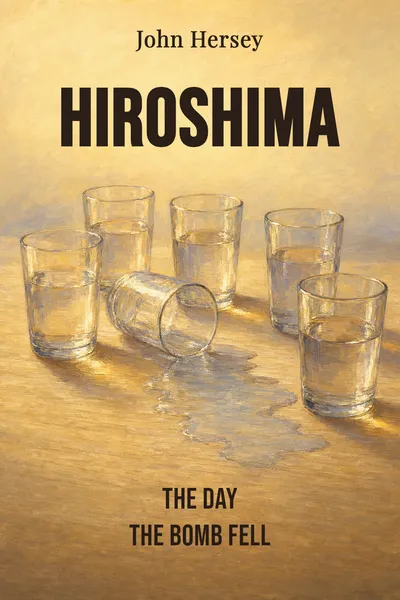
Hiroshima
The day the bomb fell
Description
On the morning of August 6, 1945, a clerk named Toshiko Sasaki sat down at her desk in the personnel office of the East Asia Tin Works in Hiroshima and turned her head to speak to the woman next to her. At that same moment, a physician named Masakazu Fujii settled onto the porch of his private hospital to read the newspaper. A tailor's widow was watching a neighbor from her kitchen window. A German Jesuit priest lay in his underclothes on a cot, reading a magazine. A young surgeon walked down a hospital corridor with a blood sample in his hand. A Methodist pastor was unloading a handcart of belongings at a rich man's house on the edge of the city. It was a warm, clear Monday, and the air-raid sirens had already sounded and cleared.
None of them heard the plane. What they registered, each in their own way, was a silent, enormous flash of light — whiter than any white they had ever seen. Then the pressure, the collapse, the strange settling dust. In the space of that flash, roughly a hundred thousand people were killed or fatally injured, and a city of a quarter million was unmade. The six who form the spine of John Hersey's account happened to live. Hersey's book, first published in the New Yorker in August 1946, is built entirely from what those six remembered.
What makes the book endure is not the scale it describes but the smallness of its lens. Hersey refuses the aerial view, the mushroom cloud, the strategic argument. He stays at ground level, inside six sets of eyes, and lets the day unfold at the pace a person actually lives it — the search for water, the misplaced shoe, the child under the beam. The atom bomb had already become an abstraction by the time he arrived. His method was to make it a Monday again.
The question we’re asking : How does one report a catastrophe too large to be seen, and why did Hersey choose six ordinary people to do it?What we’ll see : An ordinary morning, the flash that ended it, a city reduced to wreckage and rumor, and what it costs to render mass death one human being at a time.
Table of contents
01 Chapter 1 — Six people on an ordinary Monday
Hersey opens before the bomb, and the choice is deliberate. He wants us inside the ordinary texture of a Monday morning so that the rupture, when it comes, lands on a life already in motion rather than on a statistic. So we meet six people going about small, unremarkable tasks. There is Miss Toshiko Sasaki, twenty years old, a clerk at a tin works, tired from sitting up caring for family. There is Dr. Masakazu Fujii, prosperous, a little self-indulgent, owner of a small private hospital built out over a river. There is Mrs. Hatsuyo Nakamura, a tailor's widow raising three children alone.
And there are three men whose calm gives the book its moral ballast. Father Wilhelm Kleinsorge, a German Jesuit whose foreign body did not tolerate the wartime diet, is reading in the mission house. Dr. Terufumi Sasaki, a young surgeon of twenty-five and no relation to the clerk, is walking a hospital corridor, quietly worried he has been practicing medicine without the proper license in nearby villages. And the Reverend Kiyoshi Tanimoto, pastor of the Hiroshima Methodist Church, exhausted from moving valuables out of the city center, is helping a friend unload a cart in the suburb of Koi.

02 Chapter 2 — A noiseless flash
The bomb detonated at 8:15, roughly six hundred meters above the city. What Hersey records, from six vantage points at once, is that almost no one experienced it as an explosion. They experienced it as light. Reverend Tanimoto, a couple of miles out, saw a sheet of sun sweep across the sky and threw himself between two rocks. Father Kleinsorge registered only a terrible flash and then found himself wandering in the garden in his underwear, bleeding from small cuts, with no memory of how he got there. There was no sound they could later name. The event had happened faster than hearing.
For Miss Sasaki, the flash coincided with the collapse of her office. The bookcases behind her toppled, and she was buried under a rain of books — her leg crushed and twisted beneath the load, killed not by the bomb's fire but by the weight of the printed word. Hersey lingers on that irony without underlining it. Dr. Fujii's hospital, the proud building over the river, folded and slid, and he found himself pinned between two long beams, held over the water as the tide came in, unable to move, watching his own hospital float away in pieces.
03 Chapter 3 — The city that stopped being a city
As the six climbed out of the wreckage, they walked into a landscape with no precedent to compare it to. The injured moved toward the rivers and parks, drawn by an instinct for water, and along the way they passed people whose appearance survivors could barely describe — skin hanging in strips, faces burned featureless, eyebrows gone, the pattern of a woman's kimono seared onto her back where the dark cloth had absorbed the heat. Many walked in silence, holding their arms out to keep raw flesh from touching anything.
Reverend Tanimoto did what Hersey presents as the book's central act of decency: he simply began to help. He crossed back into the burning city looking for his family, then spent the day ferrying the wounded across the river in a small boat, going back again and again, apologizing to the dead he had to step over. Father Kleinsorge, himself wounded, carried water to strangers in Asano Park and returned when they begged him not to leave. These were not heroic gestures in any dramatic sense — just people doing the next small thing because the alternative was unthinkable.
04 Chapter 4 — What a hundred thousand deaths look like up close
Hersey's deepest choice was one of scale. By 1946, the atom bomb had hardened into abstraction — a weapon discussed in terms of yield, strategy, and the war it was said to have shortened. The number a hundred thousand was available, but a number that size does not register as grief; it registers as policy. What Hersey understood is that a mind cannot mourn a hundred thousand people. It can, however, follow one clerk pinned under her bookcase, one doctor floating past his ruined hospital, one mother listening for her children in the dark. He built the catastrophe out of units the human imagination can actually hold.
This is why the book was, and remains, an instrument of conscience rather than an argument. Hersey does not editorialize. He includes no debate about whether the bombing was justified, offers no verdict, permits himself almost no adjective of horror. He simply reports what six people saw and did, in plain sentences, and trusts the accumulation to do the work. The restraint is the method. Readers who might have defended the bomb in the abstract found themselves, page by page, inside a woman's crushed leg or a priest's canteen of water, and the abstraction could not survive the contact.
05 Conclusion
The six lived on. Miss Sasaki's leg healed badly and left her lame; she eventually became a nun. Dr. Fujii rebuilt a practice. Mrs. Nakamura endured years of poverty and radiation sickness before finding steadier ground. Dr. Sasaki worked through the first days almost without stopping, then went on with an ordinary surgical career, rarely speaking of what he had seen. Father Kleinsorge stayed in Japan, took citizenship, and gave the rest of his damaged health to the church. Reverend Tanimoto spent his life as a peace advocate, ferrying, in a sense, for the rest of his days.
Related books