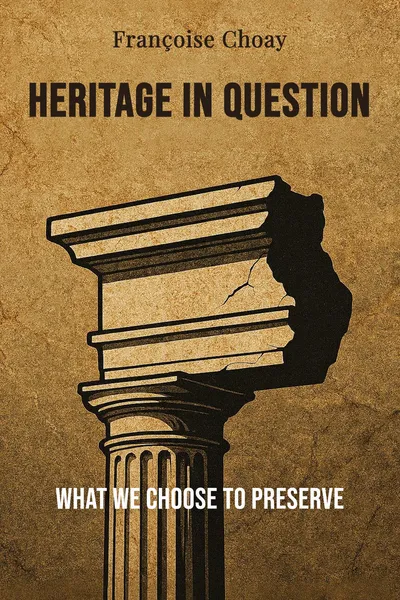
Heritage in Question
What we choose to preserve
Description
There is a word we now use for almost anything old enough to feel worth keeping: heritage. A cathedral, a nineteenth-century train station, a fishing village, a recipe, a dialect, a factory that stopped producing decades ago. We renovate, we classify, we list, we guard. And we rarely stop to ask where this reflex came from, or why it has grown so vast that it now covers whole city centers and stretches toward the entire surface of the inhabited world. Françoise Choay, a French historian of architecture and urbanism, spent much of her career worrying at exactly this question in a book whose French title says it plainly: L'Allégorie du patrimoine.
Her starting point is unsettling. The idea that old buildings should be protected for their own sake is not eternal — it is recent, European, and traceable to a handful of moments and figures. Choay follows the word patrimoine from its narrow beginning, the single 'historic monument,' to its modern swelling, when heritage came to mean not just buildings but neighborhoods, landscapes, and eventually humanity's shared inheritance under the banner of UNESCO. Along the way something shifts: preservation stops being an act of memory and becomes something closer to an industry, with its experts, its tourists, and its economics.
What interests Choay is not whether we should protect old things — of course some things deserve protecting. It is what our obsession with protecting them reveals about us. A society that lists everything may be a society that has quietly stopped believing it can build anything worth listing next. Heritage, in her hands, becomes less an inventory of the past than a symptom of the present.
The question we’re asking : Where did our reflex to preserve the old actually come from, and what does its enormous growth say about us?What we’ll see : How a narrow eighteenth-century idea about monuments swelled into a global mission — and what that swelling quietly admits.
Table of contents
01 Chapter 1 — The cult of monuments arrives late
We tend to assume that people have always cherished their old buildings. Choay argues the opposite. For most of history, the past was a quarry, not a shrine. Romans reused older stone without sentiment; medieval builders raised cathedrals on top of whatever stood before; Renaissance Rome mined its own ruins for marble. A building had value while it was useful or beautiful or holy. When it stopped being any of those, it came down, and no one felt they had committed a crime.
The change, in Choay's account, is genuinely modern. She points to the Italian Renaissance as the first stirring — humanists who began to look at Roman ruins not as building material but as traces of a lost civilization worth studying. But the decisive rupture came with the French Revolution. When revolutionaries began smashing statues and stripping churches, a countermovement formed almost at once to defend these objects, not as sacred or royal, but as belonging to the nation. A new category was born: the monument historique, the thing preserved because it testifies to a shared history.

02 Chapter 2 — From the historic monument to everything at once
The single monument was only the beginning. Choay traces how the category kept swallowing more. In the nineteenth century, the object of protection was a specific, exceptional building — a cathedral, a château, a Roman arch. By the twentieth, the frame had widened dramatically. It was no longer the isolated monument that mattered but the setting around it, then the whole urban fabric, then ordinary buildings that were remarkable only for being typical of an era.
A key figure in her account is the Austrian art historian Alois Riegl, who around 1903 tried to sort out the different kinds of value a monument could carry — its historical value, its artistic value, and what he called its age-value, the simple emotional pull of visible age, of worn stone and faded surfaces. Riegl saw that people could be moved by oldness itself, by the mere trace of time, quite apart from whether a building was important. Choay reads this as a warning sign: once age alone confers value, almost anything can qualify.
03 Chapter 3 — The tourist, the expert, and the preserved city
As the object of heritage grew, so did the machinery around it, and here Choay's tone sharpens. Preserving a single monument is one thing. Preserving a living historic center is another, because a city is not a statue — people live in it, work in it, change it. To freeze it as heritage is to make a decision about how those people may live. The old quarter becomes an object to be conserved rather than a place to be inhabited, and the two ambitions pull against each other.
The engine that resolves the tension, in her reading, is tourism. The preserved city needs visitors to justify and fund its preservation, and visitors need the city to look the part. So the historic center is polished, cleared of the awkward and the ordinary, and gradually emptied of the residents who cannot afford it, replaced by hotels, shops, and the services that serve arrivals. Venice is her recurring shadow — a city so thoroughly turned into heritage that it risks becoming a beautiful, uninhabited stage set, a monument to itself.
04 Chapter 4 — A prosthesis for a culture that no longer builds itself
Step back, and Choay's real argument comes into focus. The explosion of heritage is not simply good news about how much we now cherish the past. It is a symptom, and the thing it is a symptom of is a loss. Her diagnosis is that modern societies have lost what she calls a competence — the everyday, embodied ability to shape their own surroundings, to build cities and objects that carry meaning without a committee. As that capacity fades, we compensate by clinging to the meaningful things earlier generations made.
Heritage, in this light, functions almost like a prosthesis. It stands in for a creative ability we no longer exercise fluently. We protect the beautiful old town because we have lost confidence that we could make a new one worth loving. We list the vernacular farmhouse because the way of building it — the shared, unselfconscious craft — has evaporated. The zeal of preservation, then, is proportional to a quiet despair about production. The more anxiously a society archives, the less certain it is of its own future output.
05 Conclusion
We began with a word that now covers almost everything — heritage, stretched from a single revolutionary-era monument to the shared inheritance of all humanity. Choay's achievement is to make that word strange again, to remind us that our reflex to preserve is barely two centuries old and grew for reasons worth examining. The historic monument was invented; the historic city was invented; even the idea that age alone confers value was invented, argued over, and written into law by particular people at particular moments.
Related books