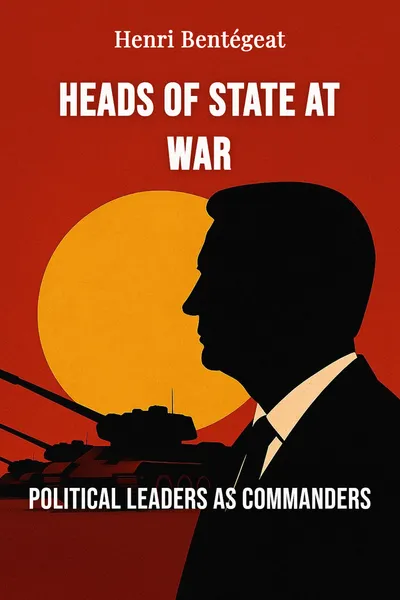
Heads of State at War
Political leaders as commanders
Description
Henri Bentégeat spent most of his life close to the people who decide whether a country goes to war. A French army general, he served as chief of the defense staff and then chaired the European Union Military Committee, and before that he worked directly alongside two French presidents, Mitterrand and Chirac, in the room where military orders get signed. He knows the view from the uniform, and he has watched the view from the suit. In his book Heads of State at War, he turns that double vantage point on the twentieth century's great wartime leaders and asks a plain, uncomfortable question about them.
The question is not who was brave or who was right. It is whether political leaders, almost none of whom have commanded troops in combat, can actually run a war — and what happens to the generals when they try. Bentégeat lines up Clemenceau and Churchill, Hitler and Stalin, de Gaulle and a handful of others, and compares not their speeches but their working relationship with the men in uniform who had to carry out the orders. The record, read this way, is far messier than the monuments suggest.
What emerges is a study of friction. Every one of these leaders had to decide how far to reach into the conduct of operations, and every general had to decide how much to push back. Some pairings produced victory, others catastrophe, and the difference rarely came down to strategy alone. It came down to a relationship most citizens never see and most histories barely mention.
The question we’re asking : Can political leaders actually command a war they have never fought in — and what does that do to the generals under them?What we’ll see : A soldier-diplomat reads the century's wartime leaders against the officers who had to obey them, and lands on the fault line between the two.
Table of contents
01 Chapter 1 — The amateur in the war room
Almost none of the leaders Bentégeat examines had ever commanded a unit in battle. Clemenceau was a journalist and a physician before he was a politician. Churchill had seen combat as a young cavalry officer and reported on several wars, but he had never run an army. Franklin Roosevelt had been assistant secretary of the navy, not an admiral. Stalin had organized revolution, not divisions. These were, by the standard of the profession they were about to direct, amateurs — and in 1914, 1939 and after, the fate of millions passed through their hands.
That gap matters, Bentégeat argues, because war has its own grammar. Logistics, terrain, the real pace at which an army can move, the difference between a plan on a map and a plan in the mud — these are learned, not intuited. A leader who does not grasp them can order the impossible and blame the soldier when it fails. Much of the century's worst military waste, in his reading, came from civilians demanding results the ground could not give, and from officers too intimidated or too careerist to say so.

02 Chapter 2 — When trust holds the line
The pairings that worked share a quality that is easy to name and hard to build: trust, running in both directions, under pressure. Bentégeat keeps returning to Clemenceau and Foch. The premier chose his general, defended him against rivals and politicians, and then resisted the temptation to run the battles himself. Foch, for his part, kept Clemenceau informed and accepted that the aims of the war — alliance politics, the terms of a future peace — were the civilian's to set. Each stayed on his own side of the line, and the line held through the German offensives of 1918.
Churchill offers a harder, more revealing case, because he was constantly tempted across the line and was, most of the time, pulled back. He had strong, sometimes reckless, operational ideas, and he pressed them relentlessly on his commanders. What saved the arrangement was Alan Brooke, the chief of the imperial general staff, who argued with Churchill daily, said no when no was needed, and absorbed the prime minister's restless energy without letting it wreck the campaigns. Their relationship was exhausting and often bitter. It also worked, precisely because the soldier would push back and the leader, in the end, would listen.
03 Chapter 3 — The leader who overreaches
The opposite case is the more famous one, and Bentégeat studies it with the cold attention of a man who has read the operational records. Hitler is his central example of the leader who crosses every line. A corporal in the First World War, he came to believe his own military genius, increasingly ran operations from distant headquarters, and treated his professional officers as obstacles rather than advisers. As the war turned, he forbade retreats that any competent general knew were necessary, froze armies in place, and dismissed or humiliated commanders who told him the truth.
The mechanism Bentégeat describes is not stupidity but the collapse of the adversarial relationship. Early on, the Wehrmacht's professionals still shaped operations, and the results were formidable. As Hitler centralized, the generals learned that honesty was punished and silence was safe, so the warnings stopped reaching him. Stalingrad, the refusal to allow the Sixth Army to break out while it still could, is Bentégeat's set piece: a catastrophe produced less by a bad plan than by a system in which no one could tell the leader that his plan was impossible.
04 Chapter 4 — The uneasy border between soldier and statesman
Step back from the individual cases and the same fault line runs under all of them. A war is at once a political act and a technical operation, and these two natures pull command in opposite directions. The statesman needs control, because war is the continuation of politics and must serve political ends — the shape of the peace, the cost the nation will bear, the alliances that must hold. The soldier needs autonomy, because battles are won by judgment on the ground that no cabinet can supply from a distance. Bentégeat's whole book sits on the seam between these two needs.
What makes the seam permanent is that neither side can be allowed to win it outright. A war run entirely by generals drifts toward strategy for its own sake, toward victory defined in military terms that may ruin the country politically — the generals of 1914 who kept feeding men into offensives no statesman had sanctioned. A war run entirely by the leader drifts toward Hitler's headquarters, where competence is overruled by will. The health of the system depends on the tension staying alive, on each side checking the other without destroying it.
05 Conclusion
Read together, the cases refuse a tidy verdict. The leaders who succeeded were not the most knowledgeable about war but the most disciplined about their own limits — Clemenceau choosing Foch and leaving him alone, Churchill arguing with Brooke and finally yielding, even Stalin learning, at terrible cost, to listen to the men he had nearly destroyed. The leaders who failed were the ones who mistook authority for competence and surrounded themselves with silence. The dividing line was never regime or ideology. It was whether the leader could bear to be contradicted by the soldier who knew more.
Related books