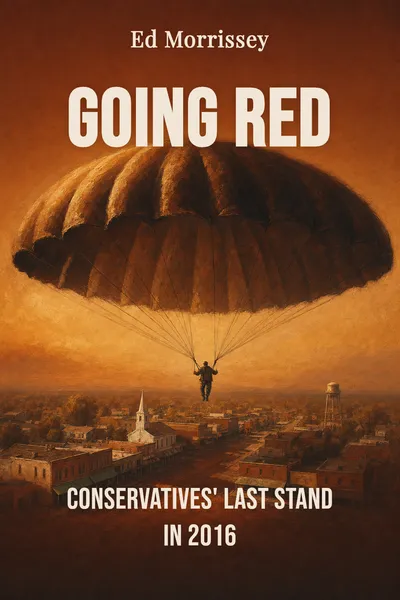
Going Red
Conservatives' last stand in 2016
Description
In November 2012, a lot of Republicans woke up genuinely confused. The polls their side trusted had shown Mitt Romney winning, or close enough to win. The enthusiasm looked real, the crowds were large, the internal models were reassuring. Then Barack Obama carried Florida, Ohio, Virginia, Colorado, and Nevada, and the confusion curdled into something more useful: the sense that the party did not actually understand the country it was trying to govern. Ed Morrissey, a conservative writer and radio host, spent the next stretch of years trying to figure out exactly where and how that misunderstanding had happened.
His answer, laid out in the 2016 book Going Red, is unusually specific for a genre that tends toward grand theory. Morrissey did not write about messaging, or the culture war, or the soul of the movement. He went to the places where presidential elections are decided — a short list of swing counties in a shorter list of swing states — and reported what the ground actually looked like. What he found was a national party that had, in many of these places, more or less stopped existing between elections, then parachuted in every four years expecting to be trusted.
The book arrived in the spring of 2016, before anyone knew how that year would end, and it read as both a diagnosis and a warning. Morrissey framed the coming election as a narrow, maybe final window for conservatives to reverse a demographic and organizational drift that was quietly closing off the path to the White House. The urgency was real. The proposed fix was almost boringly practical, which was the point.
The question we’re asking : If conservatives kept winning the argument yet losing the presidency, where exactly was the election slipping away from them?What we’ll see : A reporter's tour of the handful of counties that decide who runs the country, and the unglamorous work a national party had quietly abandoned there.
Table of contents
01Chapter 1 — The map lies to everyone
Open an electoral map on election night and the country looks overwhelmingly Republican. Vast stretches of red spread across the interior, from the Dakotas down to Texas, while the Democratic blue clings to a few coasts and cities. For years this image fed a comforting story on the right: that conservatives represented the real, geographic America, and that Democrats governed a handful of dense enclaves. Morrissey's first move in Going Red is to take that map away, gently, and explain why it has been misleading its own audience.
Land does not vote. People do, and people cluster. The red that covers most of the map is often thin — counties with more cattle than voters — while the small blue patches hold the population centers where elections are won and lost. More important, the map by state hides the fact that a presidential race is not fifty contests but a few. Most states are settled before a single ad runs. The whole thing turns on a handful of genuine battlegrounds, and inside those, on an even smaller handful of counties that swing between the parties.

02Chapter 2 — Where elections are actually decided
The states Morrissey treats as decisive were the familiar ones of that era: Florida, Ohio, Virginia, Colorado, Nevada — the places that had broken for Obama twice and that any Republican would need to claw back. But he refuses to talk about them as blocks. A state is an abstraction; a county is a place with a commute, a church schedule, a set of grievances, and a texture that shifts neighborhood by neighborhood. Going Red is organized as a tour, state by state, of the specific counties inside them that decide the outcome.
What he found on the ground rarely matched the national caricature. These were not culture-war battlefields where voters lined up neatly by ideology. They were suburbs and exurbs full of people whose politics were less about grand principle than about whether anyone had bothered to understand their lives — the traffic, the property taxes, the schools, the small businesses, the sense of being talked past by both coasts. Voters in these places were persuadable, but they were also proud, and they noticed who showed up in the off years and who only appeared with a camera crew every fourth October.
03Chapter 3 — The seven counties that pick presidents
The heart of Going Red is a set of specific portraits. Rather than survey the whole battleground at once, Morrissey drills into representative counties — places like Hillsborough County around Tampa, Jefferson County outside Denver, the suburban rings of northern Virginia and central Ohio — and treats each as a case study in what winning or losing looks like up close. The effect is to turn an abstract national problem into a series of concrete, fixable ones.
In each portrait the same lesson recurs, dressed in local clothing. In the Florida counties, the story is about Hispanic communities that were neither monolithic nor unreachable, but that had gone years without a Republican making a genuine, non-transactional appeal. In the Colorado suburbs, it is about educated, unaligned voters who cared about tone and competence as much as position. In Virginia and Ohio, it is about a shifting suburban middle that responded to presence and turned away from absence. The counties differed; the diagnosis rhymed.
04Chapter 4 — The party that stopped showing up
Step back from the individual counties and Going Red is really an argument about what a political party is for. There is a version of party life that treats the organization as a vehicle for a message — a machine that switches on to broadcast, spend, and mobilize for a few weeks, then powers down. And there is a version that treats the party as a standing presence in people's lives, a set of relationships and institutions that exist whether or not there is an election to win. Morrissey's whole case is that the first version had quietly displaced the second on the Republican side, and that presidents are made or lost by the difference.
The insight generalizes beyond 2016. Presidential power in the American system is not won by persuading the country in the abstract; it is assembled, county by contested county, through the accumulated trust of people who have decided a party is on their side. That trust is not a message. It cannot be bought in the final six weeks, no matter how large the ad buy, because it is built out of continuity — the same faces, the same storefront, the same willingness to listen in the years when no vote is on the line. A campaign is an event. A party is supposed to be a habit.
05Conclusion
The 2012 confusion that opens the book was, in Morrissey's telling, a symptom of reading the country from too high up. Going Red brings the altitude down to street level, to a manageable list of counties and a set of relationships that either exist or don't. Its answer to the question of how conservatives could win is not a new idea or a better line. It is the oldest work in politics: be present, be local, and earn trust in the seasons when nothing is being asked. The path to the presidency, the book insists, was always sitting there in plain sight, just unattended.
Related books