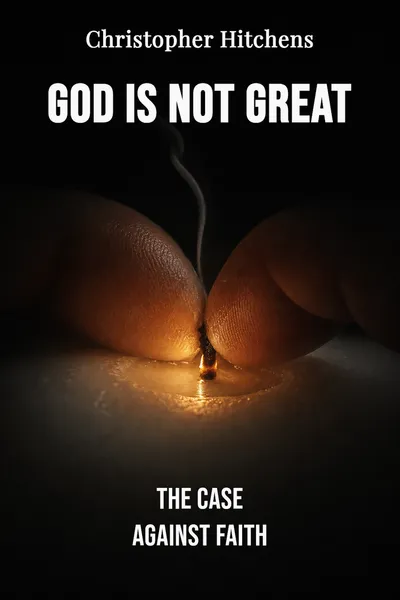
God Is Not Great
The case against faith
Description
In 2007, Christopher Hitchens published a short, furious book with a title that closed no doors and opened every argument: God Is Not Great. Hitchens was by then a familiar figure — a British-American journalist, a contrarian who had turned on old allies, a man who wrote fast and could dismantle an opponent on live television before the ad break. The book arrived in a small wave. Sam Harris had put out The End of Faith a few years earlier; Richard Dawkins had just sold enormous numbers of The God Delusion. The press gave the group a label, New Atheists, as if unbelief were a startup. Hitchens's contribution was the loudest and the most literary.
He wasn't writing a treatise. God Is Not Great reads like a prosecutor's closing argument delivered by a man who has read everything and forgotten nothing — the Bible and the Quran, Aquinas and Freud, the small print of a hundred atrocities. The subtitle in the American edition put the charge plainly: How Religion Poisons Everything. Everything is a large word, and Hitchens meant it. Faith, in his telling, is not a private comfort that occasionally goes wrong. It is a way of thinking that corrupts the mind at the source, and then licenses the worst of what people do to each other in the name of something higher.
What gave the book its heat was that Hitchens had lived among believers, argued with clerics, reported from places where religion ran the state. He wasn't sneering from a seminar room. He was making a case in the older sense — laying out evidence, calling witnesses, daring the jury to acquit. Two centuries after the Enlightenment supposedly settled this, here was a bestseller insisting the argument was still worth having, and still winnable.
The question we’re asking : On what grounds does Hitchens argue that religion is not merely mistaken but actively harmful — and does the case hold?What we’ll see : How a working journalist built a prosecutor's brief against faith, from the origins of scripture to the conduct of the faithful, and what his wager on argument itself was really betting on.
Table of contents
01Chapter 1 — The four irreducible objections
Hitchens opens not with God's non-existence — he treats that as almost too easy — but with four charges he says are enough on their own. Religion, he argues, misrepresents the origins of the human species and the cosmos. It combines a maximum of servility with a maximum of solipsism, asking us to grovel before a deity who is somehow also obsessed with our sexual habits. It is dangerous to health, whether through the ban on condoms in the face of AIDS or the ritual mutilation of children. And it is the cause and result, in his phrase, of sinister sexual repression.
These aren't offered as tidy syllogisms. They're the spine of a book that then piles on the evidence, chapter after chapter, like a man emptying a filing cabinet onto a table. The strategy is cumulative. No single item has to be decisive; the mass is the argument. Hitchens wants the reader to feel the sheer weight of what has been done, said and forbidden under religious authority, until deference starts to look not pious but negligent.

02Chapter 2 — Where holy books come from
Much of God Is Not Great is spent reading scripture the way Hitchens would read any other ancient document — as a text with authors, edits, contradictions and an agenda. The Gospels, he points out, disagree with one another on basic facts, were written decades after the events they describe, and were selected from a wider field of competing accounts by councils of men with interests of their own. The genealogies don't match. The nativity stories don't match. This isn't hidden knowledge; it's what any careful reader finds, and Hitchens is annoyed that so few look.
He extends the same treatment to the other monotheisms. The Quran, in his account, borrows heavily from the Jewish and Christian material already in circulation, which for him settles the question of divine originality. Mormonism gets particular attention precisely because it is recent enough to catch in the act: Joseph Smith producing golden plates no independent witness could inspect, a nineteenth-century American faith assembled in the full light of documented history. If we can see how one religion was manufactured, Hitchens argues, we have no reason to assume the older ones came into being any differently — only that their manufacture is harder to trace.
03Chapter 3 — Religion doesn't make us behave
The strongest card believers usually play is moral: without God, what stops us? Hitchens hits this head-on, and it may be the most quoted move in the book. He poses a challenge he claims no one has met — name a moral action performed by a believer that could not have been performed by a non-believer. He waits. Then he offers the reverse, which he says fills itself in instantly: name a wicked thing done, or said, specifically because of religious conviction. The examples arrive without effort — the stoning, the honour killing, the burning of the accused.
This asymmetry is his point. Morality, in his reading, predates the churches and does not depend on them. Human beings are social animals who worked out that murder and theft corrode the group long before Sinai; the commandments codify an ethics we already had. What religion adds is not goodness but a licence — a way to convert ordinary cruelty into sacred duty, so that the man with the knife believes himself righteous rather than criminal.
04Chapter 4 — The last argument: a life without it
Step back from the individual charges and God Is Not Great is really an argument about how we should hold beliefs at all. Hitchens's wager, shared with Harris and Dawkins, was that religious claims deserve no special exemption — that a proposition about the origin of the universe should be examined like any other, and that the polite convention of not questioning someone's faith is itself the problem. Deference, on this view, is how bad ideas survive. The remedy is argument, in public, without apology.
That wager gave the New Atheist books their electricity and also their limit. Hitchens was superb at the demolition, less interested in what people actually reach for when they pray. His account of faith as fear plus ignorance explains the inquisitor better than it explains the grieving widow, and critics were quick to say so. The book treats religion overwhelmingly as a set of truth-claims to be refuted, when for many believers it is closer to a practice, a belonging, a language for loss. Hitchens would have answered that a false comfort is still false — but the answer concedes the shape of the objection.
05Conclusion
Hitchens finished God Is Not Great as a healthy man at the height of his powers. Four years later, in 2011, he died of oesophageal cancer, having spent his final months refusing every offer of deathbed conversion and reporting on his own dying with the same clarity he'd brought to everything else. He did not soften. The book stands as he left it — a prosecutor's brief that never asked the jury to be gentle, only to look at the evidence and decide.
Related books