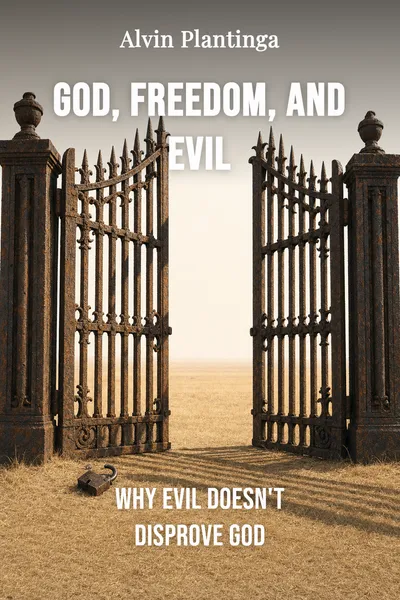
God, Freedom, and Evil
Why evil doesn't disprove God
Description
In 1974, a philosopher at Calvin College named Alvin Plantinga published a slim book with a plain title: God, Freedom, and Evil. It was not a work of consolation, and it did not read like a sermon. It read like mathematics. Plantinga took the oldest and most stubborn argument against the existence of God — the one about suffering — and treated it the way a logician treats any claim: as a set of propositions that either fit together or don't. The book runs barely two hundred pages. Much of it is spent on a single question that had haunted philosophers for centuries, and that most of them had assumed was already settled against the believer.
The question is the one everyone has asked at some point, usually in a hospital corridor rather than a seminar room. If God is all-powerful, he could stop evil. If God is all-good, he would want to. And yet the world is full of cruelty, disease, and grief. So either God can't, or he won't, or he isn't there. For a long stretch of the twentieth century, this was treated by serious thinkers not as a hard problem but as a knockout — a clean logical contradiction at the heart of religious belief. The believer, on this view, wasn't just mistaken. They were being irrational, holding two ideas that could not both be true.
Plantinga did not set out to prove that God exists — he is careful about that, and it matters. He set out to do something narrower and, in its way, more surgical: to show that the knockout doesn't land. And in doing so he built an argument, the free will defense, that changed how the whole dispute is conducted. What follows tracks how a careful man dismantled an argument almost everyone thought was airtight.
The question we’re asking : Does the existence of evil actually prove that an all-good, all-powerful God cannot exist?What we’ll see : How Plantinga takes the atheist's cleanest weapon apart, piece by piece, and what he leaves standing in its place.
Table of contents
01 Chapter 1 — The oldest objection, stated as an equation
The version of the problem Plantinga confronts is the strong one, and it's worth being precise about why it's strong. The claim isn't that evil makes God unlikely, or that suffering makes belief emotionally difficult. That would be a matter of weighing evidence, and evidence can always be argued. The claim is far more aggressive: that the propositions "God is omnipotent, omniscient, and wholly good" and "evil exists" are logically inconsistent — that they contradict each other the way "this circle is square" contradicts itself. If that's true, no amount of faith or feeling can rescue the believer. They're simply holding a contradiction.
This is what philosophers call the logical problem of evil, and its most forceful modern statement came from the Australian philosopher J. L. Mackie, writing in the mid-1950s. Mackie argued that the theist is committed to beliefs that are positively irrational, not merely lacking in support. The two statements, he said, cannot both be true, and the believer affirms both. Case closed. It's a bold move, because inconsistency is a strong charge — much stronger than "improbable."

02 Chapter 2 — Where the contradiction hides
Look hard at the hidden premise. To make the contradiction work, the atheist needs something like: a wholly good being eliminates every evil it possibly can. It sounds obviously true. But Plantinga asks us to test it, and it turns out to be false, or at least not necessarily true — which is all he needs. A good being might allow an evil if allowing it is the only way to secure a greater good, or to prevent a worse evil. We know this from ordinary life. A good parent permits a child the pain of a vaccination. A good dentist causes suffering to prevent more of it. So "good beings eliminate all the evil they can" quietly collapses.
The premise has to be repaired: a good being eliminates every evil it can, unless doing so would eliminate a greater good or produce a greater evil. Fine. Now pair it with omnipotence. Can't an all-powerful God secure any good without the accompanying evil? Here Plantinga introduces the move the whole book turns on. Even omnipotence, properly understood, does not mean the power to do the logically impossible. God cannot make a round square, or a married bachelor, and this is no limitation — those phrases don't describe anything. The question becomes whether there are goods that even an omnipotent being cannot bring about without permitting certain evils.
03 Chapter 3 — The trick is possible worlds
To make this airtight, Plantinga reaches for the tool that analytic philosophy had been sharpening throughout the 1960s: possible worlds. A possible world is just a complete, consistent way things could have been — the actual world is one of them, and there are countless others, differing in every detail down to whether you took sugar this morning. Talk of possible worlds lets a philosopher say precisely what "could" and "must" mean. Something is necessary if it holds in every possible world, possible if it holds in at least one.
The atheist's claim, translated, is that there is no possible world in which God and evil coexist — that the combination is like a round square, ruled out everywhere. Plantinga's task is correspondingly modest: he needs to describe just one possible world in which God exists, creates free creatures, and evil results, without any inconsistency. He does not need that world to be actual, or even likely. He needs it to be coherent. One consistent story is enough to show that the two ideas are not contradictory.
04 Chapter 4 — Beyond the atheist's objection
Step back from the machinery and the striking thing about Plantinga's achievement is how little it claims to deliver. The free will defense proves nothing about whether God exists. It doesn't show that suffering serves a purpose, or that any particular evil was worth allowing. It doesn't comfort anyone. All it establishes is a boundary: that a certain argument, the one alleging flat contradiction, does not work. The believer is not being irrational in the strict logical sense. That's the entire prize, and Plantinga is scrupulously honest that it's a small one, precisely defined.
This restraint is itself the deeper lesson of the book, and it reshaped the field around it. Before Plantinga, the logical problem of evil was treated as the strongest card in the atheist's hand. After him, most philosophers — believers and non-believers alike — quietly dropped it. The debate migrated to what's called the evidential problem of evil: not that evil makes God impossible, but that the sheer quantity and distribution of suffering makes God improbable. That's a live argument still. But it lives on different ground, and the shift happened because Plantinga showed the old ground was unstable.
05 Conclusion
The book that reads like mathematics ends without a flourish, because a flourish would overclaim. Plantinga set out to answer one question — does evil prove that God cannot exist? — and his answer is a careful no. The free will defense describes a coherent world in which an all-good, all-powerful God permits evil for the sake of creaturely freedom, and one coherent world is all it takes to dissolve a charge of contradiction. The knockout the atheist promised turns out not to land.
Related books