Genius
Mad genes, brilliant minds
Description
Hans Jürgen Eysenck spent most of his career measuring things other psychologists preferred to leave vague — intelligence, personality, the tangle where biology meets behavior. Late in that career, in a 1995 book he simply called Genius, he turned to the largest vague thing of all. Why do a handful of people, once or twice a century, produce work that reorganizes a whole field? Newton, Michelangelo, Beethoven, Darwin. We reach for the word genius the way we reach for weather: as if it explained anything.
Eysenck's wager was that it could be explained, or at least chased down to something firmer than awe. He noticed a pattern that had unsettled observers for a long time — that outsized creativity keeps company with strangeness. Not madness exactly, but a tilt toward it: the melancholy, the obsessive drive, the odd unclubbable temperament that shows up again and again in the biographies. Most accounts treated this as gossip, a colorful footnote to the achievement. Eysenck treated it as a clue.
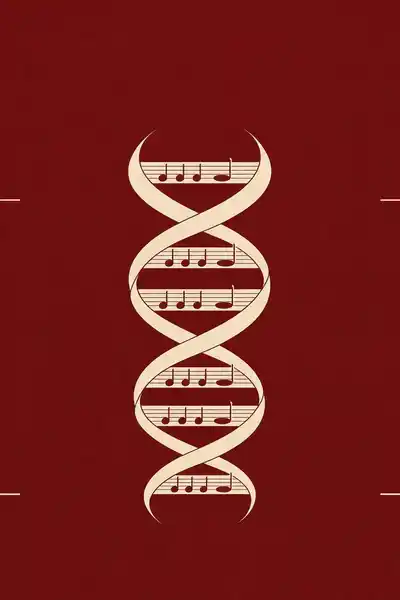
So he set out to build a chain. Not a list of great men and their quirks, but a causal line running from something as deep as DNA, up through the shape of a personality, into the specific way a mind handles ideas — and only at the far end, the finished thing we call genius. It is an audacious move, stitching biology to Beethoven, and it invites all the obvious objections. Which is exactly why it is worth following where he takes it.
The question we’re asking : Can we trace genius back down a chain — from genes, through a personality tilted toward the strange, to a particular way of thinking — rather than leaving it to awe?What we’ll see : How Eysenck links the psychopathology of creative minds to the machinery of thought, and turns a mystery into a testable theory.
Table of contents
01 Chapter 1 — The word we hand out too easily
Eysenck starts by clearing the ground, because the term is a mess. In ordinary talk, genius means anyone unusually clever — the friend who fixes the boiler and does the crossword. In the history of ideas it means something rarer and harder: a person whose output doesn't just add to a field but bends it, so that everything after looks different. Eysenck wants the second meaning, and he wants to keep it separate from the first, because they don't share a cause. High intelligence is common enough; genius, in the strong sense, is close to unique.
This matters because for a long time the assumption ran the other way. Francis Galton, Darwin's cousin, kicked off the modern study of the subject in 1869 with a book arguing that eminence ran in families and came down largely to inherited ability. Later, the American psychologist Lewis Terman spent decades tracking more than a thousand high-IQ children — the group affectionately nicknamed the Termites — expecting to watch geniuses hatch. They grew into successful, well-adjusted adults. Not one became a Newton. The lesson Eysenck draws is blunt: a very high IQ is a ticket to the game, but it does not win it.

02 Chapter 2 — From DNA to a certain kind of mind
The first link in the chain is inheritance, and Eysenck, a lifelong student of the genetics of personality, is comfortable there. Twin and family studies had by then established that traits like intelligence and temperament are substantially heritable — not fixed by genes, but strongly shaped by them. What he adds is a candidate trait, one he had spent years developing on his own personality scales: psychoticism. The name is unfortunate and he knew it. It does not mean psychosis. It marks a dimension along which everyone sits, describing a cluster of tendencies — a taste for the unconventional, a certain coldness or detachment, aggression, impulsivity, a tolerance for the odd that most people quietly avoid.
People high on this dimension are not ill. But they sit closer, on a shared continuum, to those who are — and closer, too, to the relatives of the seriously disturbed, who often show unusual creativity without the breakdown. Eysenck's claim is that this dimension, largely inherited, is the missing ingredient Terman's well-adjusted prodigies lacked. They had the intelligence. What they didn't have was the temperament that lets a mind wander somewhere disreputable and stay there.
03 Chapter 3 — Overinclusive thinking, and the price of it
The cognitive link Eysenck seizes on is an old clinical observation: overinclusive thinking. It had first been described in patients with schizophrenia, whose thought seemed unable to keep the fence around a concept — irrelevant associations flooding in, boundaries blurring, categories bleeding into one another. In the clinic this is a symptom, a failure. Eysenck's insight is that the very same loosening, in a person with the intelligence to steer it, is not a failure at all. It is the engine of original combination.
Creativity, on this account, is at bottom the pairing of ideas that don't ordinarily belong together — a remote analogy, an image dragged in from a distant field, a connection nobody else's mind would offer up because everyone else's mind keeps its categories tidy. The overinclusive thinker has access to a much wider net of associations. Most of what that net catches is junk; a mind flooded with loose connections is, more often than not, just noisy. But occasionally it lands the improbable link that turns out to be the breakthrough, the one a well-fenced mind would never reach.
04 Chapter 4 — What a causal chain buys us
Step back from the individual links and what Eysenck has really attempted comes into view. He has taken the most romantic subject in the culture — the lone titan touched by something we can't name — and refused it the exemption we usually grant it. Genius, in his hands, is not a gift from the gods or an accident of grace. It is the visible top of a chain that can, in principle, be measured at every level: heritability at the bottom, a personality trait in the middle, a cognitive style above it, achievement at the top. Each link is something you can put a number on, or at least argue about with evidence.
That is the ambition, and it is worth naming plainly because it cuts against how we prefer to talk about greatness. We like our geniuses inexplicable; the mystery flatters both them and us. Eysenck's whole project is a refusal of that comfort. If the theory is right, the melancholy Beethoven and the impossible Newton are not exceptions to psychology but cases of it — extreme values on dimensions the rest of us occupy at gentler settings. The distance between us and them becomes a difference of degree, sitting on the same continuum, rather than a difference of kind.
05 Conclusion
The book ends more or less where the intuition began, but the intuition has been rebuilt. That old suspicion — that the greatest minds are a little touched — arrives at the last page no longer as gossip but as the top of a structure. Genes tilt a temperament; the temperament loosens the fences around thought; the loosened thought, in a mind clever and stubborn enough to sift it, throws up the connection that changes a field. The strangeness the biographies keep reporting turns out to be load-bearing.
Related books