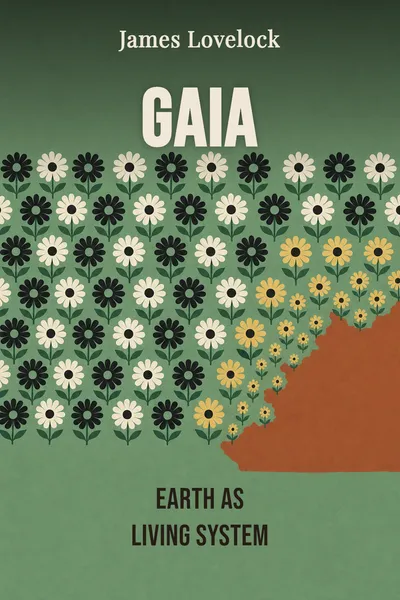
Gaia
Earth as living system
Description
In the mid-1960s, a British scientist named James Lovelock was working at NASA's Jet Propulsion Laboratory on a strange assignment: how do you tell whether there is life on Mars before you get there? The obvious answers involved landers scooping soil. Lovelock proposed something cheaper and stranger. Look at the planet's atmosphere, he said. A dead world settles into chemical equilibrium; a living one does not. Earth's air is a wild, unstable mixture — oxygen and methane coexisting, both reactive, both replenished — held far from equilibrium by something. Mars, by contrast, was chemically flat, at rest, almost certainly dead. He was right about Mars. But the reasoning left him with a bigger question about the planet he was standing on.
If Earth's atmosphere was being actively maintained in an improbable state, then who — or what — was doing the maintaining? Lovelock's answer, developed over the following decade and named at a neighbour's suggestion after the Greek goddess of the Earth, was that life itself does it. Not passively, as a passenger on a rock that happens to be habitable, but actively, as a participant that regulates the temperature, the chemistry of the air, the saltiness of the oceans. The living and the non-living, in this view, form one coupled system that keeps the conditions for life within tolerable bounds. The rock, the water, the air and the organisms are not separate things. They behave like one.
The idea landed somewhere between science and heresy, embraced by ecologists and mystics, dismissed by hard-nosed biologists who heard in it a suggestion that the planet had purpose. Lovelock spent much of his long life defending it, refining it, and — near the end — worrying about it. Because if Earth is a self-regulating system, the interesting question becomes whether the regulation still works.
The question we’re asking : If the Earth behaves like a single living system, what keeps it in balance — and is that balance still holding?What we’ll see : How a Mars mission led Lovelock to see the planet as one organism, how the self-regulation works, and what his own diagnosis of its health became.
Table of contents
01 Chapter 1 — A signal from Mars, then a question about home
Lovelock was not a conventional academic. He worked largely as an independent scientist, funding himself with inventions — most famously the electron capture detector, a device sensitive enough to trace pollutants across the whole atmosphere and later central to detecting the chemicals thinning the ozone layer. That instinct for reading a planet through its trace gases shaped everything that followed. When NASA hired him to think about detecting Martian life, he came at it not as a biologist hunting for microbes but as a chemist reading the whole atmosphere as a fingerprint.
The logic was simple and hard to argue with. Left alone, the gases in a planet's atmosphere react with one another and with the surface until they reach a dull chemical equilibrium — the state of a system that has stopped doing anything. Mars showed exactly that: an atmosphere dominated by carbon dioxide, chemically settled, going nowhere. Earth's air is the opposite. Oxygen and methane should react and cancel each other out within years, yet both persist at steady levels. Something keeps topping them up. That something is the sum of living things, breathing, rotting, growing, on a scale large enough to hold the whole atmosphere off balance.

02 Chapter 2 — The planet that keeps its own house
The heart of the argument is feedback. A system regulates itself when a change in one direction sets off a process that pushes back the other way. Turn a room too warm and the thermostat cuts the heat; too cold and it fires the boiler. Lovelock's claim was that Earth is threaded with loops like this, most of them running through living things, and that together they hold the key conditions of the planet roughly stable across enormous stretches of time.
Take temperature. Over the roughly three and a half billion years that life has existed, the Sun has grown some twenty-five to thirty percent brighter. On a lifeless planet that should have cooked the surface long ago. Yet Earth's temperature has stayed within the narrow band that liquid water and living cells can tolerate. Lovelock argued this was no accident of geology alone. Living processes have steadily drawn down carbon dioxide, the main heat-trapping gas, as the Sun warmed — cooling the planet by exactly the amount needed to compensate. The result looks less like luck and more like a controlled setting held in place.
03 Chapter 3 — Daisies on a made-up world
The obvious objection was philosophical, and it stung. Regulation implies a goal, and a goal implies a purpose — and purpose is exactly what biologists spend their careers refusing to smuggle back into nature. Critics like Richard Dawkins pointed out that natural selection acts on individual organisms competing to reproduce, not on planets. A daisy cannot evolve to cool the Earth for the good of the whole, because there is no competition between planets to weed out the ones that fail. How could a global thermostat arise from creatures that only ever look after themselves?
Lovelock's answer was a model, built with the biologist Andrew Watson, that he called Daisyworld. Imagine an imaginary planet orbiting a slowly warming star, seeded only with daisies — some dark, some light. Dark daisies absorb heat and warm their surroundings; light daisies reflect it and stay cool. Each simply grows wherever the local temperature suits it best. No daisy is trying to manage anything. Yet when the star is faint and the world is cold, dark daisies thrive and warm the surface; as the star brightens, light daisies spread and cool it. Between them, purely through self-interested growth, they hold the planet's temperature nearly steady for a very long time.
04 Chapter 4 — Reading the patient's chart
Once you see Earth as a self-regulating system, the questions you ask about it change. A rock cannot be sick. A system that holds itself in balance can be pushed past the point where the balance holds — and that is where Lovelock's late work went, growing steadily darker. If Gaia is a body that keeps its own temperature, then pumping carbon into the atmosphere faster than the loops can absorb it is not merely pollution. It is a fever, and the interesting medical question is whether the patient's own regulation will bring the temperature back down, or tip into a new and hotter steady state that suits us far less.
This is where the framework earns its keep. Standard environmentalism often treats nature as fragile — a delicate thing we might break if we are careless. Lovelock's physiology suggested something less comforting. A regulating system is robust precisely because it resists being pushed; it absorbs disturbance and returns to its set point. But push hard enough and it does not shatter — it jumps to a different set point, a different stable state, and then defends that one just as stubbornly. The danger is not that the Earth becomes lifeless. It is that it settles into a condition perfectly stable and comfortable for microbes and scrub, and hostile to the civilisation that evolved in the old regime.
05 Conclusion
The idea that began as a trick for spotting dead planets from a distance ended as a way of looking at our own. Lovelock started by asking why Mars was chemically at rest and Earth was not, and the answer led him to a planet that behaves like a living thing: breathing through its forests and oceans, holding its temperature and its chemistry steady across billions of years through loops of feedback that run through every rock, cell and current. He spent the rest of his life arguing that these systems were real, that they were coupled, and that they could be pushed too far.
Related books