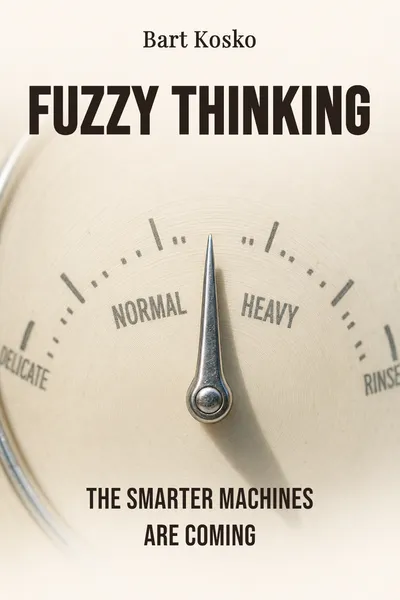
Fuzzy Thinking
The smarter machines are coming
Description
In the late 1980s, a Japanese engineer named Yasuji Sasaki was working on a problem that sounds trivial and turned out not to be: how to make a washing machine wash better. Not faster, not cheaper — better. A load of laundry is a mess of variables. How dirty is the water. How big is the load. How greasy the stains. A conventional machine ignores all of it and runs the same cycle every time. Sasaki's machine, built for Matsushita, did something else. It sensed the dirt, judged how dirty was "pretty dirty," and adjusted. It reasoned in shades. And it sold.
Behind that machine was an idea most engineers had spent decades ignoring, and many had actively mocked. Its name was fuzzy logic, and its loudest champion was an American professor of electrical engineering named Bart Kosko. In his 1993 book Fuzzy Thinking, Kosko made a large claim: that the machines around us were about to get smarter, and that they would get smarter precisely by abandoning the crisp, black-and-white logic computers had run on since their invention. The rice cookers, the camcorders, the subway brakes in Sendai — all of them would start reasoning in gray.
The book landed as both a technical primer and a provocation. Kosko wasn't only explaining a control method for appliances. He was arguing that our whole habit of splitting the world into true and false, A and not-A, was a convenient fiction we had mistaken for reality — and that a better mathematics of the in-between was already quietly running inside consumer electronics, mostly in Japan, while the West looked away.
The question we’re asking : What is fuzzy logic, and why did Kosko think it would make the machines around us smarter?What we’ll see : A book that starts with a washing machine and ends by questioning one of the oldest rules in Western thought.
Table of contents
01 Chapter 1 — The washing machine that thinks in shades
Kosko opens where the reader lives: with objects. By the early 1990s Japan had shipped millions of appliances quietly running on fuzzy control. A Panasonic camcorder that steadied a shaking hand. A Mitsubishi air conditioner that stopped lurching between too hot and too cold. The Sendai subway, whose fuzzy braking system stopped the trains so smoothly that standing passengers reportedly didn't need to hold the rails. None of these were labeled as artificial intelligence. They were just, in the marketing of the day, "smart."
What made them smart, Kosko argues, was a refusal to pretend. A thermostat running on ordinary logic treats a room as either too cold or not too cold — it flips at a threshold and overcorrects. But a room is never simply one or the other. It's a little cold, fairly warm, almost right. Fuzzy control lets a machine hold all of those partial truths at once and act in proportion: nudge the temperature gently when the room is slightly off, push harder when it's badly off. The result feels less mechanical because it is less mechanical.

02 Chapter 2 — Between zero and one, everything
The mathematics under the appliances is older than the appliances. In 1965, an electrical engineer at Berkeley named Lotfi Zadeh published a paper on what he called fuzzy sets. Classical set theory asks a yes-or-no question: is this thing a member of the set, or not? Zadeh proposed sets with degrees of membership. A fifty-year-old is, say, 0.6 a member of the set "old" — not fully in, not fully out. Truth, on this view, comes in shades between zero and one, and most interesting statements about the world live somewhere in the middle.
Kosko presses this into a claim about reality itself. Consider a glass of water with a bacterium in it. Is the water clean? Half a bacterium? A thousand? Somewhere along that line "clean" stops being true, but there is no crisp point where it flips. The same holds for tall, bald, rich, dangerous — nearly every word we use to carve up experience. The sharp categories of ordinary logic are, he argues, an idealization we impose. The mist is the territory; the crisp line is the map we drew for convenience.
03 Chapter 3 — How to build a machine that reasons like us
The bridge from philosophy to product runs through a technique with an ungainly name: the fuzzy approximation of a system. A fuzzy machine doesn't need equations describing how a helicopter flies or how cement cures. It needs rules of thumb, the kind an expert operator carries in their head. "If the load is heavy and very dirty, run a long cycle." "If the train is close to the platform and moving fast, brake hard." A handful of such rules, each covering a fuzzy patch of possibilities, can be stitched together to control something genuinely complicated.
The mechanism has three moves. First, fuzzification: the machine reads a sensor — water is 40 percent murky — and translates that number into fuzzy words. Then it fires its rules, all of them at once, each contributing its bit of advice weighted by how well the situation matches it. Finally, defuzzification: it blends the competing recommendations back into a single crisp action, a specific cycle length or brake pressure. Kosko shows that with enough rules a fuzzy system can approximate any smooth behavior at all — a result he treats as the engineering heart of the book.
04 Chapter 4 — When the West bet on black and white
Having sold the machines, Kosko turns to the argument he most wants to win, and it is a quarrel with two and a half millennia of Western thinking. The habit of splitting everything into A and not-A has a name and a father: Aristotle, and his law of the excluded middle. A thing either is or is not; there is no third option. That law became load-bearing for logic, mathematics, science, and eventually the digital computer, which is nothing but a vast machine of ones and zeros, true and false, all the way down.
Kosko's provocation is that this inheritance, for all it built, quietly filtered out most of reality. The world it describes well is the world of counting and of ideal geometry — the places where things really are discrete. But rooms, faces, risks, opinions and emotions don't come in ones and zeros, and forcing them into that mold means throwing away information at the very first step. He sees a cultural fork here: where Western engineering clung to the crisp and treated the fuzzy as sloppy, Japanese firms, less bound to the Aristotelian reflex, were willing to build in the gray — and shipped the smarter products because of it.
05 Conclusion
The washing machine that opened the book turns out to have been the small, deliberate face of a large claim. Sasaki's appliance washed better not because it computed harder but because it was permitted to hesitate — to judge a load "fairly dirty" and act accordingly. Multiply that permission across cameras, cars, brakes and grids, and you get Kosko's promised flood of smarter machines: devices that stopped rounding the world to true or false and started reasoning in the shades where the world actually lives.
Related books