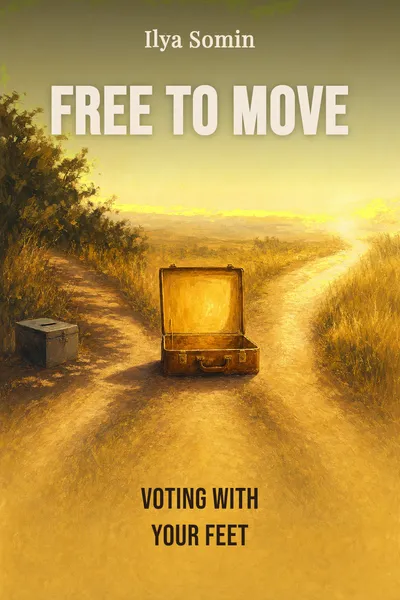
Free to Move
Voting with your feet
Description
There's a decision most of us have made without ever calling it political. We took the job in another state. We picked the school district over the border. We left the country, or thought hard about it. In each case we weighed what a place offered against what it cost us, and then we acted — quietly, individually, without a campaign or a poll. Ilya Somin, a law professor at George Mason University, spends his book "Free to Move" arguing that this ordinary act is one of the most powerful forms of freedom a person has, and that we've badly underrated it.
His term for it is "foot voting" — choosing where to live, whether between towns, states, or nations, as a way of choosing how to be governed. And his provocation is sharp: for most people, most of the time, moving gives you more real control over your life than the ballot ever will. The vote you cast in an election is one among millions, statistically almost meaningless on its own. The vote you cast with your feet is decisive. It's yours, it counts, and it changes your actual conditions.
From there Somin builds a case that runs from constitutional law through political theory and into the hardest immigration debates we have. He's not writing a travel memoir or a libertarian pamphlet. He's asking us to reconsider what political liberty even is — and what happens to that liberty when we treat borders, zoning maps, and federal lines as walls rather than doors.
The question we’re asking : If moving gives us more genuine say over our lives than voting does, why do we keep treating the ballot as the whole of political freedom?What we’ll see : How a law professor turns the everyday act of moving into a theory of liberty — and follows it straight into the migration debate.
Table of contents
01 Chapter 1 — The vote nobody counts
Start with a number Somin returns to often: the odds that any single ballot decides a major election are effectively zero. In a national contest, your individual vote has roughly one chance in tens of millions of being the one that tips the result. This isn't cynicism, it's arithmetic, and it has an uncomfortable consequence. If we measure political freedom by the power of the ballot, then for the individual, that freedom is close to symbolic. We participate, we're counted, but our own choice almost never moves anything.
Somin calls this the problem of rational ignorance, borrowing a line of thinking that runs back to the economist Anthony Downs. Because one vote almost never matters, most of us have little incentive to spend real effort learning about the issues. We stay uninformed not because we're lazy but because informing ourselves is, coldly speaking, a poor investment. The result is a democracy where the individual voter has neither much influence nor much reason to become knowledgeable enough to use it well.

02 Chapter 2 — Why the exit beats the ballot
Somin's case doesn't rest on economics alone. He weaves in political theory, and one distinction does a lot of work: the difference between voice and exit, a framing associated with the economist Albert Hirschman. Voice is complaining, organizing, voting — trying to change the institution you're inside. Exit is leaving. Democracies are built to honor voice. Somin wants us to see exit as an equal, sometimes superior, expression of consent.
Federalism is the domestic engine here. A country divided into states and localities, each with its own rules, is a country in which foot voting has somewhere to go. If a state taxes too heavily or governs badly, residents can relocate to one that suits them better, and the threat of that departure disciplines governments in a way a distant election rarely does. Somin points to the long twentieth-century movement of Black Americans out of the Jim Crow South — the Great Migration — as one of the most consequential examples of people escaping oppression not by winning a vote but by leaving the jurisdiction that denied them one.
03 Chapter 3 — The objections, taken seriously
The moment foot voting reaches national borders, the argument runs into the most heated debate we have, and Somin doesn't dodge it. If the freedom to move is a fundamental political freedom, the logic pushes hard toward opening borders far wider than any wealthy country currently does. He knows how radical that sounds, so he spends much of the book meeting the standard objections on their own terms rather than waving them away.
Take the worry that immigrants will overwhelm public services or drag down wages. Somin argues the economic evidence is far kinder to migration than intuition suggests: newcomers tend to add more to output than they consume, and the wage effects on native workers are modest and often offset by gains elsewhere. He also notes the sheer scale of what restriction costs — economists have estimated that dramatically freer movement could roughly double global output, because a worker's productivity depends enormously on where they are allowed to work.
04 Chapter 4 — When staying put is the real cage
Step back from the policy fights and Somin is really asking us to rethink what we've been measuring. For most of the modern era, political freedom has been equated with the vote — the right to help choose your rulers. It's a genuine good, but it's a collective one, diluted across millions, and it says surprisingly little about whether any given person has real command over the life they're living. Somin's foot-voting framework proposes a different yardstick: freedom as the ability to consent to your governance through a choice that is actually yours to make.
By that measure, some of the arrangements we consider free start to look thinner, and some of the ones we ignore start to look essential. A citizen with a ballot but no realistic ability to leave a failing jurisdiction — trapped by cost, by law, by a closed border — has the form of self-government without its substance. The freedom to walk away is what gives the freedom to stay its meaning. Where exit is blocked, consent becomes fictional, whatever the constitution says.
05 Conclusion
We began with the ordinary decisions — the new town, the better district, the country left behind — that we rarely file under politics. Somin's achievement in "Free to Move" is to show that these choices are political in the most direct sense available to us: they are the moments when an individual, rather than a diluted electorate, actually decides how they will be governed. The ballot spreads power thin across millions; the move concentrates it in one person's hands.
Related books