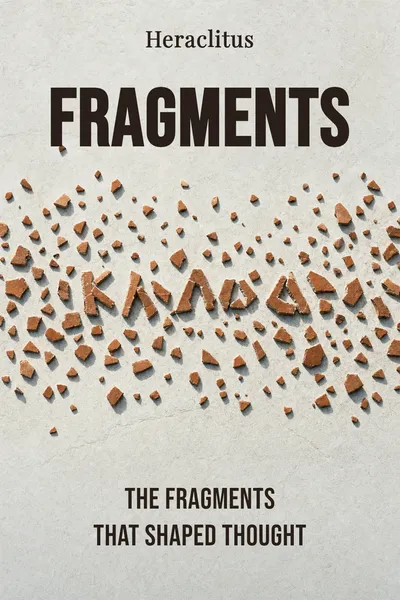
Fragments
The fragments that shaped thought
Description
Sometime around 500 BC, in the Greek city of Ephesus on the coast of what is now Turkey, a man named Heraclitus wrote a book. We call it On Nature, though we don't really know what he called it, and we don't have it. What we have are roughly 130 scraps — a sentence here, half a thought there — quoted by later writers who admired him, argued with him, or just wanted to show they'd read him. He was famous in antiquity for being hard. Even Socrates, according to one story, said that what he understood of Heraclitus was excellent, and he assumed the rest was too, but that it would take a deep-sea diver to reach the bottom.
The nickname that stuck was "the Obscure." Some ancient readers thought he wrote in riddles on purpose, to keep the careless out. Others thought he simply saw further than language could comfortably follow. He wrote in short, dense, oracular lines that sound less like arguments than like things overheard — a river you can't step into twice, a fire that measures itself out, a hidden order that most people walk past every day without noticing. Brooks Haxton, the poet whose free-verse translation gathers all the surviving fragments, treats them as exactly that: not a shattered treatise to be reassembled, but a voice caught mid-sentence, again and again.
Twenty-five hundred years later, the fragments are still being quoted. Montaigne kept coming back to him, Nietzsche adored him, Heidegger built lectures around single lines, Jung borrowed a word from him for one of his central ideas. A book that no longer exists has outlasted almost every book that does. That's the strange fact worth sitting with here — and the reason a thinker known only in pieces became one of the foundations of Western thought.
The question we’re asking : How did a philosopher who survives only in fragments become one of the most quoted thinkers in the Western tradition?What we’ll see : A lost book, the handful of lines that outlived it, and what a mind looks like when we can only see it in ruins.
Table of contents
01 Chapter 1 — A book that survived by breaking apart
We know a few things about Heraclitus, and most of them are half-legend. He came from Ephesus, one of the great Ionian cities, and he seems to have belonged to an old aristocratic family — the kind that held hereditary priesthoods. The stories say he gave up his position to a brother, that he despised the crowd, that he preferred playing dice with children to meddling in the politics of the city. He is supposed to have deposited his book in the great temple of Artemis, one of the wonders of the ancient world, as if entrusting it to something more lasting than readers.
Whether any of that is true hardly matters now, because the book itself is gone. It was probably still circulating in some form for centuries — Aristotle read it, the Stoics leaned on it, and later commentators quote from it as though they had it open in front of them. Then, somewhere in the long attrition of late antiquity and the medieval centuries, the complete text disappeared. What copyists didn't recopy, time erased. No single manuscript of On Nature has ever surfaced.

02 Chapter 2 — The river that is never the same
If one idea has escaped the fragments and entered ordinary speech, it's the river. "You cannot step twice into the same river," the saying goes, "for other waters are ever flowing on." It has been quoted, paraphrased, and misremembered for millennia, usually to mean something soft and consoling about change. The real thought is stranger and more precise. The river keeps its name and its shape while every drop of it moves on. It stays itself by not staying the same. Identity, for Heraclitus, isn't the absence of change — it's a pattern that persists through constant change.
This is his real subject, and it runs under nearly everything he wrote. The world is not a collection of stable things that occasionally move. It is process all the way down. What looks solid is a rate of flow slow enough to fool us. A living body holds together by ceaselessly replacing itself; a flame holds a steady shape while the fuel passing through it is never the same fuel. The brief said that Heraclitus, some twenty-five centuries before Einstein, sensed that matter is really energy in flux — and while we shouldn't dress a sixth-century poet in modern physics, the intuition is genuinely there: permanence is something the world does, not something it is.
03 Chapter 3 — War, fire, and the logic that hides
Heraclitus said things about conflict that still make readers flinch. "War is the father of all and king of all." Strife, he insisted, is not a breakdown of the world's order but its engine — it decides who is a god and who a man, who is free and who a slave. He rebuked Homer for wishing that conflict would vanish from among gods and men, because to wish that, in his view, was to wish the world out of existence. Without the pull of opposites, nothing would be distinct from anything else, and there would be nothing at all.
The element he chose to stand for all this was fire. Not because the world is literally made of flame, but because fire is the one thing whose whole being is transformation — it exists only by consuming and converting, never at rest, always exchanging itself for something else. "All things are an exchange for fire, and fire for all things, as goods for gold and gold for goods." The cosmos, he says, was made by no god and no man; it always was and is and will be an ever-living fire, kindling in measures and going out in measures. Even the ceaseless change has a rhythm. It is not chaos. It keeps accounts.
04 Chapter 4 — Reading a mind through its ruins
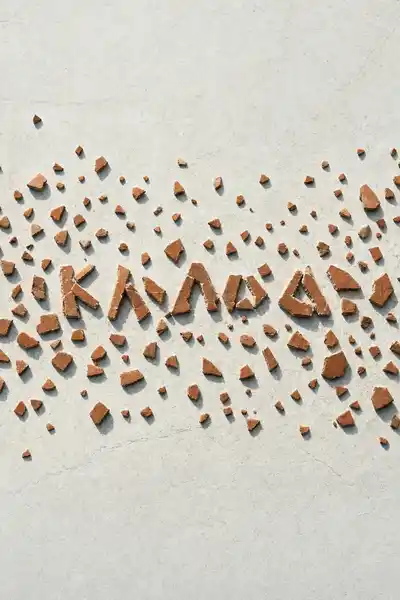
There's an irony worth holding here. A thinker who taught that everything flows, that nothing holds its form, that permanence is an illusion the senses fall for — this is the thinker whose own book dissolved most completely. On Nature flowed away exactly as he said all things do. And yet the fragments proved oddly durable, precisely because they were never continuous prose in the first place. You cannot lose the thread of an argument that was never a thread. Each line is a whole. Break the book and you don't get rubble; you get gems.
This has shaped how he's been read ever since, which is to say: as an oracle rather than a system. Later philosophers who survive intact — Aristotle above all — get argued with point by point. Heraclitus gets absorbed, borrowed, brooded over. Because the lines arrive without their surrounding scaffolding, each reader has to supply the connective tissue, and so each reader partly rebuilds him in his own image. The Stoics made him the prophet of cosmic reason. Nietzsche saw a fellow spirit who loved becoming and refused to be consoled. Heidegger heard in the logos a way of naming being itself. Jung took a term of his to describe the collision of opposites in the psyche. Each found what he brought.
05 Conclusion
So we're left with 130 lines, a Greek text facing an English one, and a book-shaped hole where On Nature used to be. The temple of Artemis is gone, the complete treatise is gone, and the aristocrat who reportedly played dice with children instead of governing his city is known to us mostly through enemies and admirers who quoted him for their own ends. What comes down to us is a voice, not a doctrine — flashes of a mind that thought the world was flame keeping careful accounts, and that most of us are asleep inside it.
Related books