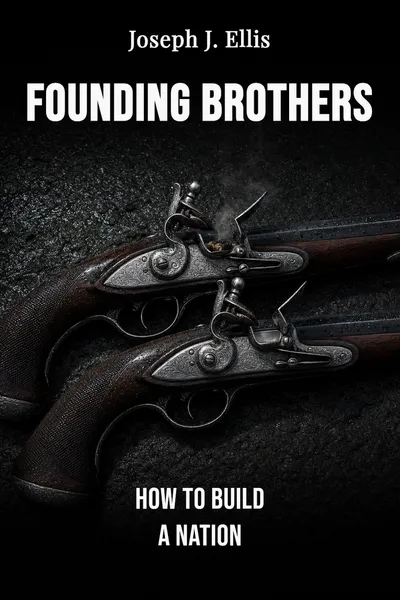
Founding Brothers
How to build a nation
Description
On the morning of July 11, 1804, two men rowed across the Hudson to a ledge below the New Jersey palisades, at Weehawken, to shoot at each other. One was the sitting vice president of the United States, Aaron Burr. The other was Alexander Hamilton, the first Treasury secretary, the man who had built the country's financial system almost single-handedly. Within a day Hamilton was dead, and Burr, though never convicted of anything, was politically finished. Two of the most gifted figures of the founding generation had settled a long feud with pistols on a riverbank ledge.
That scene is where Joseph J. Ellis chooses to begin, and it sets the tone for everything that follows. In Founding Brothers, Ellis takes the men we tend to file under marble busts — Washington, Franklin, Jefferson, Adams, Hamilton, Madison, Burr — and puts them back in the room together, arguing, scheming, writing furious letters, refusing to speak for years. They were brilliant and they were flawed, and crucially they knew each other. They had no template. Nobody had ever turned a revolutionary declaration into a functioning government before.
The United States of 1790 was less a country than a wager. The Constitution had been ratified, but whether the thing would actually hold — whether thirteen quarrelsome states would cohere, whether a republic could survive without a king — was genuinely unknown. Ellis argues that the answer was worked out in a single crowded decade, not by grand design but through a handful of intimate, often ugly encounters between men who distrusted one another and were making it up as they went.
The question we’re asking : How did a small group of rivals, without any precedent to follow, turn a fragile revolutionary idea into a working nation?What we’ll see : Six charged episodes from the 1790s — a duel, a private dinner, a suppressed petition, a broken and then rebuilt friendship — read not as founding myth but as the messy human work of improvisation.
Table of contents
01 Chapter 1 — The duel that ended a friendship
Ellis opens with the interview, as the men themselves called it, at Weehawken because it compresses everything he wants us to feel about the era. Hamilton and Burr were not strangers. They had known each other for decades, practiced law in the same New York courtrooms, moved in the same circles. Their quarrel was not abstract. It was personal, accumulated, and finally lethal — the kind of grudge that only builds up between people who have watched each other closely for years.
What tipped it into gunfire was a reported remark. Hamilton had, at a dinner, expressed a "despicable opinion" of Burr, and the word got back. In a culture where a gentleman's honor was a form of political capital, the insult could not simply be shrugged off. Burr demanded a retraction; Hamilton, lawyerly to the end, refused to disavow words he could not precisely recall. The correspondence between them, which Ellis reads closely, is a small masterpiece of two men talking past each other while both understand exactly where it is heading.

02 Chapter 2 — The dinner where the capital was traded
The most consequential meal in American history, Ellis argues, took place in June 1790, at a table Thomas Jefferson set. The republic was stuck on two problems at once. Hamilton wanted the federal government to assume the states' Revolutionary War debts — a plan that would bind creditors to the national government and establish its credit, but that southern states, having largely paid their own debts, bitterly opposed. And Congress could not agree on where to permanently locate the capital.
Jefferson, newly returned from France, found Hamilton distraught outside Washington's residence, convinced his whole financial edifice was about to collapse. Jefferson invited him and James Madison to dinner. Over that meal, a bargain was struck: Madison would ease the path for debt assumption, and in exchange the permanent capital would be located on the Potomac, in the South, near Washington's own Mount Vernon. Two intractable deadlocks resolved by three men in a private room.
03 Chapter 3 — The petition Congress refused to hear
In February 1790, an old and dying Benjamin Franklin lent his name to a petition asking the new Congress to take up the abolition of slavery. It was, Ellis notes, a deliberate provocation from the most famous American alive — a final public act from a man who had himself once owned slaves and had come, late, to the antislavery cause. Franklin knew the request would detonate, and it did.
The petition forced onto the House floor the one subject the founders had agreed, tacitly, never to press. The response from the Lower South was ferocious. Representatives from Georgia and South Carolina defended slavery openly, warned of disunion, and insisted the Constitution had placed the matter permanently beyond federal reach. James Madison, no defender of slavery in principle, worked quietly and effectively to bury the debate — to channel it into a committee report that declared Congress had no authority to interfere before 1808 and little thereafter.
04 Chapter 4 — The letters that reopened the wound
John Adams and Thomas Jefferson had been intimate friends during the Revolution, allies in Paris, brothers in the cause. Then politics drove them apart. The election of 1800, in which Jefferson defeated the sitting president Adams in a campaign of genuine viciousness, ended the friendship completely. Adams left Washington before the inauguration, and for over a decade the two men did not correspond at all.
In 1812, prodded by their mutual friend Benjamin Rush, they resumed writing. The correspondence that followed — running to well over a hundred letters until both men died — became, in Ellis's account, the closest thing the founding generation left to a considered reflection on what it had done. They argued about the meaning of the Revolution, about aristocracy and democracy, about who had gotten the history right. Adams, combative and self-justifying; Jefferson, elegant and evasive. Neither fully conceded anything.
05 Conclusion
Ellis returns us, in the end, to where he began — to a generation of gifted, quarreling men who happened to be in the room at the same moment, and who somehow held a fragile experiment together long enough for it to take root. The duel, the dinner, the suppressed petition, the broken and rebuilt friendship: none of these was a grand founding act. Each was a human transaction, improvised under pressure by people who could not see how it would come out. That the republic emerged from such contingent, personal encounters is Ellis's central and slightly unsettling claim.
Related books