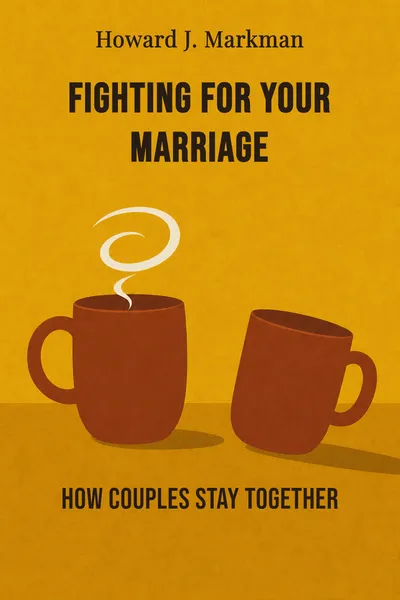
Fighting for Your Marriage
How couples stay together
Description
In the early 1980s, a psychologist at the University of Denver named Howard Markman started doing something researchers of love rarely did: he watched couples fight. Not once, but for years. He and his colleague Scott Stanley brought couples into a lab, filmed them hashing out their touchiest disagreements — money, in-laws, sex, chores — and then tracked those same couples across the following decade to see who stayed together and who came apart. The point was not to judge the arguments. It was to find out whether the way two people handle a Tuesday-night squabble could actually predict the fate of the whole relationship.
It could. What Markman's team found, and later built into a program called PREP — Prevention and Relationship Enhancement Program — was that happy and unhappy couples don't differ much in how often they disagree, or even in what they disagree about. Every couple has a short list of perpetual issues that never fully resolve. What separates the marriages that last from the ones that dissolve is what happens in the heat of the moment: whether a small complaint stays small, or slides into contempt, stonewalling, and the slow accumulation of damage that no amount of love seems able to undo.
That finding is oddly hopeful. It suggests the thing wrecking a relationship is usually not a fatal mismatch of personalities but a handful of habits — habits that can be named, and unlearned. Markman's book, first published in 1994 and revised across several editions, is essentially a field manual for that unlearning, grounded in one of the longest-running research programs on couples ever conducted.
The question we’re asking : If most couples fight about the same things, why do only some of them make it?What we’ll see : How a research program that studied couples fighting turned the survival of a marriage into a set of skills anyone can learn.
Table of contents
01 Chapter 1 — The four horsemen of a bad argument
When Markman's team scored those lab tapes, they weren't looking for shouting. Volume, it turned out, predicted almost nothing. What predicted a breakup were four specific moves that couples slid into without noticing, and that the research flags as the real danger signs — the patterns that erode a bond long before anyone files papers.
The first is escalation: a comment about the dishes becomes a comment about respect, which becomes a comment about the last ten years, each partner raising the stakes to match the other. The second is invalidation, the small put-downs that tell the other person their feeling doesn't count — the eye-roll, the "you're overreacting," the sarcasm dressed up as a joke. On their own these look minor. The research suggests they are anything but; they're the acid that dissolves goodwill.

02 Chapter 2 — Talking so the message actually lands
If the danger signs are about how conflict goes wrong, the heart of the PREP approach is a concrete tool for making it go right. Markman calls it the Speaker-Listener Technique, and on paper it looks almost too simple — which is exactly why couples underestimate it until they try it during an actual fight.
The idea is to slow a heated conversation down by giving it structure. One person holds the floor as the Speaker and talks only about their own experience, in small chunks, using "I" statements rather than accusations. The other person's single job as Listener is not to defend, not to fix, not to rebut — only to paraphrase back what they heard, until the Speaker agrees the message landed. Then, and only then, they swap. A physical object, even a TV remote, can serve as the floor, so there's no confusion about whose turn it is.
03 Chapter 3 — Fighting fair, on purpose
Beyond the moment-to-moment technique, Markman's program asks couples to set ground rules in advance — a kind of constitution for how they'll handle conflict, agreed on when things are calm rather than negotiated mid-explosion. The rules are deliberately unromantic, and that's their strength: they take the fate of an argument out of the hands of whoever is angriest.
One rule is the right to call a time-out. Either partner can stop a discussion that's overheating, no permission required — but the person calling it also commits to returning to the topic later. Without that second half, a time-out is just avoidance wearing a nicer coat. Another rule is to schedule hard conversations rather than ambushing each other at the door after work, when everyone is depleted and the pursue-withdraw loop is primed to fire.
04 Chapter 4 — What a marriage runs on when the excitement fades
Step back from the techniques and a larger claim comes into view, one that quietly reorganizes how we think about staying together. The PREP research suggests that the durability of a marriage rests far less on compatibility or the intensity of early feeling than on a set of behaviors couples choose to practice. Love, in this account, is less a state you're lucky enough to be in than a skill you keep exercising — and the couples who last are the ones who kept exercising it.
That's a genuinely different story from the cultural one. We tend to treat marriages as sorting problems: find the right person, and the rest follows; pick wrong, and no amount of effort will save you. Markman's decades of data cut against this. The couples who thrived weren't better matched at the start. They were better at protecting the good parts of the relationship from the damage done during conflict, and at doing the small, deliberate things — friendship, fun, shared meaning, physical affection — that a busy life erodes if no one tends to it.
05 Conclusion
Markman began by filming couples argue because he wanted to know whether the future of a relationship was already visible in its Tuesday-night squabbles. It was — but not as a sentence handed down. What the tapes showed was a set of patterns, and patterns are the kind of thing people can change once they can see them. A couple that recognizes escalation the moment it starts, that reaches for a paraphrase instead of a counterattack, is a couple rewriting its own forecast.
Related books