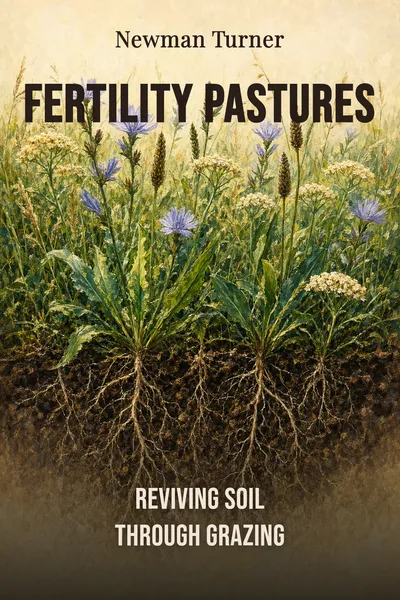
Fertility Pastures
Reviving soil through grazing
Description
On a farm in Somerset in the years after the Second World War, a dairy farmer named Newman Turner did something that made his neighbours uneasy: he stopped buying fertilizer. British agriculture at the time was moving hard in the opposite direction, toward bagged nitrogen, imported feed, and the confident chemistry of yield. Turner's fields at Goosegreen were tired, thin, and by his own account not much to look at. Rather than dose them, he decided to watch what the land wanted to grow, and to let his cattle do the work that a sprayer was supposed to do.
The result became a book, Fertility Pastures, published in 1955 — part manual, part argument, written by a man who had reasoned his way from conventional farming into what we'd now call regenerative agriculture, decades before the word existed. Turner's claim was blunt: healthy soil is not something you apply, it is something you grow, and the fastest tool for growing it walks around on four legs eating grass. The animal, not the chemist, was the fertility engine.
That idea sounds either obvious or naïve until you follow how Turner actually made it work — the mixtures he sowed, the way he timed the herd across the fields, the refusals that came with it. His farm was the evidence, and the book reads like a man showing us around it, pointing at the roots.
The question we’re asking : Can a farm build its own fertility from the ground up, using its animals instead of a supplier?What we’ll see : How Turner rebuilt depleted land with deep-rooted plants, well-timed grazing, and a herd left to do what herds do.
Table of contents
01 Chapter 1 — The farmer who stopped feeding the soil
Turner did not start out as a rebel. He farmed the way he'd been taught, reaching for the bag when a field looked hungry. What changed his mind was a slow accumulation of noticing: the fertilized fields grew fast, lush, and somehow fragile, prone to disease and to a kind of watery weakness in the grass. The soil underneath them, when he dug, was compacted and lifeless. He began to suspect that feeding the plant directly was starving the thing that was supposed to feed the plant — the living soil itself, with its worms, fungi, and bacteria.
So he inverted the problem. Instead of asking what nutrients the grass needed, he asked what would make the soil alive again, on the assumption that living soil would feed the grass on its own. This is the quiet pivot at the centre of the book. Fertility, for Turner, is not a quantity you top up but a condition you cultivate — a self-renewing loop between roots, microbes, animals, and the plants that grow back richer each season.

02 Chapter 2 — What a cow does that a bag of fertilizer can't
A bag of nitrogen delivers one thing, in one form, all at once. A grazing cow does something stranger and more useful. It walks across a field eating a mixed diet of grasses and herbs, and it returns most of what it eats to the ground as dung and urine — but transformed, broken down, inoculated with gut bacteria, dropped in scattered patches rather than sprayed in an even sheet. Turner saw the animal as a mobile composting and distribution system, and he built his farm around that reading.
The dung matters less as raw nutrient than as biological seed. It arrives full of microbial life and organic matter, exactly the material soil organisms need to multiply. Where a chemical dressing feeds the plant and bypasses the soil, manure feeds the soil and lets the soil feed the plant — the longer, slower, self-sustaining route Turner preferred. Urine adds a quick shot of available nitrogen; the trampled, uneaten grass adds a mulch of dead matter. Nothing is wasted, and nothing is imported.
03 Chapter 3 — Moving the herd, and letting grass rest
A cow left in a field will eat its favourite plants down to the ground, ignore the rest, and keep grazing the regrowth of the plants it likes until they die of exhaustion. This is overgrazing, and it degrades pasture as surely as neglect. Turner's answer was rotation: divide the land, concentrate the herd on a small area for a short time, then move it on and let the grazed ground rest and recover before the animals return. The technique is old, but Turner made a disciplined case for it.
The logic runs through the plant. Grass grazed hard once and then left alone will regrow vigorously, drawing on its roots and rebuilding stronger than before. Grass grazed continuously never gets the chance; it stays short, weakens, and lets bare soil open up between the plants. By timing the moves — days on, weeks off — Turner let each division reach the point of maximum recovery before the herd came back, so the field spent most of its life growing rather than being bitten.
04 Chapter 4 — The medicine grows in the field
Read closely, Fertility Pastures is not really a book about grazing. Grazing is the visible mechanism; the underlying argument is that fertility is indivisible, and that soil, plant, animal, and the people who eat the produce are links in one chain that either strengthens or weakens together. Turner refused to treat any one of them in isolation, and this refusal is what separates him from a farmer merely economizing on fertilizer. He was proposing a whole theory of health that happened to begin in the dirt.
This is why his farm bought so little from outside. Imported feed, chemical fertilizer, veterinary drugs — each, in his view, was a symptom of a loop that had been broken somewhere and was now being patched with purchases. A cow that needs constant medicating is telling you something about the pasture it grazes; a pasture that needs constant dressing is telling you something about its soil. Turner's instinct was always to trace the problem back up the chain rather than to buy a fix for the symptom at the bottom.
05 Conclusion
The farm at Goosegreen ended where it began, with a man watching his fields — but the fields were no longer thin. Turner's wager, made against the grain of his era, was that a farmer could stop buying fertility and start growing it, using a herd of cattle, a rich mixture of deep-rooted plants, and the patience to let grazed ground rest and recover. The animal that his neighbours saw as a consumer of grass he had reframed as the engine that made more grass possible, one dunged and trampled paddock at a time.
Related books