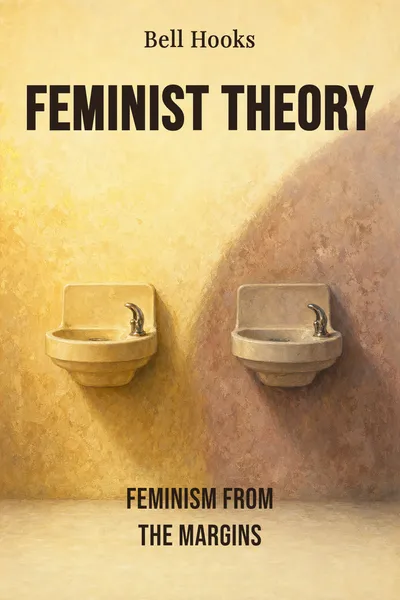
Feminist Theory
Feminism from the margins
Description
In 1984, a thirty-one-year-old writer named Gloria Watkins, publishing under the name bell hooks, put out a slim book with a title that read like an instruction: Feminist Theory: From Margin to Center. She had grown up Black and working-class in a segregated Kentucky town called Hopkinsville, and she had spent her twenties inside a feminist movement that spoke constantly about "women" while rarely seeming to mean women like her. The book was an argument with a movement she belonged to and refused to leave.
The movement she was arguing with had, by the early 1980s, real victories behind it and a real theory of itself. That theory, she noticed, kept describing the situation of women through the eyes of a particular woman: white, college-educated, materially comfortable, whose main grievance was being kept out of paid work she was otherwise well positioned to do. hooks had grown up watching women who were already exhausted by paid work that no man envied. The feminism on offer did not so much exclude her as fail to imagine her — and she suspected that failure was structural, not accidental.
From the margin, she argued, you can see the center and the edge at once, which is exactly what the people at the center cannot do. That double vision was not a disadvantage to be pitied but a vantage point the movement urgently needed. The book asked what a feminism built from that vantage — rather than one that generously invited the margin in — would actually look like, and why the version built the other way around had never become the mass movement it claimed to want.
The question we’re asking : Why has a movement against sexist oppression, decades in, never become the mass movement it keeps saying it wants to be?What we’ll see : How a feminism written from its own edge redraws almost everything the center took for granted.
Table of contents
01 Chapter 1 — The word "woman" that meant one woman
hooks opens with a sentence that had already made her first book, Ain't I a Woman, controversial: the feminism that dominated public conversation was speaking as though all women shared a single condition, when in fact it was universalizing the condition of one kind of woman. Betty Friedan's The Feminine Mystique, published in 1963 and widely treated as the movement's founding text, described the misery of educated suburban housewives trapped in domesticity. hooks does not dismiss that misery. She points out what Friedan left out: the maids, factory workers, and field hands who would have been glad to trade problems, and who did not appear in the book except as the help.
The problem, hooks argues, is not that Friedan wrote about a narrow experience. It is that the narrow experience got promoted to the definition of the whole. "Woman" came to mean the woman for whom the barrier was the front door of the workplace — not the woman who had always worked, for whom the barrier was that the work was invisible, unpaid, or paid in insult. When that single figure stands in for everyone, the demands that follow serve her first. Equality with men becomes the goal, as though all men occupied the same comfortable position women were being kept from.

02 Chapter 2 — Oppression isn't a country club
A recurring habit in the feminism hooks was reading, she notes, was the tendency of relatively privileged women to describe themselves as oppressed in the same breath, and with the same weight, as women facing hunger, violence, or racism. She is careful and unsparing here. Being bored and unfulfilled in a comfortable home is a real form of suffering, and she does not mock it. But she insists it is not interchangeable with being unable to feed your children, and a movement that treats every dissatisfaction as equivalent has lost the ability to see where the harm is worst.
The confusion, she argues, comes from a theory that located oppression in the individual woman's feelings rather than in her material conditions. If oppression is mainly about the constraint on your self-realization, then the housewife with a degree and the domestic worker cleaning her house can be described as equally oppressed, because both feel constrained. hooks finds this obscene, and traces it to who was writing the theory. Women who had never faced material deprivation naturally built their picture of oppression out of the deprivations they had faced, which were psychological and social rather than economic.
03 Chapter 3 — Solidarity isn't the same as sisterhood
Much of the movement's emotional vocabulary, hooks observes, ran through the word sisterhood — the idea that all women, sharing a common oppression, were natural allies bonded by that shared condition. She wants to keep the bond and lose the fantasy underneath it. Women are not automatically united by being women, because women also stand on opposite sides of race and class lines, and a white woman can hold power over a Black woman that no shared gender erases. Sisterhood pretended those divisions away, and pretending them away meant they never got worked through.
What she offers instead is solidarity, which she treats as harder and more honest. Solidarity is not a feeling you already have because you were born female; it is something built between people who genuinely differ, by facing the differences rather than papering over them. That means the woman with more power has to give something up, not just extend sympathy. hooks is blunt that many women preferred the warm language of sisterhood precisely because it asked for feeling rather than for redistribution. Loving your sisters is cheaper than sharing your position with them.
04 Chapter 4 — What it costs to speak from the edge
Step back from the specific quarrels and what hooks is really proposing is a different theory of where good thinking comes from. The center, in her account, is not just where power sits; it is where a certain blindness sits, because people at the center only ever see outward from themselves. The woman at the margin sees the center clearly — she has to, to survive it — and she sees the edge she stands on. That double sight is not a wound to be compensated for. It is an epistemic advantage, and a movement that keeps discarding it in favor of the center's self-portrait is throwing away its best instrument.
This reframes what the margin is asking for. The demand is not "let us into the center" — that would leave the center intact and simply widen the guest list. The demand is that the center be decomposed altogether, because a structure organized around a privileged standpoint will keep reproducing that standpoint no matter how many newcomers it admits. hooks is arguing against the whole logic of inclusion as the goal. Inclusion into an unjust arrangement is not liberation; it is a better seat at the same table.
05 Conclusion
The girl from Hopkinsville who could not find herself in The Feminine Mystique did not respond by leaving feminism or by asking politely to be added to it. She responded by rewriting its foundation from the ground she was standing on, arguing that the ground itself — the margin the movement had treated as a problem — was the only place a real theory of women's lives could be built. Feminism from the margins was not a sub-department of the main project. In hooks's hands it was the main project, correctly located at last.
Related books