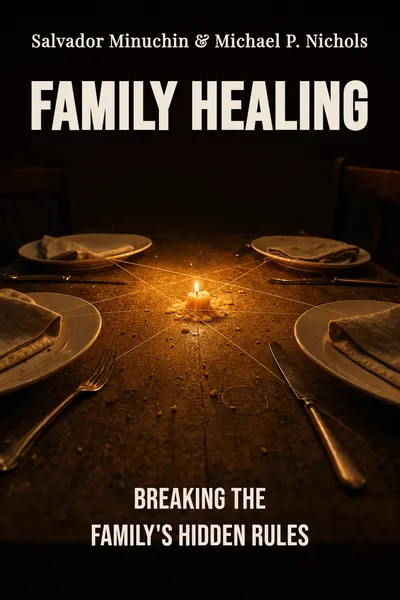
Family Healing
Breaking the family's hidden rules
Description
A mother brings her teenage daughter to therapy because the girl has stopped eating. She is wasting away, and the parents have tried everything — pleading, monitoring meals, hospital stays. Everyone in the room agrees on the problem: something is wrong with the daughter. Salvador Minuchin, the Argentine-born family therapist who spent decades running the Philadelphia Child Guidance Clinic, watches the family sit down, and within minutes he is looking somewhere else entirely. Not at the girl. At the space between the parents, at who speaks for whom, at the way the father's silence and the mother's over-attention hang together like load-bearing walls.
Family Healing, the 1993 book Minuchin wrote with the psychologist Michael Nichols, is built out of scenes like this one. It reads less like a clinical manual than like a set of stories — anorexic teenagers, warring couples, a boy who won't leave his room — each one opening onto the same buried machinery. The families arrive convinced they have a broken member. They leave, when it works, having discovered that the trouble was never inside one person at all. It lived in the arrangement, in the rules nobody wrote down and nobody can quite name.
That is the reframing this book keeps performing: the symptom is a message about the household, and the person carrying it is often the one holding the whole structure together. Minuchin does not treat individuals in isolation. He treats the pattern that individuals are stuck inside — and to do that, he first has to make the pattern visible to the people living blind inside it.
The question we’re asking : Why does the family's most troubled member so often turn out to be a symptom of something the whole household is doing?What we’ll see : How a therapist reads the hidden rules that lock families into their roles, and what has to break for them to move.
Table of contents
01 Chapter 1 — The problem is never just one person
When a family walks into Minuchin's office, they arrive with a story already written. There is a patient — the anxious child, the depressed wife, the acting-out teenager — and there is everyone else, gathered around to help. This is what Minuchin calls the identified patient: the member the family has silently agreed to treat as the sick one. The whole household organizes itself around this diagnosis, and it feels obvious, almost natural, that fixing the symptom means fixing that person.
Minuchin's instinct, honed over years, is to distrust the obvious patient. He came to family therapy in the 1950s and 1960s working with troubled boys at the Wiltwyck School in New York, and he noticed something that individual treatment kept missing: a boy would improve in the clinic and relapse the moment he went home. The change didn't hold, because the home hadn't changed. Whatever the boy was doing, the family needed him to keep doing it. His symptom had a job.

02 Chapter 2 — The invisible architecture of a household
Every family, in Minuchin's account, is held up by a structure — a set of unspoken rules about who belongs with whom, who has authority, where one person ends and another begins. Nobody drafts these rules. They accrete over years, out of a thousand small transactions, until they feel like the natural order rather than one arrangement among many. His word for the crucial internal walls is boundaries: the lines that separate the couple from the children, one generation from another, the family from the outside world.
When those boundaries hold at a healthy tension, the household breathes. Parents can be a team without shutting the children out. Children can grow toward the door without being pulled back. But boundaries go wrong in two directions, and Family Healing returns to both. Some become too rigid — members wall themselves off, communication thins to nothing, and a struggling person is left to sink alone. Minuchin calls this disengagement. Others dissolve entirely into what he calls enmeshment: everyone is inside everyone else's business, a child's mood becomes the mother's mood, and no one can have a feeling that isn't immediately everyone's.
03 Chapter 3 — The therapist as agent of disturbance
If the structure is the problem, then the therapist's job is not to soothe but to shake. Minuchin is famous, and sometimes controversial, for how active he is in the room. He does not sit back and reflect. He joins the family — he flatters, teases, sides with one member and then another, deliberately raising the temperature until the hidden rules break the surface and have to be dealt with in the open. He wants the crisis, not the ceasefire.
One of his signature moves is enactment. Rather than let a couple describe a fight, he tells them to have it, right there. The daughter and the father who always speak for each other are made to stop; he blocks the usual channel and forces a new one. In the anorexia cases that made his clinic famous, he would sometimes stage a family lunch, watching how the parents pushed food at the child and how the child's refusal organized everyone's panic — then intervening to hand the parents back to each other and let the girl step out of the middle.
04 Chapter 4 — What families are, once we stop blaming
Step back from the case files and Family Healing is making a quiet argument about where suffering comes from. The dominant way we explain a troubled person is to locate the trouble inside them — a chemical imbalance, a personality flaw, a private wound. Minuchin does not deny that inner life is real. But he keeps redirecting the gaze outward, to the web of relationships a person is embedded in, and insisting that much of what we call individual pathology is a person doing the job their system assigned them.
This flips the moral of the story. If the identified patient is carrying the family's unspoken arrangement, then they are not the weak link — they are, in a strange way, the strong one, absorbing a strain the others could not hold. The depressed teenager keeping her parents' marriage intact by giving them a shared worry is performing a kind of service. Seen from inside the structure, the symptom is not a failure. It is a solution — a costly, self-defeating one, but a solution to a problem the family could not otherwise face.
05 Conclusion
Return to the girl who won't eat, and the family gathered around her plate. By the end of the work Minuchin describes, the picture in the room has quietly rearranged. The parents are speaking to each other instead of over the child. The child is losing the terrible importance her symptom gave her, and gaining the ordinary freedom of someone no longer holding the household together. Nothing was fixed in her alone. What changed was the space between the people around her — the boundaries redrawn, the alliance interrupted, the load handed back to those who should have been carrying it.
Related books