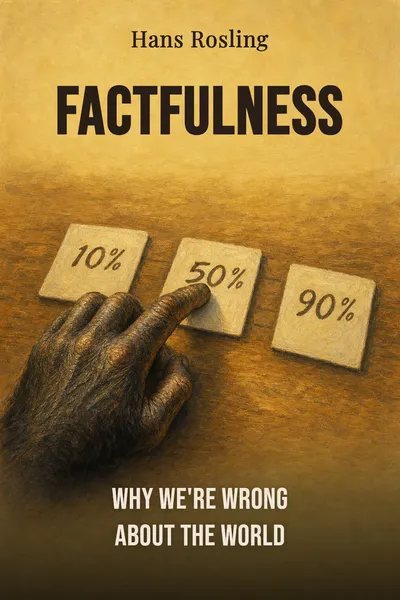
Factfulness
Why we're wrong about the world
Description
In a lecture hall somewhere in Europe, Hans Rosling would hand his audience a simple multiple-choice quiz. How many of the world's one-year-olds have been vaccinated against something? What share of people live in low-income countries? Has the number of children in extreme poverty roughly doubled, stayed the same, or nearly halved over the past twenty years? Three answers each, one obviously right. He asked these questions of Nobel laureates, of bankers at Davos, of medical students and journalists and corporate executives. And almost everyone got most of them wrong — not a little wrong, but wrong in the same direction, always too dark.
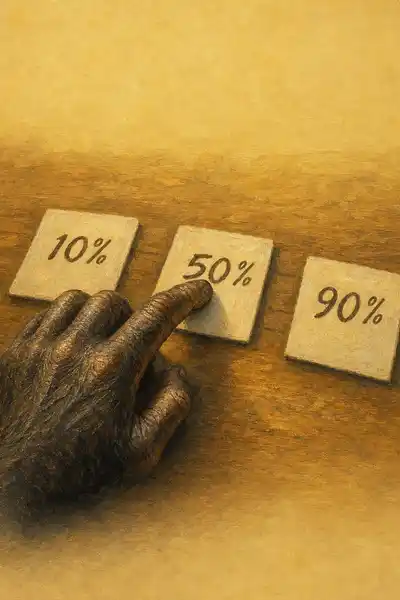
Rosling, a Swedish physician who spent decades studying global health and teaching statistics, noticed something that gnawed at him. If people were simply guessing at random, they would land on the right answer about a third of the time. A chimpanzee picking bananas labelled with the three options would do exactly that. Yet his human audiences scored below the chimp. Their errors were not ignorance in the ordinary sense. They were systematic, confident, and pointed relentlessly toward a world poorer, sicker, and more dangerous than the one that actually exists.
He turned that observation into a book, finished with his son Ola and daughter-in-law Anna Rosling Rönnlund and published in 2018, the year after he died of pancreatic cancer. Its title was a word he half-invented. The point was not that the world is fine. It is that we carry a set of dramatic instincts, useful once, that now bend the data before we ever read it.
The question we’re asking : Why do informed, intelligent people get the basic facts about the world so consistently, and so darkly, wrong?What we’ll see : How a lifetime of quizzes and fieldwork led Rosling to name the mental reflexes that distort our picture of the planet — and what he proposed we do about them.
Table of contents
01 Chapter 1 — The chimpanzee test
The chimpanzee is not a joke, or not only one. It is Rosling's way of measuring the exact size of the problem. When people underperform random chance, something is actively steering them wrong. A coin flip is neutral; a wrong answer given confidently is the fingerprint of a bias. Rosling collected these scores for years, across countries and professions, and the pattern held with a stubbornness that surprised even him. The most educated audiences were often no better than the least, and sometimes worse, because their confidence was higher.
Take the poverty question. Asked whether the share of humanity living in extreme poverty had halved, doubled, or stayed roughly the same over the previous two decades, most people chose doubled or stayed the same. The correct answer was that it had nearly halved — one of the largest improvements in human welfare in recorded history, and almost nobody knew it. On vaccination, most people badly underestimated coverage; roughly eight in ten of the world's children now receive basic immunizations, a figure that would have sounded like science fiction two generations ago.

02 Chapter 2 — Two boxes that never existed
The first reflex Rosling attacks is the one he calls the gap instinct: our habit of splitting everything into two opposed camps with a chasm in between. Rich and poor. Developed and developing. The West and the rest. Us and them. It is a satisfying way to see the world, because it makes a messy continuum feel like a simple pair of boxes, and it flatters the sense that we stand on the good side of the divide.
The trouble is that the gap is mostly imaginary. When Rosling plotted countries by income and by child survival, he did not find two clusters with an empty valley between. He found a smooth spread, with the vast majority of humanity somewhere in the middle — not destitute, not wealthy, but living lives that would have counted as comfortable to a European a century ago. The old picture of a small rich world and a huge miserable one had quietly stopped being true, if it ever was, while the story in our heads kept running.
03 Chapter 3 — Everything is bad and getting worse
If the gap instinct distorts where people are, the negativity instinct distorts which way they are moving. This is the reflex, Rosling argues, that most reliably darkens our worldview: the tendency to notice the bad more than the good, and to assume that things are getting worse even when the long lines point up. Ask people whether the world is getting better, worse, or staying the same, and the great majority say worse. The data, patiently assembled, says better on almost every measure that matters — child mortality, literacy, hunger, deaths from disaster, the share of girls in school.
Rosling traces the reflex to three sources. We misremember the past, bathing it in a nostalgic glow that erases how brutal it was. We consume a news diet built on events, and improvement is rarely an event; a factory that did not collapse and a child who did not die make no headline. And we feel, understandably, that declaring progress is heartless while suffering continues. He was careful here. Saying things are better is not the same as saying they are good. Both can be true at once: the world can be bad and improving, the way a patient can be seriously ill and recovering.
04 Chapter 4 — Ten instincts, one habit
By the end, Rosling has named ten of these reflexes — gap, negativity, straight line, fear, size, generalization, destiny, single perspective, blame, urgency. Listed out, they can read like a catalogue of ways to be wrong. But the deeper move of the book is to treat them not as ten separate failings to memorize, but as one habit to build. Factfulness, the coined word, is less a body of knowledge than a practice: the discipline of noticing when a dramatic instinct is firing and pausing to check it against a number before you let it decide what you believe.
That reframing matters because Rosling is not asking anyone to become an optimist. Optimism and pessimism are both moods, and both are guesses. He wants something colder and steadier — a willingness to be corrected by evidence, held as a routine rather than a one-time epiphany. The instincts do not switch off once you have read about them. They fire again tomorrow, on the next headline, in the next argument. The habit is the ongoing act of catching them.
05 Conclusion
The chimpanzee remains the sharpest thing in the book, because it makes the failure impossible to blame on ignorance. The people who scored below random chance were not uninformed; they were misinformed by their own instincts, confidently and in unison. Rosling finished the manuscript while dying, and there is something unsentimental about the choice — not a plea for hope, but a set of tools handed over, along with the news that the world was in far better shape than his readers believed.
Related books