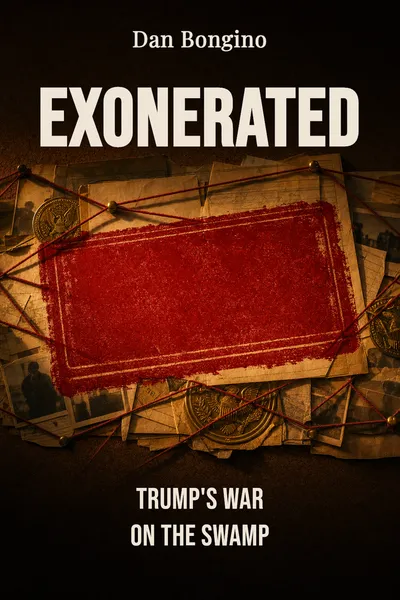
Exonerated
Trump's war on the swamp
Description
In 2018, a former Secret Service agent and New York police officer named Dan Bongino published a book called Spygate, then followed it with Exonerated. By that point Bongino had already remade himself into one of the loudest conservative voices in American media — a radio host, a podcaster, a fixture on Fox News, a man whose whole brand was built on relentless defense of Donald Trump. Exonerated arrived in the middle of the special counsel investigation led by Robert Mueller into whether the 2016 Trump campaign had coordinated with Russia. The book was not a neutral chronicle of that inquiry. It was a weapon aimed at it.
The argument, delivered with the certainty of a man who has already made up his mind, is that the investigations into Trump were never really about Russia or collusion at all. They were, in Bongino's telling, a coordinated effort by intelligence agencies, career bureaucrats, partisan officials and a compliant press to reverse the result of an election they could not accept. He calls this coalition the swamp, borrowing Trump's own campaign word, and he treats it as the true subject of the story — the villain whose exposure is the point of the book. The title states the verdict in advance: the president is innocent, the accusers are guilty, and the reader is invited to feel vindicated.
Reading a book like this decades of political noise later, the interesting thing is less whether Bongino was right on any given fact than what the book itself is — how it works, who it speaks to, and what it tells us about the way partisan certainty gets manufactured, packaged and sold. It belongs to a genre, and the genre has its own rules.
The question we’re asking : What kind of book is Exonerated, and what does its argument reveal about how political combat literature works?What we’ll see : We look at the man, the counter-narrative he constructs, the enemy he needs it to have, and the marketplace that rewards it.
Table of contents
01Chapter 1 — The book and the man behind it
To understand Exonerated, it helps to understand where Dan Bongino was standing when he wrote it. He had spent years in the Secret Service, including a stint on the presidential protective detail, before leaving to run for the Senate in Maryland in 2012. He lost. He ran for the House twice more, in 2014 and 2016, and lost those races too. What he found instead of elected office was an audience. By the second half of the decade he had a podcast climbing the charts, a growing radio presence, and a recurring seat on conservative cable — a career built entirely on speaking to people who already agreed with him and wanted to hear it louder.
Exonerated came out of that ecosystem, and it reads like it. Bongino is not writing as a detached analyst weighing evidence. He writes as an advocate, a former investigator turned prosecutor for the defense, using the vocabulary of federal law enforcement — sources, methods, chains of surveillance, FISA warrants — to lend his account the texture of insider authority. That vocabulary matters to the effect. A reader is meant to feel that the man explaining the FBI's conduct actually knows how the FBI works, and that his outrage is therefore informed rather than merely felt.

02Chapter 2 — The counter-narrative Bongino builds
The heart of Exonerated is a retelling. Bongino takes the sequence of events that mainstream reporting and the eventual Mueller report had assembled — the opening of the FBI's Crossfire Hurricane investigation in mid-2016, the use of the so-called Steele dossier, the surveillance applications, the appointment of the special counsel in 2017 — and reassembles the same pieces into a different shape. Same facts, roughly; opposite story. This is the craft of the book, and it is worth seeing how it operates rather than simply agreeing or disagreeing.
The method is selective emphasis. Details that support the plot theory get foregrounded and repeated: the fact that the dossier was funded through Democratic channels, the anti-Trump text messages exchanged between two FBI officials, the reliance on unverified claims in a surveillance application. Details that complicate the theory — the Trump campaign contacts with Russian-linked figures, the guilty pleas that came out of the investigation, the finding that Russia did interfere in the election — are minimized, reframed as trivial, or folded back into the narrative of overreach. Nothing is quite fabricated; the argument works by what it chooses to spotlight and what it leaves in the dark.
03Chapter 3 — How the swamp becomes the villain
Every combative story needs an antagonist, and Bongino's is not a person but a machine. The swamp, in Exonerated, is the permanent apparatus of Washington — the intelligence agencies, the senior bureaucracy, the prosecutors, the leakers, and the reporters who publish what the leakers hand them. It is presented as a single organism with a shared instinct for self-preservation, capable of coordinated action against an outsider president who threatened its interests. The word does a lot of work. It converts a sprawling, disorganized government into one villain with one motive.
This framing has obvious appeal and obvious limits. Its appeal is that it explains everything at once. Any setback, any damaging story, any inconvenient finding can be attributed to the same source, which means the reader never has to weigh competing explanations. Its limit is that real institutions are messier than that — full of rivalries, incompetence, leaks in every direction, people who disagree with one another. The swamp as Bongino draws it is less a description of how Washington works than a character designed to carry the plot. It behaves with a unity that actual bureaucracies almost never manage.
04Chapter 4 — A partisan genre and its readers
Exonerated is not a freak object. It belongs to a well-worn category of American political publishing — the insider-turned-defender book, written by someone with the right credentials to sound authoritative and the right loyalties to reach a hungry audience. These books tend to appear at moments of maximum conflict, sell fast to a base that already shares their premise, and function less as investigations than as flags to wave. Bongino's law-enforcement background gave his version an extra layer of plausibility, but the shape of the thing is familiar.
What is worth stepping back to see is how this genre reframes the very idea of accountability. In its logic, an investigation into a powerful figure is not a normal function of a system of checks — it is an act of aggression that demands a defender. Scrutiny becomes persecution; institutions doing their job become conspirators. Once that frame takes hold, the ordinary machinery of oversight can only ever be read as a plot, which makes the frame self-sealing. There is no version of an inquiry that could count as legitimate, because legitimacy has been defined out of existence in advance.
05Conclusion
Bongino closes the loop the title opened: the president is cleared, the accusers stand accused, the reader can put the book down feeling that justice, at least on the page, has been served. Whether that verdict matched the eventual record is beside the book's real purpose. Exonerated was never trying to be the last word in a factual dispute. It was trying to arm a movement with a story it wanted to hear, and by that measure it did exactly what it set out to do.
Related books