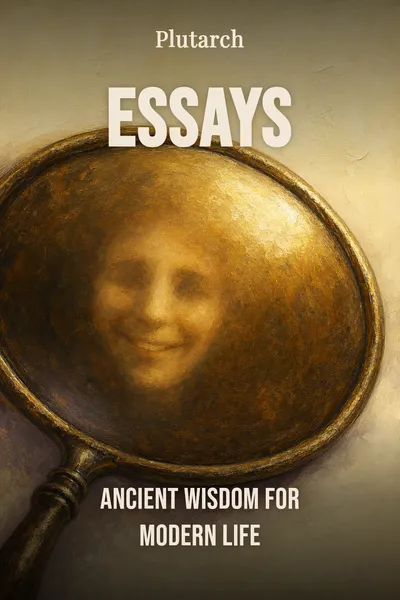
Essays
Ancient wisdom for modern life
Description
Sometime around the year 100, in the small Greek town of Chaeronea, an aging priest of Apollo sat writing letters, lectures and short treatises to friends across the Roman Empire. Plutarch had known emperors and held a local magistracy; he had traveled to Rome and lectured on philosophy; and he had chosen, deliberately, to spend his old age in a town he loved rather than a capital he could have had. What poured out of that decision was not a grand philosophical system but dozens of small essays — on anger, on talkativeness, on raising children, on how to profit from your enemies, on the right way to listen. Collected later under the title Moralia, they read less like treatises than like a wise friend leaning across the table.
That table manner is the whole point. Plutarch is remembered today mostly for his Parallel Lives, the biographies of Greeks and Romans that Shakespeare mined for his Roman plays. But the Moralia is where he is most himself — warmer, more curious, more willing to admit that virtue is hard and that most of us fail at it daily. He does not hand down commandments from a mountain. He notices how a flatterer talks, how a father overreaches, how a person handles a run of bad luck, and he draws his morals from the noticing.
Which raises a fair question about a writer nearly two thousand years dead. What can a Greek priest, working long after the great age of Athenian philosophy had closed, still offer someone scrolling through a modern life? Plutarch's answer, never stated as a thesis, runs through every essay: philosophy is not what you know, it is how you conduct an ordinary day.
The question we’re asking : What does a provincial Greek writer, working centuries after Plato and Aristotle, still have to say about how to live an ordinary day?What we’ll see : We follow Plutarch out of Chaeronea and into the small essays where he decodes friendship, learning, luck and the self — and shows why practical wisdom outlasts systems.
Table of contents
01 Chapter 1 — The man who wrote to be useful
Plutarch was born around the year 46 in Chaeronea, a town in Boeotia that had seen more history than it wanted — a decisive battle in 338 BC had ended Greek independence there, and another in 86 BC had wrecked it again. He studied philosophy in Athens, absorbed Plato without becoming a rigid Platonist, and could quote the Stoics and Epicureans as easily as he disagreed with them. He was, in the useful sense, well-read: he read to think, not to win arguments.
What distinguishes the Moralia from the philosophy that came before it is its scale and its address. These are not attempts to build a theory of everything. They are occasional pieces, often written for a specific friend facing a specific situation — a man about to marry, a father worried about his son's education, someone crushed by exile or by the death of a child. Plutarch writes to that person, and the reader two thousand years later feels, oddly, addressed too.

02 Chapter 2 — How to tell a friend from a flatterer
One of Plutarch's most quietly brilliant essays asks a problem we still have not solved: how do you distinguish a real friend from a flatterer, when the flatterer has learned to sound exactly like a friend? The easy flatterer, the one who agrees with everything and praises without pause, is simple to spot. The dangerous one is subtler. He criticizes you — but only for the small things, and always in ways that flatter your larger vanity.
Plutarch's flatterer will scold you for being too generous, too trusting, too brave for your own good. Each rebuke is a compliment wearing a frown. He mirrors your moods, adopts your opinions a half-beat after you voice them, and grows heated about your enemies. The friend, by contrast, is inconvenient. He tells you what you would rather not hear, and he tells you when it costs him something to say it, not when it wins him points.
03 Chapter 3 — The mind is not a vessel to be filled
In his essay on listening to lectures, Plutarch drops the line that has outlived almost everything else he wrote: the mind is not a vessel to be filled but a fire to be kindled. He is writing to a young man, Nicander, who has just put on the adult toga and started attending philosophical talks, and he is worried the boy will treat learning as pouring facts into a jar. Real education, Plutarch insists, lights something that then burns on its own.
This has practical consequences for how one should listen, and Plutarch is refreshingly specific. Do not, he says, sit in judgment ready to pounce on the speaker's mistakes; the eager critic learns nothing because he is too busy scoring. But do not sit in passive worship either, nodding at everything. The right posture is active attention — following the argument, testing it against your own experience, taking away not the lecturer's exact words but the impulse to think further.
04 Chapter 4 — Fortune deals the cards; character plays them
Underneath the variety of the Moralia lies a single conviction that keeps Plutarch coherent: what happens to us is not in our control, but what we make of it is. Fortune — chance, luck, the accidents of birth and circumstance — deals the hand. Character decides how it is played. This is not fatalism and it is not naive optimism; it is the steady middle ground of a man who had watched his own town be crushed twice by history and had still chosen to stay and cultivate it.
This is why his essays refuse to become a system. A system tells you what is true in general. Plutarch is interested in what you do in particular — with this anger, this grief, this stroke of bad luck, this flattering acquaintance. In his consolation to his own wife on the death of their young daughter, he does not offer a theory of death; he offers a way of grieving that neither denies the loss nor drowns in it. The philosophy is inseparable from the conduct. Take away the conduct and nothing is left to prove.
05 Conclusion
The priest of Chaeronea died sometime after the year 120, having spent his last decades doing exactly what his essays recommend: staying close to home, tending a role he found meaningful, and writing to be useful rather than admired. The Moralia was never meant to be a monument. It was meant to be reached for — opened at the essay you needed, on the day you needed it, the way you turn to a friend who has read more than you and judges you less than you fear.
Related books