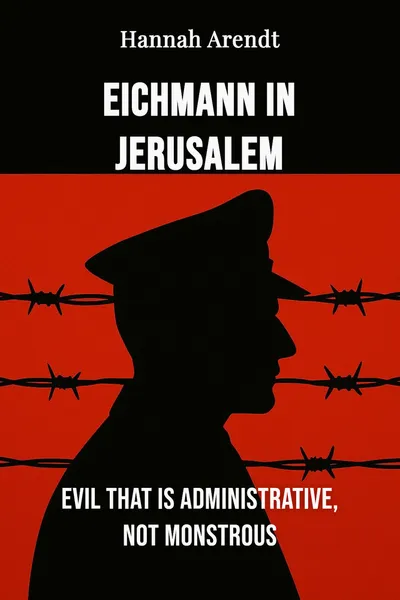
Eichmann in Jerusalem
Evil that is administrative, not monstrous
Description
On April 11, 1961, in a Jerusalem courtroom converted from a theater, a middle-aged man sat inside a booth of bulletproof glass. His name was Adolf Eichmann. A few months earlier, Israeli agents had seized him from a street outside Buenos Aires, where he had been living under a false name, and flown him to Israel to stand trial. He had run the office that organized the transport of millions of Jews to the death camps — the trains, the schedules, the logistics. And Hannah Arendt, a German-born political philosopher who had herself fled the Nazis, arrived to cover the proceedings for the New Yorker.
She expected, as most people did, to find something recognizable in the defendant: cruelty, fanaticism, a hatred vast enough to match the crime. Instead she found a man who was, in her word, almost ordinary. Eichmann spoke in bureaucratic clichés, took visible pride in his career advancements, and insisted he had merely done his duty and obeyed the law. Half a dozen psychiatrists had pronounced him normal. He was not, Arendt concluded, a raging antisemite hidden behind a desk. He was something stranger and, she thought, more disturbing.
The book that grew out of those dispatches appeared in 1963 as Eichmann in Jerusalem, carrying a subtitle that would follow Arendt for the rest of her life: A Report on the Banality of Evil. Three words. They provoked one of the fiercest intellectual quarrels of the postwar era, cost her friendships, and are still misread today. What she meant by them, and why the phrase struck such a nerve, is worth staying with.
The question we’re asking : How could a man who helped murder millions turn out to look so unremarkable — and what does that say about evil itself?What we’ll see : A courtroom in Jerusalem, a defendant who insisted he was only a functionary, and a three-word phrase that split the intellectual world.
Table of contents
01Chapter 1 — A man in a glass booth
The trial opened before three judges, with the world watching. This was, in part, the point. David Ben-Gurion, Israel's prime minister, wanted the proceedings to teach a generation — to lay out, through witness after witness, the full scope of what had been done to European Jewry. Over the following months the court heard survivors describe ghettos, deportations, gas chambers. Much of it had little direct connection to the man in the booth, and Arendt, watching, grew uneasy about the gap between the courtroom's ambitions and the narrow question of one defendant's guilt.
Eichmann sat through it wearing headphones, taking notes, occasionally correcting the record on points of organizational detail. He had been, from 1941, the head of the Gestapo section responsible for Jewish affairs and deportation. He did not deny the facts. His defense was that he had been a small cog, a man who arranged timetables and never personally killed anyone, who had sworn an oath and could not have disobeyed without, as he saw it, betraying his duty.

02Chapter 2 — The clerk who followed orders
Eichmann's own account of himself was, in a way, the heart of the matter. He presented his life as a series of postings and duties. He had joined the SS, found a niche in Jewish emigration and later deportation, and applied himself to it with the diligence of a man who wanted to be good at his work. He invoked, at one point, the philosopher Immanuel Kant — claiming to have lived by the categorical imperative, by which he seemed to mean that he had done his duty as the state defined it.
Arendt took this seriously enough to dismantle it. Kant's moral law asks a person to test their conduct against a universal principle they could will for everyone; Eichmann had replaced that inner judgment with obedience to the Führer's will. He had, she noted, followed orders even at the end, when Himmler himself ordered the killing stopped — because stopping was not, to Eichmann, a real order. His conscience worked, but it had been recalibrated to run on the rules of a criminal state.
03Chapter 3 — The banality of evil
The phrase appears almost quietly, at the very end of the book. Watching Eichmann walk to the gallows in May 1962, mouthing funeral oratory clichés to the last, Arendt wrote that it was as though those final minutes summed up the lesson of the whole affair — the fearsome, word-and-thought-defying banality of evil. She did not develop it into a theory in the book itself. It was a description of what she had seen, offered almost as an afterthought, and it detonated.
What she meant was not that the crimes were banal. She was insistent, then and afterward, that the deeds were monstrous beyond measure. What was banal was the doer. The evil of the Holocaust had been carried out, in large part, by people who were not themselves monstrous — people with no particular depth of wickedness, who did unspeakable things while thinking mostly about their careers, their standing, their duty. The horror was not that a demon had done it, but that a man like Eichmann had.
04Chapter 4 — Thinking, and the failure to think
If Eichmann was ordinary, the unsettling implication is that the capacity he displayed is not rare. Arendt was not saying that everyone is a potential murderer, nor that circumstances excuse the guilty. She was saying something more precise and more disquieting: that the wall between decent conduct and complicity in atrocity may not be built of some special moral fiber, but of the ongoing, unglamorous work of actually thinking about what one is doing. When that work stops, the rest can follow.
This is why she kept returning, in her later years, to the activity of thinking itself. Eichmann's failure, as she came to see it, was not a failure of intelligence or information — he knew perfectly well where the trains went. It was a failure to hold an inner conversation, to ask whether he could live with himself as the kind of person who did this. The thoughtless person, she suggested, is peculiarly available to evil, because evil offered from above meets no internal resistance.
05Conclusion
Eichmann was hanged shortly after midnight on June 1, 1962, and his ashes were scattered at sea beyond Israeli waters. Arendt's report on his trial appeared the following year and immediately drew fire — not chiefly for the phrase itself, but for a related argument in the book, where she criticized the wartime Jewish Councils for their role in the deportations. To many readers that seemed to shift blame onto the victims, and old friends broke with her over it. The controversy was bitter, personal, and long.
Related books