Edison
Edison: genius and exploiter
Description
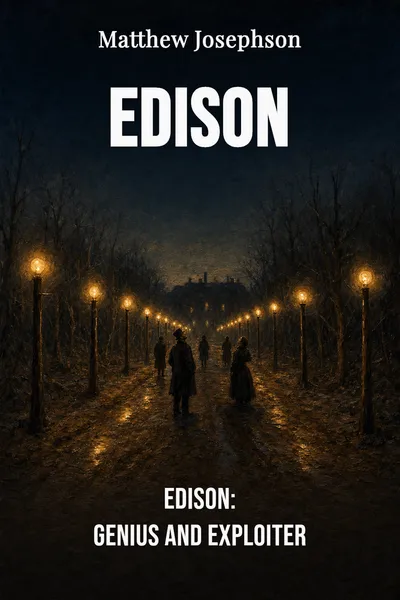
On the night of December 31, 1879, a few hundred people rode a special train out to a hamlet in New Jersey called Menlo Park to see something a newspaper had promised: a whole street lit by electricity. Thomas Edison, then thirty-two, had strung his glowing bulbs along the lanes around his laboratory, and the visitors wandered through the cold looking up at lamps that did not flicker or smoke. It was theater as much as science — the demonstration ran ahead of the working system by months — but it worked. The man who staged it had left school after a few months, sold newspapers on trains as a boy, and gone half-deaf young. He would end his life holding more than a thousand patents.
Matthew Josephson's biography, first published in 1959 and still treated as the standard life by the keepers of Edison's own archive in West Orange, refuses the schoolbook version of that scene. Josephson had spent the 1930s writing about the men who built industrial America, and he read Edison the same way — through the notebooks, the correspondence, the ledgers. What emerges is a man of genuine and relentless ingenuity who was also a hard bargainer, a showman who bent facts, and an employer who could be crude with the people who made his ideas real.
The book holds those two Edisons together without choosing between them. It is neither a takedown nor a monument, and that is what makes it useful. It asks how the same person could be both the tireless experimenter and the operator who squeezed rivals and collaborators alike — and what that combination reveals about the country he helped electrify.
The question we’re asking : How could the same man be the tireless inventor America mythologized and the shrewd, sometimes ruthless operator the record also shows?What we’ll see : A life read through the notebooks and the ledgers, where the laboratory, the marketplace, and the man's own temperament turn out to be inseparable.
Table of contents
01 Chapter 1 — The boy who wouldn't sit still
Thomas Alva Edison was born in Milan, Ohio, in February 1847, the youngest of seven children in a family that moved to Port Huron, Michigan, when he was still small. Josephson is careful with the childhood, because so much of it later hardened into legend that Edison himself enjoyed retelling. What the record supports is a restless, curious boy whose formal schooling lasted only a few months. His mother, a former teacher, taught him at home, and he read widely and unsystematically, drawn to anything he could take apart and put back together.
By twelve he was working — selling newspapers and candy on the Grand Trunk Railway line, running a small printing press and even a chemistry setup in the baggage car. The deafness that would define his adult life began around this time and worsened steadily. Josephson treats it plainly, neither as tragedy nor as secret advantage, though Edison later claimed it helped him concentrate by shutting out distraction. What is clear is that it pushed the young man inward, toward machines that did not require him to hear well.

02 Chapter 2 — Menlo Park, the invention factory
In 1876 Edison built something new in New Jersey: a laboratory at Menlo Park designed not to produce a single invention but to produce inventions continuously, as a kind of output. Josephson sees this as Edison's deepest innovation, deeper than any single device. He gathered machinists, chemists, glassblowers and draftsmen under one roof, kept them working long hours, and set the whole operation to the rhythm of his own restlessness. He liked to promise a minor invention every ten days and a big one every six months, and while the boast was theater, the factory metaphor was serious.
The results came fast. The phonograph, in 1877, astonished even Edison, who had stumbled into recorded sound while working on the telegraph and telephone. It made him famous almost overnight — the press called him the Wizard of Menlo Park — and Josephson shows how deliberately Edison fed that image. He understood that publicity raised money, and money bought more laboratory time. The wizard persona was part of the machinery.
03 Chapter 3 — The war of the currents
Having built the first central power station on Pearl Street in Manhattan in 1882, Edison had staked his fortune and his name on direct current — DC, the system he had designed and understood. The trouble was physical: direct current could not travel far without heavy losses, meaning a power station every mile or so. Alternating current, championed by George Westinghouse and refined by the work of Nikola Tesla, could be stepped up to high voltage, sent for miles, and stepped back down. It was, for large-scale distribution, simply better.
Edison knew the technical case against him and fought it anyway, and Josephson does not soften how he fought. Through the late 1880s Edison waged a public campaign to brand alternating current as lethal, sponsoring gruesome demonstrations in which animals were electrocuted to dramatize its dangers. He lent his laboratory's involvement to the development of the electric chair, hoping the association of AC with execution would frighten the public away from it. This was not the tinkerer at work; it was the operator defending an investment.
04 Chapter 4 — Two Americas in one man
Josephson's larger argument is that Edison stands at a hinge in economic history, and that his contradictions are the hinge itself. Before Edison, the inventor was imagined as a solitary figure — a Franklin, a lone mechanic with a flash of insight. After Edison, invention became an industry: organized, salaried, capitalized, and owned. He was the last great embodiment of the first kind and the founder of the second, and the strain between those roles ran straight through his character.
The tinkerer in him never disappeared. Well into old age he was still at the bench, working absurd hours, indifferent to comfort, chasing problems for the pleasure of solving them. That part of Edison is entirely real, and Josephson honors it. But the same man had learned early that ideas without capital go nowhere, and he built the apparatus — the laboratories, the companies, the patents, the publicity — to convert curiosity into ownership. The crudeness the book records, the sharp dealing and the willingness to fight dirty, was not separate from the genius. It grew from the same soil: a conviction that the world rewarded whoever got there first and held on.
05 Conclusion
The lamps strung around Menlo Park on that last night of 1879 were, in a sense, an honest picture of the whole life: real light, produced by real work, arranged as a spectacle to raise money for more of both. Edison went on inventing for another fifty years, through the phonograph's refinements and the motion-picture camera and the long, losing fight over current, dying in 1931 as one of the most famous men in the world. Josephson's account leaves the electricity intact while draining away the halo, and the man who remains is larger for it — more capable, more calculating, and more human than the wizard the newspapers sold.
Related books