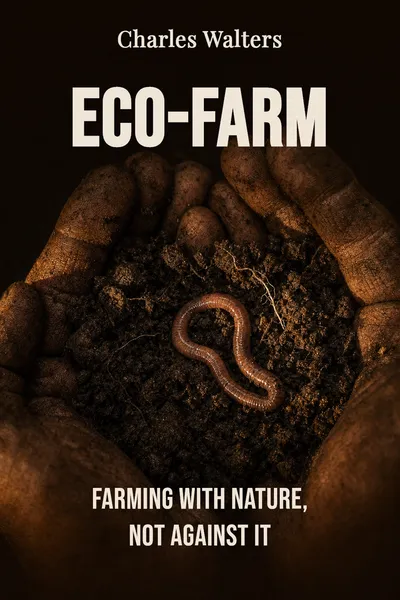
Eco-Farm
Farming with nature, not against it
Description
Walk across a field that has been farmed hard for thirty years and one that has been left to build itself back, and the difference shows up in your boots. One is packed, pale, and quiet. The other gives a little underfoot, smells of something faintly sweet, and turns up an earthworm every time a spade goes in. Charles Walters spent decades listening to farmers describe exactly this difference, and in Eco-Farm he set out to explain why it happens — and why the tired field is not a failure of effort but a failure of thinking. The farmer working it may be doing everything the extension agent recommended.
Walters was not a romantic. He founded Acres U.S.A., a publication for commercial growers, and he wrote for people whose farms had to pay a mortgage. That is what makes Eco-Farm unusual. It argues for working with soil biology, beneficial insects, and natural nutrient cycles — but it argues in the language of yield, cost, and margin. The pitch is not that ecological farming is virtuous. The pitch is that it is the more intelligent way to run a business that happens to depend on living systems, and that fighting those systems is expensive in ways the balance sheet takes years to reveal.
That framing puts the book at an angle to both camps that usually claim the subject. It is too practical for the purists and too ecological for the industrialists, and Walters seemed to enjoy that. He wanted to describe how a farm actually works when the soil is treated as an organism rather than a medium — and to show, farm by farm, that the change holds up in the account books as well as in the field.
The question we’re asking : Can a farm that works with nature instead of against it actually pay its own way — and what changes when soil is treated as something alive?What we’ll see : How Walters reframes the whole enterprise, from what happens underground to what happens at the market stall.
Table of contents
01 Chapter 1 — The ground is alive, or it isn't
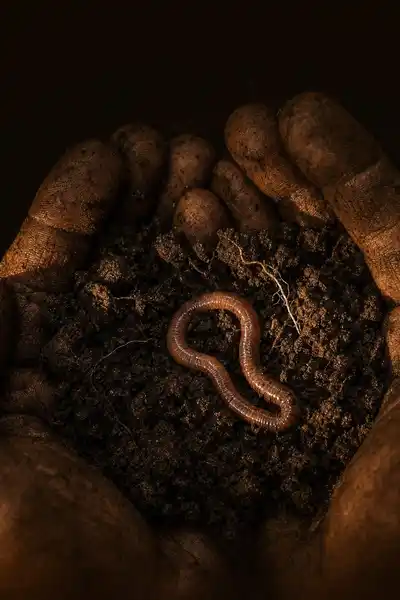
Walters starts underground, because that is where he thinks most farming goes wrong. Soil, in his account, is not a passive substrate that holds roots and receives fertilizer. It is a dense living community — bacteria, fungi, protozoa, earthworms, and countless organisms too small to name — and its health is the health of the farm. A teaspoon of good soil holds more microorganisms than there are people on the planet, and those organisms do the work: breaking down organic matter, freeing minerals into forms plants can use, building the crumbly structure that lets water and air move. When that community thrives, the soil feeds the crop almost on its own.
The consequence Walters draws is blunt. If the biology is doing the feeding, the farmer's job shifts from delivering nutrients to keeping the workforce alive. That means feeding the soil organic matter, keeping it covered, disturbing it as little as possible, and rotating what grows on it so no single demand drains it. Diversity above ground, he argues, produces diversity below ground, and diversity below ground is what makes a field resilient — able to shrug off a dry spell or a pest year that would flatten a monoculture.

02 Chapter 2 — What chemistry borrowed and never paid back
The postwar decades sold farmers a clean story: nitrogen, phosphorus, potassium in a bag, plus a chemistry set of pesticides and herbicides, and yields would climb. For a while they did. Walters does not deny the short-term gains — that would be dishonest, and he is writing for people who watched them happen. His argument is about what the ledger left out. The chemical model treats the farm as a factory with measurable inputs and outputs, and it works beautifully until the living parts of the system start sending the bill.
The bill arrives in several forms. Pesticides kill the target insect, but they also kill its predators, so the next outbreak comes back harder with nothing left to hold it in check — and the farmer reaches for a stronger spray. Herbicides and salts alter the soil chemistry in ways that suppress the microbial life doing the nutrient work. Heavy applications leach into groundwater and run off into streams. And the residues do not stop at the field edge; Walters is direct about the human cost, the growing evidence linking agricultural chemicals to the health of the people who apply them and eat what they grow.
03 Chapter 3 — Letting the farm do the work
The heart of Eco-Farm is what Walters calls ecosystem management, and it amounts to a simple reversal: instead of forcing the farm to behave, the farmer arranges conditions so the farm largely runs itself. A balanced system already contains most of what a crop needs. Pests have predators. Nutrients cycle from residue back into soil. Fertility renews through what grows and dies and decomposes in place. The farmer's craft is to build and protect those relationships rather than substitute for them with a purchase.
In practice this looks like a set of interlocking habits. Diverse rotations break pest and disease cycles that monocultures invite. Cover crops feed the soil and smother weeds between cash crops. Hedgerows, flowering strips, and undisturbed margins give beneficial insects a home, so the aphids have something eating them before they become a problem. Compost and manure return organic matter to keep the microbial workforce fed. Each practice does several jobs at once, which is the tell that the system is working with nature rather than bolting fixes onto it.
04 Chapter 4 — The ledger that pays the farmer
Step back from the compost and the cover crops and Eco-Farm turns out to be an argument about what kind of thing a farm is. The industrial model treats it as a manufacturing line: standardize the inputs, control the variables, maximize the throughput. Walters treats it as a set of relationships to be managed — between soil and microbe, crop and insect, farmer and market. That shift is why he keeps returning to the balance sheet rather than to conscience. He is not asking farmers to sacrifice for the planet. He is arguing that managing relationships is simply the smarter economics.
This is where his business instinct shows. A farm dependent on purchased inputs is exposed to every price shock in the fertilizer and chemical market, and its margins shrink as those prices climb. A farm that generates its own fertility and pest control has pulled those costs off the books and made itself more resilient — not only to weather but to markets. Walters pushes the logic outward into the whole operation: plan the farm as a system, use resources efficiently so little is wasted or bought twice, and diversify income so no single crop or price carries the entire enterprise.
05 Conclusion
Come back to the two fields, the packed one and the springy one. Walters' whole project is to explain that the difference between them is not luck or land quality but a choice about how to run a farm — whether to feed the soil's living workforce or to replace it, whether to host the insects that control pests or to spray them along with everything else. Eco-Farm argues that the springy field is not just healthier but cheaper to farm and steadier through bad years, and it backs the claim with growers who lived it rather than with slogans.
Related books