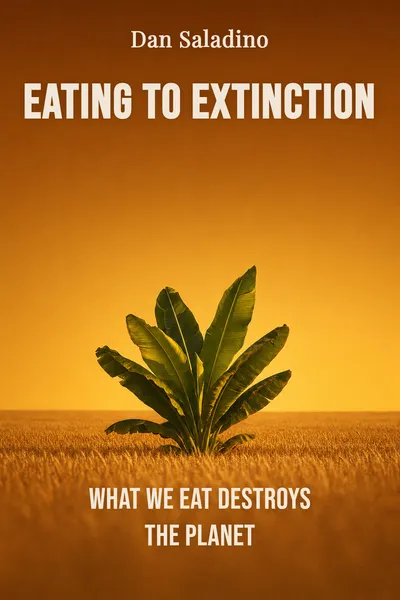
Eating to Extinction
What we eat destroys the planet
Description
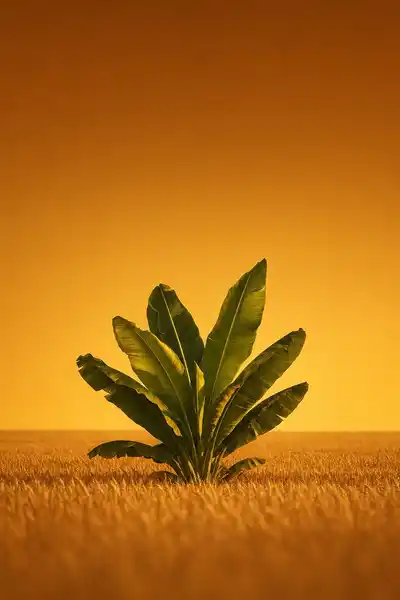
In the highlands of southwest Ethiopia, in the shadow of a mountain called Fandika, a small community still grows a cereal almost nobody else on Earth eats. It is called enset, a relative of the banana, and the people who tend it can name dozens of varieties, each suited to a different slope, a different rainfall, a different taste. Dan Saladino, a food journalist who spent much of the past decade tracking down foods on the edge of vanishing, went there because enset is exactly the kind of thing his book is about: a food that once fed millions, that survives famines when other crops fail, and that the modern food system has almost entirely forgotten.
His book, "Eating to Extinction," published in 2021, is built from journeys like that one. Saladino travels to a Turkish village for a nearly lost wheat, to the Faroe Islands for wind-dried mutton, to the American South for a bean the size of a fingernail. Each chapter is a food most of us will never taste, and each one is disappearing. Behind the individual stories sits a single, unsettling figure that runs through the whole book: of the thousands of plants humans have eaten across history, we now get the overwhelming majority of our calories from a tiny handful of crops, and most of our meat from a few industrial breeds.
That narrowing is the quiet catastrophe Saladino wants us to notice. Not a dramatic collapse but a slow flattening — of fields, of flavours, of the genetic variety that once let farming absorb drought, disease and heat. The book asks what we lose when food becomes uniform, and whether the loss is reversible while a few people still hold the seeds and the knowledge in their hands.
The question we’re asking : What exactly do we lose when the world's food narrows down to a handful of crops and breeds — and who is still holding the line?What we’ll see : A journalist's search for the foods on the verge of vanishing, and what their disappearance says about the fragility we have built into the way we eat.
Table of contents
01 Chapter 1 — The last man who ate a wild grain
Saladino opens where our diet began, because you cannot understand the loss without seeing the abundance it replaced. For most of human history, eating was local and various. Foragers knew hundreds of edible plants; early farmers kept dozens of landrace grains, each adapted over generations to a particular valley or hillside. Food was not a product but a relationship between people and a place, carried in memory and passed down by hand. The variety was not sentimental. It was survival. When one variety failed, another held.
He gives that abundance a face by seeking out its survivors. In a Turkish village he finds a wheat called Kavılca, an ancient hulled grain that farmers had grown for millennia before high-yield modern varieties pushed it to the margins. Only a few families still plant it, drawn by its flavour and its stubborn ability to grow where nothing modern will. Saladino treats these people less as curiosities than as witnesses — the last living link to ways of eating that fed our species for thousands of years.

02 Chapter 2 — A century of choosing sameness
How did the world's food narrow so fast? Saladino traces it to the twentieth century, when feeding a fast-growing population became an industrial project. The Green Revolution of the mid-century — new high-yield wheat and rice, chemical fertiliser, irrigation at scale — saved enormous numbers of people from hunger. It was, by its own measure, a triumph. But it came with a logic: to grow more, grow the same thing everywhere. Uniform seed, uniform field, uniform result. Diversity was not the goal; volume was.
The consequences compounded quietly. Farmers dropped their old varieties for the new ones that yielded more and sold better. Seed companies bred for traits that suited machines and long-distance transport, not for the local resilience that landraces carried. Governments and markets rewarded the crops that fit the system. Within a few generations, a huge share of the planet's calories was flowing from a shrinking pool of plant varieties, grown in vast single-crop expanses that would have astonished any earlier farmer.
03 Chapter 3 — The foods worth saving and the people saving them
The heart of the book is a series of portraits, each a food clinging to existence and a person refusing to let it go. There is Bere barley in Orkney, sown on thin northern soil where little else thrives. There is a rare Georgian wheat, and a cheese made in a single Alpine valley, and Hawaiian taro varieties tended by growers restoring a food their islands nearly lost. Saladino lets each stand for something larger: proof that another way of eating is not gone, only cornered.
He is drawn especially to the guardians — the seed savers, the small farmers, the cooks and scientists who keep a variety alive through sheer stubborn attention. Many are elderly, and much of the book's quiet tension comes from wondering who will take over when they are gone. Knowledge like this does not live in a database. It lives in hands that know when to plant, in tongues that remember a taste, in a household that keeps sowing a grain long after the market stopped paying for it.
04 Chapter 4 — Diversity is the insurance we stopped paying
Step back from the individual foods and Saladino's deeper argument comes into focus. Diversity in what we eat is not a matter of taste or nostalgia. It is a form of insurance — the accumulated genetic answers to problems farming will face again. A wild relative of a crop, an obscure landrace adapted to heat or salt or a particular disease, may hold the trait that keeps a staple alive when conditions shift. Every variety lost is a possible solution deleted before the question arrives.
That matters urgently now, because the climate our crops evolved in is changing faster than our narrow modern varieties can adapt. A food system resting on a few genetic lines is efficient in a stable world and dangerously exposed in an unstable one. History is blunt on this point: uniform crops invite catastrophe when a single disease finds the vulnerability they share. Saladino's book is, at bottom, an argument that we have traded resilience for yield without fully pricing the risk.
05 Conclusion
Saladino ends much where he began, among the people still growing foods the world has nearly forgotten — the enset farmers, the barley sowers, the keepers of a single cheese or a single grain. Their fields are small and their numbers are shrinking, but they hold something the vast uniform harvests cannot supply: the variety from which a food system can be rebuilt when the one we have runs into trouble. In their patience is a kind of banked wealth we have been spending without noticing.
Related books