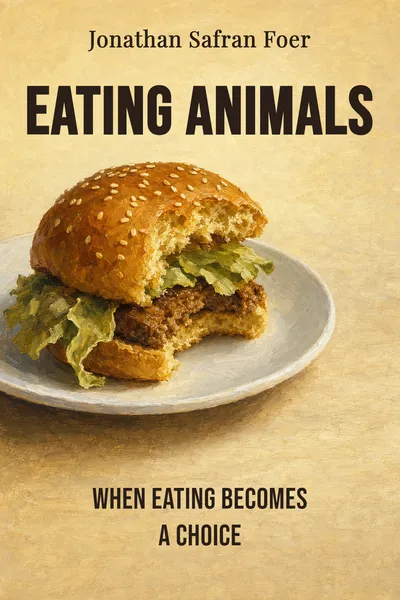
Eating Animals
When eating becomes a choice
Description
In 2009, the novelist Jonathan Safran Foer published a book that did not read like his novels. It opened not with invention but with a kitchen, a memory, and a newborn son. For most of his life, Foer had been an unreliable eater — a boy who loved a hamburger, a college student who swore off meat for a while, an adult who drifted back to it whenever the smell of a barbecue overrode his convictions. He had, by his own account, been a vegetarian several times and a meat-eater many more. The question of what to put on a plate had always been a mood, never a position.
Then he became a father, and the plate stopped being his alone. Feeding a child means deciding, on someone else's behalf, what counts as normal — which foods are simply what people eat and which require an explanation. Foer found he could no longer coast on appetite. He wanted to know where the food came from, what had happened to the animal, and whether the story he'd tell his son at the table was one he actually believed. So he spent nearly three years reporting: touring factory farms, sometimes at night and uninvited, talking to farmers and slaughterhouse workers, animal-rights activists and ranchers who despised them.
What he produced was not a manifesto but an argument built out of facts he had trouble looking away from — and a running unease with the tidy conclusions vegetarians and carnivores both like to reach. He refused to let the reader off with a simple villain. The book that resulted made eating feel, maybe for the first time for many readers, like a decision rather than a reflex.
The question we’re asking : What changes when eating stops being a habit and becomes something we have to justify?What we’ll see : How a father's ordinary question about dinner turned into a reckoning with where meat comes from — and what our meals quietly say about us.
Table of contents
01 Chapter 1 — The night the question arrived
Foer traces the book to a specific pressure rather than a sudden conversion. The birth of his son gave the old, lazy question of vegetarianism a new weight. Deciding what to feed a child, he realized, is one of the first stories a parent tells — this is food, this is not, this is what we do. He didn't want to hand his son a lie by omission, but he also didn't trust his own history. He had quit meat and returned to it enough times to distrust the certainty of both camps. What he wanted first was simply to know what he was eating.
That impulse pulls the book away from the usual shape of the food argument. Foer is suspicious of the vegetarian who feels morally finished and equally suspicious of the eater who insists the question is silly. He keeps returning to his grandmother, a survivor of the war who nearly starved and who once refused a piece of meat from a stranger because it wasn't kosher — even when refusing might have cost her life. Her line, that if nothing matters there's nothing to save, becomes a quiet spine for the book. Food, for her, was never only fuel.

02 Chapter 2 — What we don't want to know
The reporting takes Foer inside the system that produces the overwhelming majority of American meat — what the industry calls concentrated animal feeding operations and what most people never picture when they order chicken. The scale is the first shock. He lays out how roughly ninety-nine percent of the meat, eggs, and dairy eaten in the United States comes from factory farms, a figure that reframes the word farm itself. The pastoral image on the packaging, the red barn and the open field, describes almost nothing that is actually happening.
Foer is careful with his facts because he knows the material invites exaggeration. He describes birds bred to grow so fast their legs can barely hold them, animals confined in spaces that make ordinary movement impossible, and slaughter lines running at speeds that make clean killing statistically unlikely. He reports the routine use of antibiotics, not to treat sick animals but to keep crowded ones alive and growing, and he connects this to the wider public-health worry about resistant bacteria and the origins of influenza strains. These are not fringe claims; they are the operating conditions of an ordinary supply chain.
03 Chapter 3 — The animals we choose to forget
Having shown the system, Foer turns to the stranger question of why we treat some animals as family and others as food, drawing no line that survives scrutiny. He opens with dogs — America's beloved companions and, in much of the world, a perfectly ordinary meal. He half-seriously proposes eating dogs, since millions are euthanized each year anyway, precisely to expose how arbitrary the boundary is. The proposal is a provocation, and it works: the reader's instant revulsion reveals that our categories are cultural, not logical.
From there he complicates the easy story. Foer does not simply crown the vegetarian as the hero. He spends real time with people trying to raise and kill animals decently — a rancher, a turkey farmer preserving an old breed, a man who builds slaughterhouses designed to reduce fear. He takes their arguments seriously enough to let them stand, even when he ultimately can't accept them. The book keeps its integrity by admitting that thoughtful, humane meat exists in the margins, and that it is nowhere near enough to feed the appetite we have built.
04 Chapter 4 — The story we sit down to tell
Step back from the slaughterhouse and the supermarket, and Foer's real subject comes into view: eating is never a purely private appetite. It's one of the oldest ways human beings tell each other who they are. Every cuisine is a memory, every family recipe a claim about belonging, every shared meal a small ritual that says these are my people and this is how we do things. Foer's grandmother refusing meat that wasn't kosher, even near starvation, wasn't making a nutritional decision. She was holding onto a self.
This is why he frames the whole question as one of narrative rather than diet. When we sit down to eat, we are continuing a story — about where we come from, what we value, what we're willing to know. Factory farming, in his account, is disturbing not only for what it does to animals but for the kind of story it asks us to tell: one that requires forgetting, that depends on the packaging lying to us, that only functions if the table and the killing floor never meet in our minds. It is a meal built on a plot hole we've agreed not to notice.
05 Conclusion
Foer ends where he began, at a table with his family, having decided not to feed his children animals — but the decision is quieter and less triumphant than a convert's. He does not claim to have solved anything, and he keeps the door open to the humane farmers whose work he respects even as he declines to eat their animals. What he refuses is the return to sleep: the comfortable arrangement in which we pay for something three times a day and agree, by mutual convenience, never to look at it. Once you have seen the farm at night, the reflex of eating is gone, and only the choice remains.
Related books