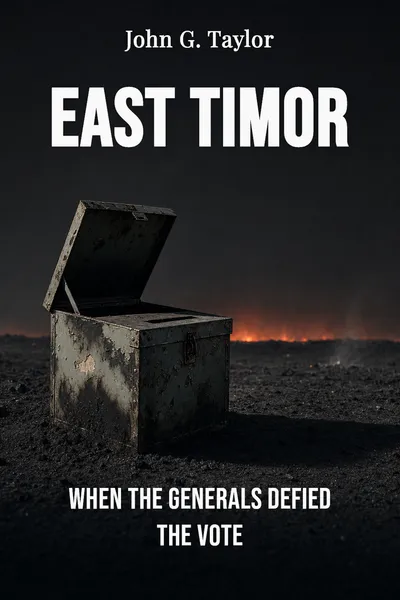
East Timor
When the generals defied the vote
Description
On August 30, 1999, roughly 98 percent of registered East Timorese walked past intimidation, past burned houses and the men with machetes waiting near the polling stations, and cast a ballot. The United Nations had finally organised a referendum, twenty-four years after Indonesia invaded the former Portuguese colony and annexed it as its twenty-seventh province. The question was blunt: stay with Indonesia under a wide autonomy, or move toward independence. Nearly four in five voters chose independence. It was, by any measure, one of the clearest expressions of a people's will in the twentieth century.
Then the results were announced, and the island burned. Militias armed and directed by elements of the Indonesian military swept through Dili and the countryside, killing, torching, and driving something like half the population from their homes. Bishop Carlos Belo's residence was attacked. Whole towns were emptied at gunpoint into West Timor. The vote had been counted, the answer was known, and the response from the losing power was not concession but a scorched-earth reprisal carried out in front of the world's cameras.
John Taylor, who had already chronicled the earlier, quieter phase of this occupation, returns to the story at the moment Suharto's regime collapses and asks how a referendum meant to end a conflict instead detonated one. His account tracks the decision to allow the vote, the machinery built to sabotage it, and the slow, embarrassed arrival of the outside world.
The question we’re asking : How could an occupying army lose a vote it had allowed, and then answer the result with organised massacre while the world watched?What we’ll see : A referendum granted from weakness, a campaign of terror designed to void it, and a reckoning with how little a small people's ballot could compel the powerful to act.
Table of contents
01Chapter 1 — The vote nobody in Jakarta wanted
For most of the occupation, the idea of a referendum was unthinkable to Jakarta. Indonesia had taken East Timor by force in December 1975, days after the Portuguese withdrew and the pro-independence movement Fretilin declared a state. The annexation was never recognised by the United Nations, but the Cold War made it convenient for Western capitals to look away, and Suharto's New Order regime treated the territory as a settled fact. To reopen the question of sovereignty was to admit the invasion had been a mistake.
Taylor's point is that the opening came from outside East Timor entirely. The Asian financial crisis of 1997 gutted the Indonesian economy, the rupiah collapsed, and in May 1998 the street pressure forced Suharto from power after three decades. His successor, B. J. Habibie, inherited a bankrupt state that badly needed international goodwill and loans. East Timor, a small territory that had cost Indonesia its reputation and a steady drain of military spending, suddenly looked less like a province to defend than a liability to shed.

02Chapter 2 — A militia built to break a referendum
Well before the ballot, the answer to a possible independence vote was already being assembled. Through early 1999, pro-Indonesian militias appeared across the territory with names like Aitarak and Besi Merah Putih, ostensibly local self-defence groups, in practice organised, funded, and armed by parts of the Indonesian military. Taylor documents the pattern carefully: the weapons, the coordinated movements between districts, the shared command threads running back to the army's territorial structure. These were not spontaneous loyalists but an instrument of policy.
Their work in the spring was to terrorise. The Liquiçá church massacre in April, in which scores of people sheltering on holy ground were killed, and the attack on a pro-independence leader's house in Dili the same month, signalled what a vote for independence might cost. The strategy, in Taylor's reading, was twofold: frighten enough people into voting for autonomy, and build a plausible cover story that any violence was Timorese-on-Timorese civil conflict rather than a state operation.
03Chapter 3 — The counting, and the burning that followed
The turnout on August 30 was the part no one had planned for. Despite everything, the East Timorese came out in overwhelming numbers, and on September 4 the United Nations announced the count: 78.5 percent had rejected autonomy and chosen the road to independence. For a few hours the outcome sat in the open, undeniable, the exact result the generals had spent months trying to prevent.
The reprisal was immediate and systematic. Militias, moving with the army rather than against it, went through Dili and then the districts with fire and machetes. Taylor's account emphasises the coordination: the burning was too widespread, too simultaneous, too logistically organised to be a spasm of anger. Utilities were cut, records destroyed, UN staff besieged in their own compound. Estimates put the death toll in the hundreds to well over a thousand, with the true figure obscured by the destruction itself.
04Chapter 4 — A small island and the limits of the world's conscience
What East Timor exposes, in Taylor's telling, is the distance between what the international community declares and what it will actually enforce. The referendum was the world's instrument; the United Nations ran it, foreign governments blessed it, observers certified the vote. And yet when the result triggered slaughter, the same actors who had convened the vote had no mechanism ready to protect the people who cast it. The security had been left with the aggressor, and the guarantors watched.
The intervention, when it came, came late. An Australian-led multinational force, Interfet, authorised by the Security Council and deployed in late September, only after weeks of televised destruction and mounting public pressure had made inaction untenable. Taylor is careful about the sequence: the force arrived after the burning had largely done its work, once the population was scattered and the towns already ash. It restored a kind of order, but to a territory that had been deliberately wrecked in the interval between the count and the response.
05Conclusion
East Timor did become independent. Under UN administration through the transition, it moved to formal sovereignty in May 2002, the first new state of the century, born from the vote its neighbour had tried to annul. The ballot held; the burning had failed to erase the answer, even if it succeeded in extracting a terrible price for it. The people who returned from the camps came back to rebuild a country that existed largely because they had refused to be frightened out of voting.
Related books