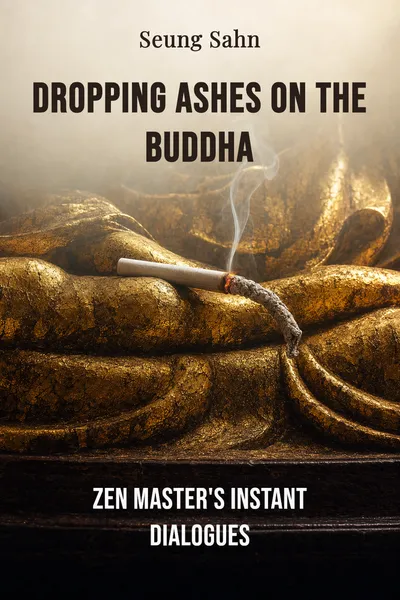
Dropping Ashes on the Buddha
Zen Master's instant dialogues
Description
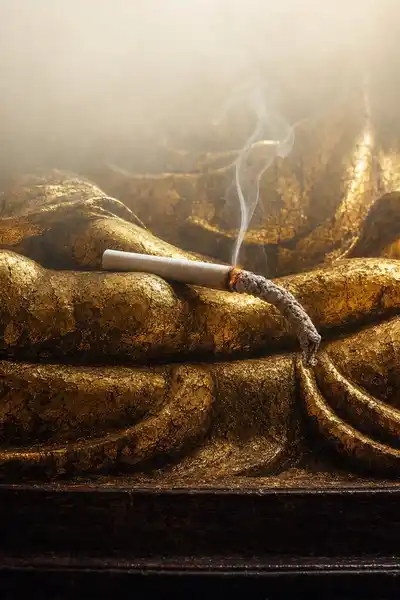
Someone walks into a Zen center with a lit cigarette. He steps up to the Buddha statue on the altar, blows smoke in its face, and taps his ashes into its lap. Then he turns to you. You are standing right there. What can you do? This is a question Seung Sahn, a Korean Zen master, liked to drop on the American students who filled his centers in the 1970s. It has no clean answer, and that is the whole point. Say the statue is only wood and metal, and you have missed something. Scold the man for disrespecting the Buddha, and you have missed something else. The question is a trap, and it is also an invitation.
Dropping Ashes on the Buddha collects hundreds of moments like this one. Published in 1976 and edited by his student Stephen Mitchell, the book is a record of Seung Sahn actually teaching — the letters he wrote, the talks he gave, the sharp back-and-forth of his formal interviews, the jokes, the scoldings, the long silences. He had arrived in the United States a few years earlier, speaking almost no English, and started fixing washing machines in a Providence laundromat while a handful of young Americans gathered around him. What came out of those rooms is less a set of ideas than a way of moving.
The book keeps its charm because it never settles into a lecture. Seung Sahn teaches through astonishment — a slap, a shout, a question that turns back on the asker — and the students on the page are as confused as we are. We watch them get stuck, argue, misunderstand, and occasionally, briefly, get it. That is the texture of the thing: not wisdom handed down, but a conversation caught in the act.
The question we’re asking : What does a Zen master actually do when a student asks him something, and why does he so often refuse to answer straight?What we’ll see : A displaced Korean teacher, a room of skeptical Americans, and a method that works by knocking the mind sideways rather than filling it up.
Table of contents
01Chapter 1 — The man with the cigarette
The ashes-on-the-Buddha problem is the book's signature because it exposes, in one clean move, how badly the mind wants a correct answer. Seung Sahn poses it and then watches. One student says the man is free to do as he likes, since the statue is empty of any real Buddha. Another says the man must be stopped, because respect matters. A third tries to be clever and stays silent. Each response, the master points out, is a kind of getting caught — caught in an idea about emptiness, caught in an idea about propriety, caught in the fear of being wrong.
The answers he approves of are startlingly practical. In one version, he suggests you simply hit the man. In another, you hand him a cup of tea. The reply that pleased him most came from a student who said he would tell the man, 'The Buddha is over there,' and point to the ashtray. What these answers share is that they act. They do not stop to build a theory about what the situation means. They meet the man where he is, without a gap between the seeing and the doing.

02Chapter 2 — A Korean master lands in America
Seung Sahn was born in Korea in 1927, ordained as a monk in his early twenties, and by the time he reached the United States he had already taught in Japan and Hong Kong. He landed in Providence, Rhode Island, in 1972, roughly forty-four years old, knowing barely any English and carrying no institutional support. He took a job repairing washing machines and dryers in a laundromat. Students found him there. The first American Zen center in his lineage grew out of that unlikely arrangement, and the transcripts in the book carry the flavor of it — informal, close, unpolished.
The language barrier turned out to matter less than anyone expected, and the book suggests why. Seung Sahn's teaching did not depend on eloquence. His English stayed rough for years, full of dropped articles and blunt constructions, and the transcripts keep it that way rather than smoothing it out. A master who cannot deliver a graceful lecture is forced to teach some other way — through gesture, through the odd concrete example, through the shout that needs no grammar. The clumsiness became part of the transmission.
03Chapter 3 — How the mind gets stuck
The recurring diagnosis running through the dialogues is that thinking creates the problem it then tries to solve. A student worries about whether she is making progress. Seung Sahn tells her the worry is the obstacle — checking your own mind is like a knife trying to cut itself. The moment you step back to evaluate where you are, you have left the actual moment and moved into a commentary about it. Much of the book is him catching students in this move and pointing it out, again and again, in fresh disguises.
His central image for the goal is emptiness that is also completely engaged. Before thinking, he says, there is no you and no world, only clear seeing. When you are truly doing something, there is only the doing. He liked to say that when you eat, just eat; when you drive, just drive. It sounds simple to the point of banality, and that is exactly the difficulty — the mind refuses to just do anything, insisting instead on narrating, comparing, and worrying alongside the act. The narration is what he is trying to switch off.
04Chapter 4 — When the teaching is the whole life
Step back from the individual dialogues and the striking thing about Dropping Ashes on the Buddha is what kind of book it refuses to be. It is not a manual, not a treatise, not a tidy summary of Zen doctrine. It is a record of a person teaching across every situation that came up — a letter about a student's dying mother, a scolding over center politics, a joke during a work retreat, a burst of anger, a moment of tenderness. The teaching is not extracted from the life and set out separately. The teaching is the life, caught in motion.
This is the deepest thing the form itself says. Seung Sahn's whole point is that there is no special spiritual compartment where enlightenment happens, apart from washing dishes and answering mail and dealing with the man blowing smoke at the statue. So a book that tried to abstract his ideas into clean principles would betray them. By keeping the mess — the bad English, the trivial questions, the domestic squabbles of a young community — the book stays faithful to a Zen that lives entirely inside ordinary moments or nowhere at all.
05Conclusion
Seung Sahn kept teaching in the United States and beyond for decades after this book appeared, founding centers across several countries before his death in 2004. Dropping Ashes on the Buddha stayed his best-known work in English, partly because it never tried to be authoritative. It is a snapshot of a particular moment — a Korean master in a Providence laundromat, a scatter of young Americans, a method built on shock and paradox rather than explanation — and it keeps the moment alive by refusing to clean it up.
Related books