Dopamine Nation
Pleasure, pain and the addicted brain
Description
Anna Lembke runs the addiction medicine clinic at Stanford, and one of the first patients she describes in Dopamine Nation is a mild, intelligent man who came to her because he could not stop masturbating to increasingly extreme pornography. He was not a monster or a stereotype. He was a lonely person who had found a machine that delivered pleasure on demand, and the machine had quietly rewired what pleasure meant to him. Lembke, published in 2021, treats him the way she treats everyone who walks in: not as a moral failure, but as a nervous system doing exactly what nervous systems do when a reward becomes cheap, fast and endless.
Her argument in the book is that his story is not exotic. It is the story of the smartphone, the vape, the food-delivery app, the streaming queue, the shopping cart that never empties. We have engineered a world where the rewards our brains evolved to chase — sugar, novelty, connection, sex — are now available in industrial quantities at the swipe of a thumb. And the same neurotransmitter that lights up when we get them, dopamine, turns out to be governed by a mechanism far stranger and less forgiving than the word "pleasure chemical" suggests.
What Lembke offers is not a scolding and not a detox program with a hashtag. It is a physiology — a clinician's account of how the brain balances feeling good and feeling bad, why that balance tips under modern abundance, and what her patients actually do to climb back out. The book is unusual because the doctor keeps putting herself on the couch too, admitting to her own compulsions. That honesty is the point.
The question we’re asking : Why does a world overflowing with easy pleasure leave so many people feeling flat, restless and unable to enjoy anything at all?What we’ll see : How Lembke's clinic reframes modern compulsion through the brain's balance between pleasure and pain — and where the way out actually leads.
Table of contents
01 Chapter 1 — The same wiring for pleasure and pain
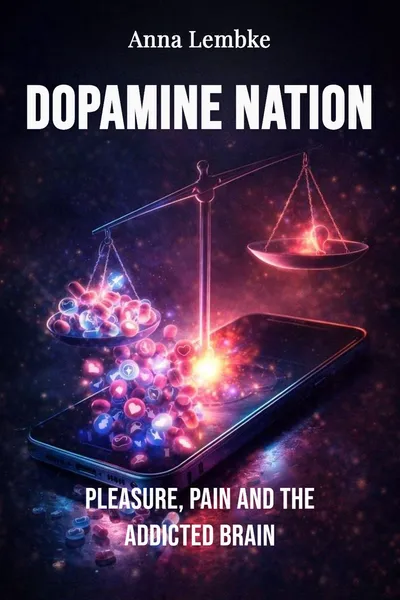
Lembke builds the whole book on one piece of neuroscience that most of us have never been told plainly: pleasure and pain are processed in overlapping regions of the brain, and they work like opposite ends of a balance. Picture a seesaw. When something pleasurable happens — a bite of chocolate, a like on a post, a hit of a drug — dopamine tips the balance toward the pleasure side. But the brain has a deep, non-negotiable commitment to keeping that balance level. It hates being tilted in either direction.
So the moment the balance tips toward pleasure, the brain works to restore equilibrium by tipping it just as hard the other way. Lembke calls this the process of self-regulation, and it is not gentle. After the pleasure fades, we don't return to neutral. We overshoot into the pain side. That small comedown after the last chip in the bag, the dip after scrolling stops, the deflation when the episode ends — that is the balance swinging back, and by design it swings a little past level.

02 Chapter 2 — Why more never lands the way it used to
This is where Lembke connects the physiology to the world outside the clinic. The dopamine system evolved in an environment of scarcity, where rewards were rare and required effort — you tracked the animal, you found the honey, you courted the mate. The comedown afterward didn't matter much, because the next reward was days or weeks away. The balance had ample time to recover. Modern life has removed the scarcity and left the wiring intact.
Now the reward arrives the instant we want it, in unlimited supply, from a device in our pocket engineered by people whose job is to make us want more. Lembke is direct about this: we have turned the smartphone into what she calls the modern-day hypodermic needle, delivering digital dopamine at all hours. And because we keep pressing the pleasure side without pause, the brain does what it always does — it adapts downward. Tolerance sets in. The thing that thrilled us last month barely registers now.
03 Chapter 3 — The self-binding no smartphone wants
If the environment is the problem, willpower alone is a poor defense, and Lembke says so bluntly. Telling a person surrounded by frictionless reward to simply resist is like telling someone standing in a river not to get wet. What actually works, in her clinical experience, is putting physical and structural distance between yourself and the thing — a strategy she calls self-binding. It is the deliberate construction of barriers, done in a moment of clarity, to constrain a future self you know will be weaker.
The classic image she reaches for is Ulysses ordering his crew to tie him to the mast so he can hear the Sirens without steering the ship onto the rocks. Self-binding is the ordinary version of that rope. It can be physical — leaving the phone in another room, not keeping alcohol in the house, deleting the app rather than trusting yourself to open it less. It can be temporal — allowing the reward only at fixed times. It can be categorical — a rule that removes the daily negotiation entirely, because deciding once is easier than deciding a hundred times.
04 Chapter 4 — Discomfort as a way back to feeling
Here is the turn that gives Dopamine Nation its real force, and it inverts everything the surrounding culture tells us. If pressing endlessly on the pleasure side leaves us numb and hurting, then pressing deliberately on the pain side should, by the same physics, tip the balance back toward pleasure. Lembke argues exactly this. The brain that overshoots into pain after pleasure also overshoots into pleasure after pain. Cold water, hard exercise, fasting, difficult work, even the sting of confessing something true — these hurt going in, and reward coming out.
She is careful to separate this from a wellness fad. This is not about optimizing yourself or hacking your morning. It is the clinical observation that a nervous system flooded with easy reward has lost its capacity to feel, and that the fastest route back is to reintroduce the scarcity and effort that abundance removed. A patient of hers who took up cold showers wasn't punishing himself; he was, in physiological terms, borrowing a pain that would be repaid, over the following hours, in a durable, hard-won lift the app could never deliver.
05 Conclusion
The man with the pornography compulsion, and the many patients Lembke describes after him, do not recover by finding a superior high. They recover by putting distance between themselves and the reward, by telling the truth about what they were doing, and by tolerating the grim stretch of comedown until their brains relearn how to feel ordinary things. The seesaw, pinned so long to one side, finally levels — and only then does a walk, a meal, a conversation start to register again as pleasant.
Related books