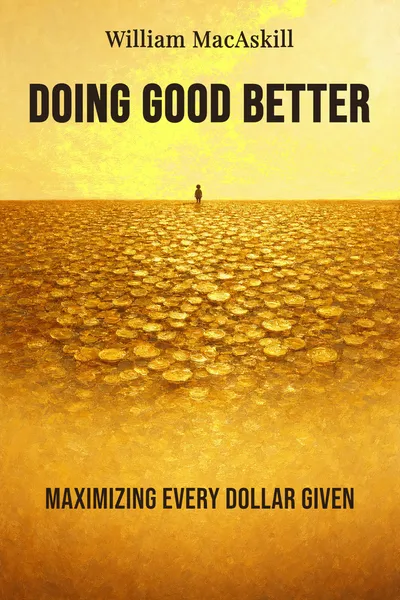
Doing Good Better
Maximizing every dollar given
Description
In the early 2000s, a development economist named Michael Kremer ran a set of randomized trials in western Kenya to figure out what actually got more children into school. The intuitive answers — new textbooks, more teachers, free uniforms — did surprisingly little. Then someone tried deworming pills. Intestinal worms kept kids sick and out of class, and the pills cost roughly fifty cents a year. The result was one of the cheapest ways ever measured to buy a year of school attendance. It was not a heroic intervention. It was a boring one, and it worked better than almost everything that looked more impressive.
That gap — between what feels like helping and what measurably helps — is the whole subject of William MacAskill's 2015 book Doing Good Better. MacAskill, a young philosopher at Oxford, was one of the people who gave the movement called effective altruism its name and its arguments. His claim is unsettling in its simplicity: two charities working on the same problem can differ not by a little but by a factor of a hundred in how much good they do per dollar. If that's true, then choosing well is not a nicety. It's most of the game.
Which means the familiar question — am I doing good? — is the wrong one, or at least an incomplete one. Almost anyone writing a check to a reputable cause is doing some good. The harder, more interesting question is whether they're doing the most good they could with the same effort, the same money, the same career. MacAskill thinks we usually aren't, and that the reasons are fixable.
The question we’re asking : How do we tell the giving that helps a little from the giving that helps enormously — and why do we so rarely bother to check?What we’ll see : A set of tools for weighing causes against each other, the intuitions that quietly sabotage generosity, and how far the same reasoning reaches once it leaves the donation box.
Table of contents
01Chapter 1 — The deworming that beat the playground
MacAskill's opening move is to take seriously a number most of us wave away. He asks how much good a dollar does, and points out that the honest answer depends enormously on where the dollar lands. A rich-country donor and a person living on a dollar a day are not in the same position: because money has diminishing returns, the same amount transferred to someone extremely poor produces far more welfare than it would spent at home. He borrows the economist's language of the hundredfold multiplier — the idea that a given sum can do roughly a hundred times more good in the poorest places than in the richest. It isn't a slogan. It follows from the plain fact that we are, globally speaking, among the very rich.
From there the book turns to measurement, and this is where the deworming story earns its place. Kremer's trials, later championed by economists like Esther Duflo and Abhijit Banerjee, showed that the effect of a program is rarely obvious from the outside. Programs that photograph well — building a school, handing out laptops — can do less per dollar than something as unglamorous as treating parasites. MacAskill's point is not that deworming is always the answer. It's that without evidence, our guesses about impact are close to worthless, and our guesses tend to favor whatever is easiest to picture.

02Chapter 2 — Five questions before the check clears
Having argued that impact varies wildly, MacAskill needs to give the reader something to do about it. The core of the book is a set of questions meant to be asked before committing money or effort — a framework that turns a vague wish to help into a decision one can actually inspect. The first is the one already established: how many people benefit, and by how much? Scale matters, and it's easy to underweight problems that are large but distant against problems that are small but vivid.
The second question is neglectedness. A cause that already draws enormous funding has, in a sense, had its cheapest opportunities taken; the next dollar into a crowded field does less than the next dollar into an overlooked one. This is why MacAskill is wary of causes that are already fashionable. The third is tractability: some problems are heartbreaking and also, for now, resistant to money — we simply don't yet know how to fix them at any price. Backing a tractable problem beats backing an intractable one even when the intractable one feels more urgent.
03Chapter 3 — The trap of the visible good
The most useful part of the book may be its catalogue of well-meaning mistakes, because the mistakes are ones nearly everyone makes with a clear conscience. MacAskill starts with the pull of the concrete. We are moved by the single identifiable person far more than by the statistic — the child in the photograph, not the thousand children in the figure. Psychologists have shown that people will sometimes give more to help one named victim than to help eight. Compassion is real, but it is a poor guide to scale, and the causes that trigger it are not reliably the causes where a dollar goes furthest.
Then there is the seduction of overhead. Donors obsess over how much of a charity's budget goes to administration versus programs, treating a low overhead ratio as a mark of virtue. MacAskill dismantles this. A charity that spends more on staff and evaluation may be far more effective precisely because it measures what it does; a lean charity running a useless program is still running a useless program. Judging by overhead measures the wrong thing entirely — the input, not the result.
04Chapter 4 — Where the reasoning stops being about charity
The reason Doing Good Better matters beyond the donation box is that its logic doesn't stay there. Once you accept that impact can be compared, neglectedness weighed, and counterfactuals taken seriously, the same reasoning starts asking about the largest resource most people control: their working life. MacAskill co-founded an organization, 80,000 Hours — named for the rough length of a career — built entirely on this extension. If a well-chosen job can do more good than a lifetime of donations, then career choice becomes an ethical decision of the first order, not an afterthought.
This is also where the book's most contested idea lives: earning to give. If your comparative advantage is making money, MacAskill argues, it can do more good to take a lucrative job and fund several effective workers than to do the frontline work yourself, especially where your presence isn't counterfactually necessary. Stated plainly, it sounds cold — reduce your own hands-on virtue in order to buy more of someone else's. But it follows directly from taking counterfactual impact seriously, and MacAskill is willing to follow his premises even when they lead somewhere uncomfortable.
05Conclusion
The deworming pill is a fitting emblem for the book because it is so thoroughly unromantic. Nobody sets out wanting to fund parasite treatment; it wins on the evidence, not on the feeling. That is the whole shift MacAskill is after — from giving that satisfies the giver to giving that helps the recipient most, measured rather than assumed. The framework of scale, neglectedness, tractability, counterfactuals and evidence is his attempt to make that shift teachable, so it doesn't depend on being a philosopher to pull off.
Related books