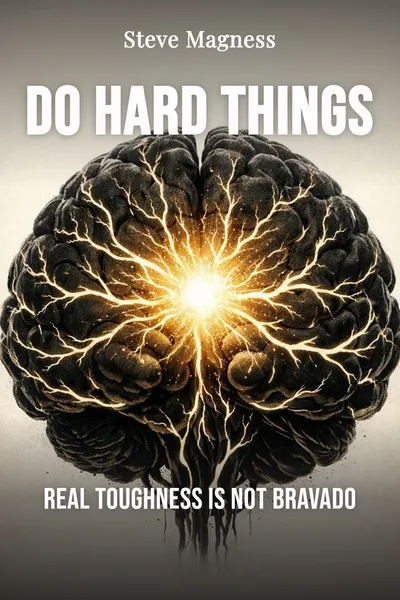
Do Hard Things
Real toughness is not bravado
Description
There is a scene almost everyone recognizes, whether from a locker room, a bootcamp movie, or a bad boss. Someone in charge is screaming. Push-ups until you throw up. No water breaks — water is for the weak. The message underneath the noise is always the same: pain is the point, and whoever endures the most of it wins. Steve Magness, a coach who spent years training elite runners and studying performance, calls this the model most of us absorbed without ever questioning it. And in his book Do Hard Things, he argues it is almost entirely wrong.
Magness came to this the hard way. He grew up inside the culture that treats suffering as a proxy for character, then watched it fail the people it was supposed to build — athletes who cracked under pressure, who quit exactly when it mattered, who confused being yelled at with being coached. The tough-guy playbook, it turned out, produced fragility dressed up as strength. Meanwhile the genuinely resilient people he studied looked nothing like the drill sergeant. They were quieter, calmer, and far more in control.
So he went looking for what toughness actually is — not the performance of it, but the mechanism. What he found draws on psychology, physiology, and decades of research that the bravado model has been happily ignoring. It reframes toughness as something closer to a skill than a trait, one that can be taught, and that the loudest people in the room usually lack.
The question we’re asking : If shouting and suffering don't build toughness, what does — and why has the fake version lasted so long?What we’ll see : How a coach dismantled the bootcamp myth and rebuilt toughness from the ground up, using what the science actually says.
Table of contents
01 Chapter 1 — The drill sergeant who was selling a lie
Magness opens with a confession about the culture he came from. American sports, the military, plenty of corporate offices — they all run on a shared theory of toughness that nobody bothers to examine. The theory says pressure is applied from the outside. A stronger person breaks you down, strips away your softness, and what survives is grit. Fear is the tool. Suffering is the curriculum. If you flinch, you weren't tough enough to begin with.
The trouble is that the evidence points the other way. Magness walks through what actually happens under this regime, and it is not resilience. Fear narrows attention and floods the body with stress hormones, which is useful for outrunning a predator and useless for the kind of sustained, thoughtful effort most hard things require. People trained through intimidation learn to comply while a boss is watching and to fold the moment nobody is. They become brittle, not tough. He points to the grim end of the spectrum too — hazing rituals and abusive coaching that leave lasting damage — and notes we've dressed all of it up as character-building.

02 Chapter 2 — Toughness starts before the hard part
The first pillar of real toughness, Magness argues, is set long before the moment of difficulty arrives. It comes down to how we appraise a challenge — whether the brain reads it as a threat or a challenge. The distinction isn't just semantic. Under a threat appraisal, the body braces for danger: blood vessels constrict, attention tunnels, and we go into a defensive crouch. Under a challenge appraisal, the same physical arousal shows up, but the body prepares to engage rather than survive. Same racing heart, completely different outcome.
What tips the balance is a simple internal calculation: do the demands of this situation exceed the resources I have to meet them? If the answer feels like yes, it registers as a threat. If it feels manageable, even barely, it registers as a challenge. And this is where the bravado model backfires spectacularly. By manufacturing fear and stripping people of any sense of control, it practically guarantees a threat response — the exact state that makes people crumble. The drill sergeant is optimizing for the wrong thing.
03 Chapter 3 — The inner voice that talks you through
Once the hard thing actually begins, Magness shifts to what happens inside the head — specifically, the running commentary nobody can turn off. Everyone has an inner voice, and under stress it gets loud. The old model treats this voice as noise to be silenced or overpowered: push through, don't think, just grind. What the research suggests is subtler and more effective. You don't beat the voice. You learn to work with it.
One tool he highlights is a small linguistic shift that turns out to matter. When people talk to themselves in the second or third person — using their own name, or "you can do this" instead of "I can do this" — they create a sliver of psychological distance. That distance is what lets someone step back from a wave of emotion instead of drowning in it. Studies on this self-distancing show it lowers stress and improves performance on tasks that matter. It sounds almost too simple, which is part of why the tough-guy model would never think to teach it.
04 Chapter 4 — Feel the discomfort, then decide
Step back from the running and the training, and Magness's model is really an argument about how we build people — and about the institutions still getting it wrong. Coaches, teachers, managers, and parents are all in the toughness business, and most of them inherited the bootcamp theory without ever testing it. They confuse control with strength. They mistake compliance for character. They produce people who look tough right up until the moment that actually demands it, and then discover that fear-trained resilience has a very short shelf life.
What the science points toward is almost the reverse of the drill sergeant's instinct. The environments that produce genuine toughness are ones that hand people real responsibility, let them struggle inside a supportive structure, and treat discomfort as information rather than punishment. Magness's own coaching philosophy leans on giving athletes agency and helping them make sense of their own experience, because that's what builds the capacity to meet a challenge instead of fleeing a threat. The best coaches, he suggests, talk less and demand more thinking, not more suffering.
05 Conclusion
We started with the man screaming in the locker room, the one who treats pain as proof and never lets anyone see him flinch. Magness's whole project is to reveal that figure for what he is: not the embodiment of toughness but its most convincing counterfeit. The performance is loud because there's nothing solid behind it. The person who is actually in control under pressure has no need for the show — they've done the preparation, they can read their own fear, and they can keep thinking while the noise continues.
Related books