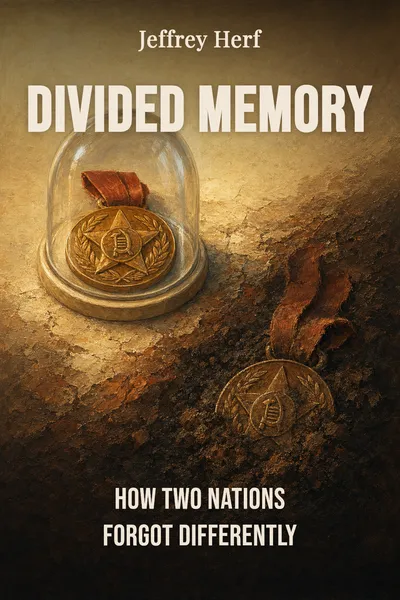
Divided Memory
How two nations forgot differently
Description
On January 27, 1996, the German federal government declared a national day of remembrance for the victims of National Socialism, timed to the liberation of Auschwitz fifty-one years earlier. By then, the ritual seemed almost self-evident: of course Germany remembers, of course it names the crime, of course there is a date on the calendar. But nothing about that gesture was automatic. The Nazi regime had commanded deep and broad support among ordinary Germans. Raising the specter of its crimes meant, for any postwar politician, reminding voters of what many of them had cheered, tolerated, or carried out. The safer path, on paper, was silence.
For forty years there had not been one Germany answering that dilemma but two, and they answered it in opposite directions. In the Federal Republic to the west, the memory of the persecution and murder of Europe's Jews surfaced — unevenly, late, contested, but it surfaced, and eventually became official. In the German Democratic Republic to the east, a state that called itself antifascist and claimed to be the true heir of the resistance to Hitler, that same memory was pushed to the margins and, for long stretches, actively repressed. Two nations, the same past, two ways of forgetting.
Jeffrey Herf, in Divided Memory, follows this split from the anti-Nazi emigration of the 1930s to that 1996 remembrance day, tracing how belief and political calculation shaped what each Germany allowed itself to say aloud. His argument runs against a comfortable assumption — that democracies bury guilt and dictatorships confront it — and lands somewhere more unsettling.
The question we’re asking : Why did the memory of the Holocaust take hold in liberal West Germany yet get buried in the self-declared antifascist East?What we’ll see : How émigrés, party interests, and the Cold War pulled two German states toward opposite ways of remembering the same crimes.
Table of contents
01Chapter 1 — The émigrés who chose to remember
The story does not begin in 1945 with rubble and tribunals. It begins earlier, among the Germans who fled Hitler in the 1930s and carried out of the country a set of convictions about what the regime was and what would have to be said about it afterward. Herf treats these émigrés — political exiles, Social Democrats, Communists, a handful of liberals and Jewish intellectuals — as the people who first drafted the language a defeated Germany might use to face its own crimes. What they decided abroad would echo, decades later, in Bonn and East Berlin.
They did not agree. And that disagreement is the seed of everything that follows. Some, particularly on the anti-totalitarian left and among Jewish émigrés, insisted that the persecution of the Jews was central — not one Nazi crime among many but the crime that defined the regime's character. Others, especially the Communists who would return to build the East German state, folded Jewish suffering into a larger story of fascism as the violent last stage of capitalism, in which the victims were above all antifascist fighters and the working class.

02Chapter 2 — Bonn keeps the wound open
The Federal Republic that emerged in the late 1940s was not, at first, eager to dwell on Jewish suffering. Its early years were marked by amnesties, the quiet reabsorption of former Nazis into administration and industry, and a public mood that preferred reconstruction to reckoning. Herf does not pretend otherwise. West German memory was selective, slow, and often driven more by foreign expectation than by domestic hunger for the truth. But it had one thing the East lacked: a political space in which the subject could not be permanently closed.
Konrad Adenauer's decision to pursue restitution and a reparations agreement with Israel, signed in 1952, is central to Herf's account. It was intensely unpopular — most West Germans opposed paying anything — and Adenauer pushed it through partly out of conviction and partly to anchor the young republic in the Western alliance. Whatever the mix of motives, the effect was to place the persecution of the Jews on the official record of the state, as an obligation acknowledged in law and money, not merely in speeches.
03Chapter 3 — Berlin buries it under antifascism
The German Democratic Republic told a cleaner story, and that cleanliness was the problem. Its founding myth was antifascism: the East German state descended from the Communist resistance to Hitler, and so it stood on the right side of history by birth. Its citizens were reassured that the fascists and their heirs lived in the West, in capitalist Bonn, while the East had been purified by the victory of socialism. In this account there was no shared German guilt to work through — the guilty were the class enemy, safely across the border.
Within that frame, the murder of the Jews had almost nowhere to go. To dwell on it would have meant admitting that the victims were persecuted as Jews, not primarily as antifascists, and that ordinary Germans, including many who now lived under socialism, had participated or looked away. Herf documents how Jewish suffering was consistently subordinated to the celebration of Communist martyrs, and how the very category of the Jewish victim was treated as a distraction from the class struggle.
04Chapter 4 — When memory follows the shape of the state
The comfortable intuition is that confronting national guilt is a matter of moral courage — that some peoples are brave enough to look and others are not. Herf's paired history dismantles that. West Germans were not, on the whole, more willing to remember than East Germans; if anything the popular reluctance ran deep on both sides of the border. What differed was not the conscience of the population but the structure of the regime asking the question. Memory followed the shape of the state.
A dictatorship that claims total legitimacy cannot easily host a memory that implicates its own people, because that memory becomes a lever against the regime's founding myth. East Germany's antifascism was not a lie its leaders cynically told so much as a system that made certain truths unusable. Once the state defined itself as the outcome of the resistance, the Jewish victim had no place in the official narrative without cracking the narrative open. So the crime was managed by subordination and, when necessary, by purge.
05Conclusion
By the time a united Germany fixed January 27 as its day of remembrance in 1996, the East German answer had lost. The antifascist framework that once buried the Jewish victim collapsed with the state that authored it, and the West German vocabulary — halting, guilt-laden, centered on the Holocaust as the defining Nazi crime — became the vocabulary of the whole country. That outcome was not preordained by any German moral awakening. It was the residue of which political system survived the Cold War and which one did not.
Related books