

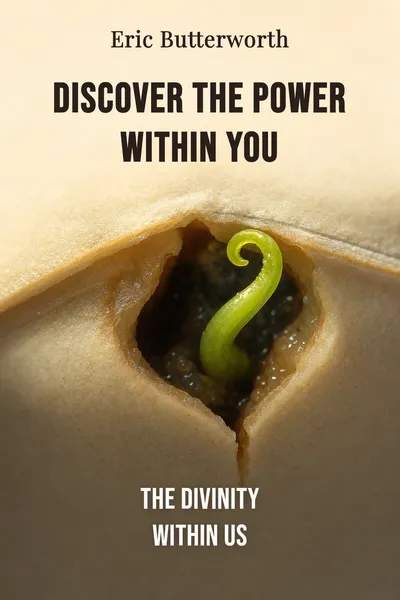
Discover the Power Within You
The divinity within us
Description
In 1968, a Unity minister named Eric Butterworth published a book that took one of the most familiar figures in Western culture and read him against the grain. The figure was Jesus. The book was Discover the Power Within You, and it has stayed in print for more than fifty years, carried along by readers who found in it something they had not found in the churches they grew up in. Butterworth preached for decades at Lincoln Center in Manhattan, and Maya Angelou, among others, counted herself a follower. His claim was disarmingly simple and, for many, unsettling: the Gospels are not chiefly the record of one exceptional man. They are a manual for a capacity that lives in everyone.
The move Butterworth makes is to shift the emphasis of a single sentence. When Jesus says the kingdom of heaven is within you, most of Christian history has treated the speaker as unique and the hearer as a subject of worship. Butterworth treats the sentence as a piece of instruction. If the kingdom is within, then it is within us too — not as a metaphor, not as a reward deferred to some afterlife, but as a present, usable dimension of every person. He calls it the divinity of man, and he insists Jesus meant it about all of us, not only about himself.
That reframing changes what the whole book is for. It is not an argument to win a theological debate; it is an invitation to notice something Butterworth believes is already there, waiting, in each of us. And it raises a question that the polite version of religion usually steps around.
The question we’re asking : What did Jesus actually see when he looked at ordinary people, and what changes if we take him to have been describing us rather than only himself?What we’ll see : How Butterworth rereads the Gospels as a map of an inner capacity — and what he says that capacity does once we stop treating it as someone else's gift.
Table of contents
01Chapter 1 — The line everyone read backwards
Butterworth starts with a complaint, though he is too warm to call it that. For most of two thousand years, he argues, the West has read the story of Jesus as a story about one person's exceptional nature — a divine visitor, unrepeatable, sent to be admired and obeyed. The natural response to such a figure is worship, and worship, by definition, keeps its distance. You do not become what you kneel to. And so the very reverence meant to honor Jesus, in Butterworth's telling, quietly emptied his teaching of its point.
The point, he says, was never Jesus's difference from us. It was his sameness. When Jesus told a crowd that they were the light of the world, he was not flattering them; he was informing them. When he said the works he did, they would do also, he meant it literally enough to say it out loud. Butterworth reads these lines not as generous exaggerations but as diagnoses — descriptions of a human potential that Jesus happened to have realized and that he spent his short public life trying to point out in everyone else.

02Chapter 2 — The kingdom is an inside address
If the kingdom is within, the obvious question is: within what, exactly? Butterworth's answer is that there is a dimension of every human being that is not the anxious, calculating self we usually take ourselves to be. He calls it, in various places, the divinity within, the Christ in us, the depth potential. The name matters less than the claim, which is that beneath personality and biography there runs a current of the same life that religions have always pointed at when they said the word God — and that this current is not somewhere above us but running through us.
He is careful, though, about what he is not saying. This is not the ego inflating itself into a deity. Butterworth is not telling us we are each personally in charge of the universe. The divinity he describes is precisely the part of us that is not merely personal — the point where the individual opens onto something larger and drinks from it. Realizing it feels less like grabbing power and more like getting out of the way, letting a source that was always there flow through without the usual obstruction of fear and self-doubt.
03Chapter 3 — Not a man to worship, a possibility to live
Once the inner dimension is granted, Butterworth turns to what it does when it is released — and here the book takes on the texture of practical counsel rather than theology. Health comes first. He treats the body not as a machine separate from the spirit but as responsive to it, and he reads Jesus's healings as demonstrations of a principle rather than one-off miracles: that a mind aligned with its inner source restores rather than corrodes. He is not prescribing medicine, and he is not dismissing it; he is arguing that the state of a person's inner life is not neutral toward their body.
Confidence is next, and this is where his warmth is most visible. So much of what limits people, he suggests, is a low estimate of themselves that they mistake for humility. If the divine dimension is genuinely within, then chronic self-deprecation is not modesty — it is a misreading of the facts. To discover the power within is, in large part, to stop apologizing for a smallness that was never the truth about us. Success follows from the same shift. Butterworth does not preach hustle; he preaches a change in the assumption a person carries about what is possible, and lets outward results follow the inward correction.
04Chapter 4 — When the divine stops being a doctrine
Step back from the individual promises — health, confidence, success — and something larger is happening in Butterworth's book. He is quietly changing what religion is for. In the model he inherited and resisted, religion is a set of beliefs about a God who exists at a distance, plus a set of rules for staying in that God's good graces. It is oriented outward and upward, toward an authority to be appeased. Butterworth reorients the whole enterprise inward. Faith stops being agreement with propositions and becomes a practice of recognition — noticing the dimension in oneself that was already divine.
This is why he can fold physical well-being, self-worth and generosity into a single teaching. They are not four separate self-improvement projects; they are what one source looks like when it stops being blocked. Health is the inner life expressed in the body, confidence is it expressed in the personality, success is it expressed in circumstance, and love is it expressed toward others. The unity is the whole argument. Butterworth is not offering techniques so much as insisting there is only one thing to discover, seen from four angles.
05Conclusion
Butterworth's Jesus ends where he began: pointing away from himself and toward the people in front of him. The whole book is an extended argument that the pointing was the message — that the line about the kingdom being within was not poetry but a plain description of where to look. What tradition made into an object of reverence, Butterworth returns to as a mirror. The power he keeps naming is not imported from a founder or granted by a church. It is, on his reading, the standing condition of being human, waiting only to be noticed and stopped from being blocked.