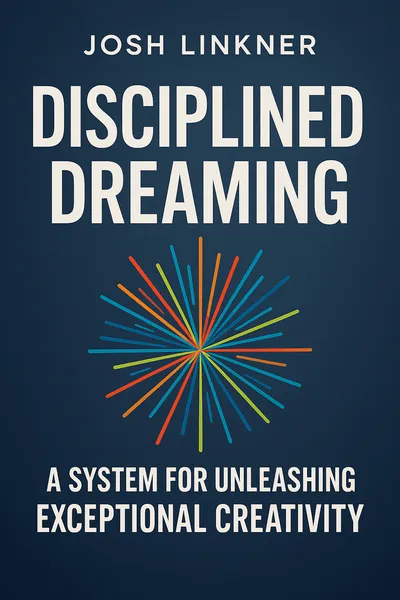
Disciplined dreaming
A system for unleashing exceptional creativity
Description
Many companies have established systems that govern all their operations, from mundane tasks to product manufacturing. While these systems enhance efficiency, they often overlook the crucial role of creativity, a factor that distinguishes successful companies from the rest. It's essential for companies to understand and foster creativity through a systematic approach, enhancing everyone's ability to think innovatively.
A study involving interviews with two hundred successful individuals underscored the importance of creativity in maintaining their success. In essence, standing out in a competitive market requires offering something unique and compelling, which is a product of creative thinking.
Table of contents
01 Step 1 – inquire .
The Disciplined Dreaming process is a structured approach to fostering creativity and innovation within an organization. It starts with the creation of a Creativity Brief, a document that lays the foundation for the creative endeavor ahead. This brief is essential as it outlines the current situation and the creative idea that needs to be generated. It serves as a roadmap for the creative process, ensuring that everyone involved has a clear understanding of the objectives and the approach.
The Creativity Brief should be comprehensive, detailing nine critical elements that the idea must address. These include the desired outcome, which defines what success looks like; the creativity challenge, which articulates the specific problem to be solved; a situational analysis, which provides context and background information; anticipated resistance, which prepares for potential obstacles; the target audience, which identifies who the idea is for; the communication strategy, which outlines how the idea will be shared; competitors, which acknowledges the market landscape; a first-draft project plan, which sketches out the initial steps; and key metrics, which establish how progress and success will be measured.

02 Step 2 – ready.
Dispelling myths about the creative process is a crucial first step in fostering an environment conducive to generating innovative ideas. One common misconception is that creativity strikes spontaneously, without the need for preparation. However, just like athletes and musicians who warm up before a performance, individuals seeking to be creative can benefit from engaging in activities that prime the mind for idea generation.
Creating a physical environment that encourages creativity is also important. While there is no universal template for such a space, drawing inspiration from places like the Googleplex can be beneficial. These environments often feature bright, comfortable seating, communal work tables, and expansive whiteboards to facilitate interaction and brainstorming. Replacing traditional, staid office designs with vibrant, light-filled spaces adorned with stimulating artwork and open architectural elements can also inspire creative thinking.
Establishing a warm-up routine before diving into creative work can set the stage for success. This could involve unconventional methods such as tossing a beach ball around the room while listening to energizing music, or it might be as simple as taking a field trip to an inspiring location. Engaging in playful activities, such as brief games or discussing a random image in detail, can help break the routine and stimulate the mind.
03 Step 3 – explore .
Fostering creativity is not just an art; it's a strategic imperative that requires stepping away from conventional methods and embracing new perspectives. This process involves looking at problems through different lenses, seizing societal inflection points, borrowing ideas from diverse domains, inverting problems, and applying patterns from various sources. Such an approach can unveil unique dimensions of a problem and lead to innovative solutions.
Viewing issues from the standpoint of individuals in unrelated fields, such as musicians, architects, or even villains, can provide fresh insights. For example, a musician might see a problem in terms of rhythm and harmony, suggesting a solution that emphasizes balance and timing. An architect might approach the issue with an emphasis on structure and design, leading to a solution that is both functional and aesthetically pleasing. This shift in perspective can reveal overlooked aspects of a problem and inspire creative solutions.
Societal inflection points, marked by technological advancements or shifts in public awareness, present opportunities for innovation. These moments of change can disrupt industries and create new markets. For instance, the rise of the internet and mobile technology has transformed how we communicate, shop, and work, leading to the creation of entirely new industries and services.
04 Step 4 – ignite.
The creative process is a journey that begins with the generation of initial sparks of ideas, which are then developed into fully-fledged concepts. To facilitate this, various techniques are employed to lay the groundwork for creativity. Among these are Imbizo groups, which bring together diverse individuals to brainstorm, and the Hot Potato technique, which encourages rapid, spontaneous idea sharing. Another method is the Wrong Answer approach, where participants deliberately list incorrect solutions to problems, thereby stimulating creative thinking by breaking conventional patterns.
Once these sparks are ignited, they must be carefully nurtured. Ideas, especially in their infancy, are delicate and can easily be stifled. It's essential to create an environment where these nascent concepts can grow without being prematurely judged or dismissed. This nurturing phase often involves using a set of eight specific techniques designed to shape and refine ideas. These techniques encourage looking at problems from different angles, challenging the status quo, and combining disparate elements to create novel solutions.
To further enhance the creative process, adopting different personas can be a powerful tool. By stepping into the shoes of someone else, individuals can gain new perspectives that might not be apparent from their usual viewpoint. Making provocative statements is another tactic that can jolt people out of their habitual ways of thinking and lead to breakthrough ideas. Additionally, identifying moments of frustration and using them as springboards for innovation can turn negative experiences into opportunities for creative problem-solving.
05 Step 5 – launch.
The final stage of Disciplined Dreaming is a critical phase where analytical thinking is re-engaged to bring creative ideas to fruition. This stage demands a harmonious blend of left-brain and right-brain thinking, applying business acumen to the creative process. The initial step is to sift through the generated ideas and select the most promising ones. This selection can be achieved through various methods, such as a scoring matrix that evaluates ideas based on predefined criteria, the poker chip method where stakeholders allocate chips to their preferred ideas, a trial by jury approach where ideas are debated and defended, mapping ideas against a matrix that reflects the organization's core values, or using a Creativity Brief as a guide to score and prioritize ideas.
Once the top ideas are identified, it's crucial to validate them before investing significant resources. This validation often involves creating a simple, low-cost prototype to test the idea against reality. Prototyping serves as a tangible proof-of-concept that can be compared to the ideal vision, allowing for adjustments and refinements.
Related books