Dirt
The ground beneath us disappears
Description
There is a layer of loose material under our shoes, our fields, and our cities that most of us have never once thought about with any seriousness. We call it dirt when it stains a shirt and soil when it grows food, but it is the same stuff: a thin, living skin where broken rock, decayed plants, water, and microscopic life mix into something that can feed a wheat field. In his 2007 book Dirt: The Erosion of Civilizations, the geologist David R. Montgomery makes a plain and unsettling case. This skin is far thinner than we assume, it forms far slower than we spend it, and we have been quietly running through it for as long as we have farmed.
Montgomery is a geomorphologist — someone who studies how the shape of the land changes over time — and he came to soil through rivers and hillslopes, watching how earth moves. What he found, tracing that movement across continents and millennia, was a pattern too regular to be coincidence. Societies clear the forest, break the ground, and harvest well for a few generations. Then the exposed topsoil begins to wash and blow away faster than nature can rebuild it. The good land thins, yields sag, and the civilization that grew on that soil starts to strain — not with a bang, but over the slow arc of centuries.
It is a strange kind of catastrophe, because no single farmer ever sees it happen. A few millimeters lost a year is invisible against a human lifetime, yet ruinous across the lifespan of a culture. That mismatch of timescales is the quiet engine of the book, and it turns something we dismiss as beneath notice into one of the underrated forces of history.
The question we’re asking : How can something as ordinary as dirt help decide the fate of civilizations — and are we repeating the mistake right now?What we’ll see : A journey through the slow arithmetic of soil, from its rock-born birth to the farms of the ancient world and the machinery of the present.
Table of contents
01 Chapter 1 — The thin skin of the planet
Start with what soil actually is, because most of us have it wrong. It is not simply ground-up rock, and it is not dead. Montgomery describes it as a frontier zone where the mineral world meets the living one: weathered rock fragments bound together with decomposing organic matter, threaded with fungi, bacteria, worms, and roots, and shot through with air and water. This mixture is what holds moisture for a plant, delivers nutrients to it, and keeps the whole surface from simply sliding off the hillside. Fertile topsoil, the dark upper layer that does the real agricultural work, is the product of all of it working together.
The part that should stop us is how slowly it forms. Left to nature, soil builds from the bottom as rock weathers and from the top as plants die and rot, at a pace measured in centimeters per thousand years — Montgomery cites figures on the order of an inch every few centuries in favorable conditions, less where the climate is harsh. A mature soil profile a meter deep can represent tens of thousands of years of patient accumulation. It is, in geological terms, a slow deposit, closer to a mineral resource than to a renewable crop.

02 Chapter 2 — How civilizations spent their soil
Montgomery's most striking move is to walk this arithmetic through the ancient world and show the same story playing out again and again. The pattern is consistent enough to feel almost scripted. A society settles fertile ground — a river valley, a volcanic plain, a forested hillside — and farms it richly. Population grows on the strength of the harvests. To feed the growth, farmers push onto steeper, more marginal slopes and clear the trees that once held them. Those slopes erode fast, the valley bottoms silt up, and within several generations the land that launched the boom can no longer sustain it.
Ancient Greece is one of his sharpest examples. Plato, writing in the Critias, already described the hills of Attica as the skeleton of a body wasted by disease, all the rich soft earth washed away, leaving bare rock where forests and pastures once stood. Montgomery reads this not as poetic lament but as accurate field observation: the Greeks had farmed their steep terrain hard, lost the topsoil off the slopes, and were living with the consequences. Rome faced its own version, leaning ever more heavily on grain shipped from North Africa and Egypt as Italian soils tired under continuous cropping.
03 Chapter 3 — The plow that outran the rock
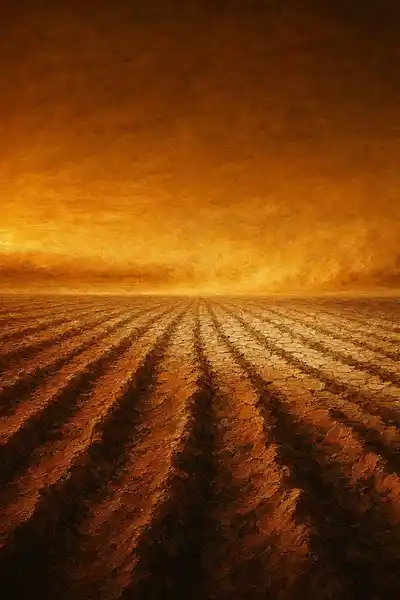
If erosion is the villain, the plow is its most faithful accomplice, and Montgomery does not spare it. Turning the soil kills weeds and prepares a seedbed, which is why it has been central to agriculture for thousands of years. But every pass of the plow also loosens the ground, breaks up the protective structure, and leaves the surface bare and exposed between crops. On any slope, plowed soil creeps and washes downhill season after season. Tillage, the very act we associate with good husbandry, is in his account one of the great long-run drivers of soil loss.
The book's engine is the mismatch between two clocks. Nature builds soil on the scale of millennia; a plowed and unprotected field can lose it on the scale of decades. When the spending rate outruns the formation rate, the account draws down, and no amount of hard work changes the direction of the flow — it only sets the speed. This is the quiet mechanism Montgomery keeps returning to, because it explains why diligent, skilled farmers can still preside over the ruin of their own land without ever intending to.
04 Chapter 4 — A geological force in work boots
Step back and the wider argument of Dirt comes into focus. Montgomery, being a geologist, ends up making a geological claim: humanity has become a force that moves earth on a scale comparable to rivers, glaciers, and wind. Through plowing and clearing, he estimates, people now shift more soil around the planet than all the world's natural processes combined. We are not merely living on the landscape; we are actively reshaping it, and mostly in the direction of thinning the very layer we depend on. The humble farmer, multiplied across the globe and armed with steel and diesel, has become a planetary agent.
The deeper point is about how we perceive our own resource base. We treat soil as a backdrop — permanent, free, beneath consideration — in the same way earlier societies did, right up until the ground gave out beneath them. Montgomery's history is an argument that this perception is a category error. Soil behaves less like sunlight, which arrives fresh each day, and more like an ore body that took ages to concentrate and can be mined out. Calling it dirt, something worthless we brush off our clothes, is itself a symptom of the blindness that lets us spend it so casually.
05 Conclusion
We began under our own shoes, with the layer nobody looks at. Montgomery's achievement in Dirt is to make that layer visible and to attach a clock to it — a slow one for how soil forms, a fast one for how we spend it — and then to run that mismatch across the whole span of human settlement. Greece, Rome, the Dust Bowl: the same quiet arithmetic, the same invisible loss compounding across generations while each generation blames something else. The ground really is disappearing beneath us, just too gradually for any single set of eyes to catch.
Related books