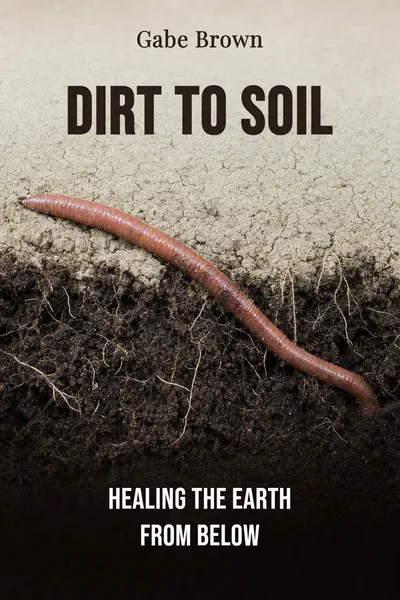
Dirt to Soil
Healing the earth from below
Description
In the mid-1990s, a rancher named Gabe Brown was farming five thousand acres near Bismarck, North Dakota, the conventional way: heavy tillage, synthetic fertilizer, the usual chemical program. Then the sky turned on him. Hail wiped out his crop in 1995, again in 1996, then drought in 1997 and hail once more in 1998. Four straight years of ruin. He had no money left for fertilizer or the machinery passes he had always assumed were non-negotiable. The bank was, in effect, forcing him to farm differently — because he could no longer afford to farm at all the way he had been taught.
What happened next is the story he tells in Dirt to Soil. Broke and out of options, Brown stopped doing the things that were bleeding him dry. He left his fields covered instead of bare. He stopped tilling. He planted mixtures of crops where he used to plant one. And slowly, over years, the ground under his boots changed. Dirt that ran off in the rain and blew away in the wind turned into dark, spongy soil that held water and grew things without a bag of fertilizer in sight. The disaster had pushed him onto a path he would spend the rest of his career mapping.
His claim is bigger than one farm in North Dakota. Brown argues that most of the ground feeding us is biologically dead — mineral dust kept productive by chemistry — and that it can be brought back to life by anyone willing to treat it as a living thing rather than a growing medium. The stakes run from the nutrient content of our food to the water in our rivers to the carbon in our air.
The question we’re asking : How does dead dirt become living soil — and can a farm actually make money doing it?What we’ll see : A ruined ranch, the handful of principles that revived it, and what a spadeful of living ground turns out to be worth.
Table of contents
01 Chapter 1 — Four years of hail, and a lucky break
Gabe Brown and his wife Shelly bought her parents' farm outside Bismarck in 1991, and for the first few years Brown ran it the way the extension agents and the seed dealers said to run it. Plow the ground, plant a single cash crop, feed it synthetic nitrogen, spray for weeds and pests, repeat. It was expensive and it was normal. Every farmer he knew was doing roughly the same, and every farmer he knew was carrying debt to do it.
Then came the run of catastrophes. Hail in 1995 took the crop. Hail in 1996 took it again. In 1997 a drought did the same job with no water at all, and in 1998 the hail came back. Four consecutive years without a harvest to sell. There was no cushion left, no line of credit for another round of inputs. Brown describes the period plainly as the worst thing that ever happened to him, and also the best, because it removed every option except paying attention.

02 Chapter 2 — The five rules the ground was asking for
Out of a decade of trial and error, Brown distilled a short set of principles he came to call the rules of soil health. They are not a product line or a patented system. They are closer to a description of how healthy land behaves when left to itself, translated into things a farmer can actually do.
The first is to disturb the soil as little as possible. Every pass of a plow shreds the fungal networks and tears open the ground, burning off carbon and inviting erosion. Brown went to no-till and stayed there. The second is to keep the soil covered at all times, with living plants or their residue, so that it is never exposed to sun, wind, and pounding rain — armor, in his word, against the forces that turn soil back into dirt.
03 Chapter 3 — What lives under a spadeful
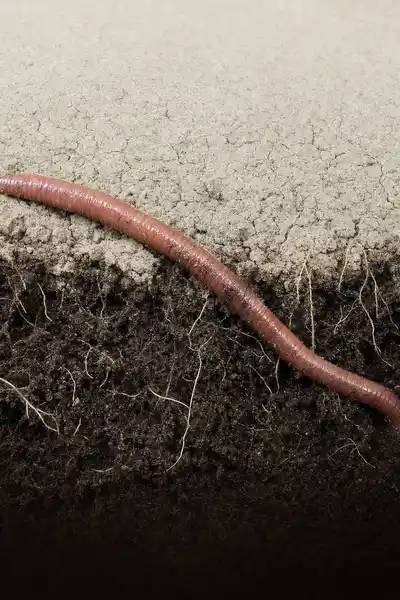
The engine underneath all five rules is invisible. A single teaspoon of healthy soil can hold billions of bacteria along with yards of fungal threads, and Brown's central lesson is that these organisms are not passengers — they are the farm's real workforce. Plants pump a large share of the sugars they make through photosynthesis straight down into their roots and leak them into the soil on purpose, feeding microbes that in return unlock minerals and deliver them back to the plant. It is a trade, worked out over hundreds of millions of years, and conventional farming quietly breaks it.
Synthetic fertilizer breaks it by handing plants their nutrients for free, so the plant stops trading sugars with the soil and the microbial economy shuts down. Tillage breaks it by physically ripping apart the fungal networks, called mycorrhizae, that extend a plant's root system many times over and ferry water and phosphorus across distances roots could never reach. Bare ground breaks it by starving the whole community between crops. Do all three, year after year, and you are left with what Brown calls dirt: mineral particles with almost nothing alive in them, dependent on an annual chemical drip to grow anything at all.
04 Chapter 4 — Farming as if the soil were alive
Set the individual practices aside and what Brown is really proposing is a change of category. Conventional agriculture treats a field as a chemistry problem: measure what the plant needs, buy the missing inputs, apply them. Regenerative agriculture, as he practices it, treats the field as a living system to be managed — one whose health you support rather than one whose deficiencies you purchase your way out of. That shift reorganizes everything downstream of it, from the balance sheet to the dinner plate.
The economics are the part that tends to surprise people, and Brown leans on them hard because he knows no farmer switches on faith alone. By eliminating synthetic fertilizer, most pesticides, and repeated tillage, he cut his largest costs to near zero. His profit per acre rose even when his yields were merely average, because he was keeping far more of what he earned. A regenerative farm, on his accounting, is not a sacrifice made for the environment; it is often the more resilient business, precisely because it is not hostage to input prices or a single crop's market.
05 Conclusion
The farm that hail nearly destroyed is now something Brown shows to visitors from around the world: dark, crumbling, water-drinking soil that grows diverse crops and grazes livestock without synthetic fertilizer or a spray program. The four disaster years he once counted as the worst of his life turn out to be where the whole story starts, because they stripped away every option except watching what the land would do if he stopped working against it.
Related books